The color of faith in the grim darkness
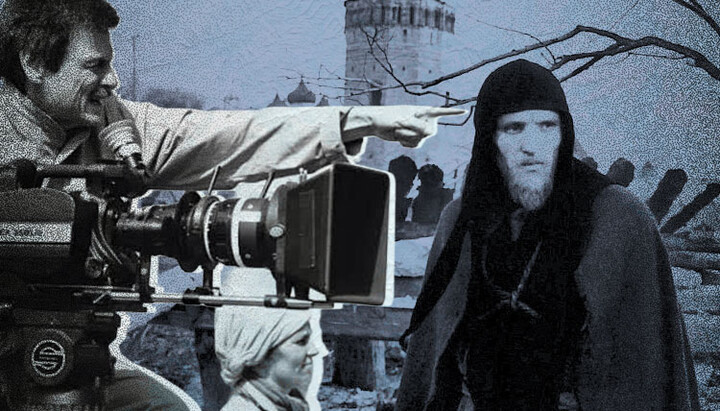
Andrei Tarkovsky and his cinematic masterpiece. Photo: UOJ
Autumn slush, feet constantly slipping on wet clay, cold rain pouring endlessly from above, and the sky so heavy and gray that it seems like it's about to fall. For almost three hours, Andrei Tarkovsky forces us to sit and peer into this melancholy, gray reality of medieval Rus. The shots drag slowly, and there's nothing cheerful in them: all around are some foolish internecine wars, nomadic raids, hungry people, dirt, betrayal and stupidity. You look at all this suffering of others, and it seems that grayness has triumphed completely, and the world is stuck in some endless dead end.
But the most astonishing thing is that it was precisely from this dead end, from this utter darkness, that something was born which made people in the twentieth century see the old Russian icon in a completely different way.
We often think that for true faith – or to create something truly beautiful – we need ideal conditions. We need silence, calm, to be left undisturbed, for everything around us to be peaceful and good. But the film Andrei Rublev, which Andrei Tarkovsky finished in 1966 and which then sat banned on the shelf for a full five years, shows us a completely different truth. Incidentally, Soviet officials did not ban it because of its violent scenes. What truly shook them to the core were the conclusions the director ultimately arrives at.
A dispute about man
The entire middle of the film is essentially one big and very unhurried dispute between two artists, Theophanes the Greek and Andrei Rublev. Theophanes in Tarkovsky's version is such a harsh, weary intellectual. He has completely lost faith in people. He looks at the crowd and sees only darkness, stupidity and sin. For him, the only way to make a person think about the soul is to frighten him properly. That's why he paints severe scenes of the Last Judgment on the walls of temples so that sinners tremble with fear before heavenly retribution.
Rublev has no complicated theological formulas or ready-made answers. What he does have, however, is an astonishing and very rare ability simply to feel compassion.
He flatly refuses to paint these nightmarish scenes with devils and boiling tar. Saint Andrei understands a simple thing: the people around are already scared to death to live. They can be killed, robbed, or have their homes burned every day. They don't need another judge with a hammer; they seek in God at least some protection, warmth and hope. Rublev feels that if you see only the bad in a person, you can simply go mad from hopelessness.
True, then life strikes Andrei himself so hard that all his kind thoughts crumble to dust. During the raid on Vladimir, while trying to save a local fool from violence, he kills a man. For a monk, this is a catastrophe, a complete loss of self. He decides to fall silent, takes a vow of silence and won't touch brushes for long fifteen years. In his diaries, Tarkovsky later wrote that Rublev's true art was born precisely from this terrible longing for brotherhood and purity, when there was neither one nor the other around.
Clay under the fingernails
In the film, the process of creating an icon is shown without any lofty romanticism. It is extremely hard, dirty manual labor. We can almost physically feel people grinding stones into powder, smell the wood, the glue, the eggs used to mix the paints. There are no easy paths here.
And this physical labor reaches its peak in the film’s finale, in the story of the bell. The city has been devastated, the old masters have died of hunger and disease, and the prince urgently needs a new bell. Then a boy named Boriska, a son of a bell-founder, appears. Trembling with fear, he lies to everyone around him, claiming that his father revealed to him the secret of bell casting before he died. It is a sheer gamble, because if the bell fails to ring, the boy will simply be executed on the spot.
The entire casting scene is some kind of mad impulse. Boriska, who actually knows nothing, intuitively commands a bunch of adult men, shouting at them until he loses his voice, falling into the mud and kneading the cold sludge with his feet. And Rublev simply stands aside, silently watching this frightened yet stubborn boy.
When the bell is finally cast, lifted onto wooden supports, and struck, a pure, deep ringing sound is heard. Boriska falls to the ground and begins to sob uncontrollably from the fear and strain he has endured. Then Andrei approaches him, lifts him out of the muddy puddle, and for the first time in fifteen years speaks: "We will go together. You will cast bells, and I will paint icons.”
At this moment, the artist's voice returns to him.
We often think that all ties are severed, traditions are lost and we remain alone on the ashes. But this story reminds us: life continues thanks to those who, despite fear and tears, simply continue to do their work and knead clay.
Heavenly harmony
Immediately after such an emotional finale, a miracle occurs, for which, probably, the entire film was made. The black-and-white picture in which we lived for three hours suddenly explodes with bright colors. The camera begins to slowly and very closely show details of frescoes and icons by Saint Andrei Rublev. We see warm gold, bright cinnabar and deep ochre.
And finally, the "Trinity" appears before us. That very famous heavenly-blue color that Rublev managed to find in the midst of a ruined and burned country. Three Angels sit quietly at the table, forming a perfect, calm circle. They simply converse. In their world there is no place for malice, fear and division.
Priest Pavel Florensky said an amazing thing: "There is Rublev's Trinity, therefore, there is God."
The strongest proof that God exists becomes the very fact of the appearance of such incredible, unearthly harmony at a time when real hell was happening around.
This icon became the artist's answer to all the cruelty of his era, a quiet place where a weary soul can finally breathe out and rest.
Tarkovsky once wrote in his diary that an artist is a witness, not a judge. Rublev didn't accuse or judge anyone. He simply showed us that no matter how stained our earthly life may be, somewhere there, in the depths, heavenly purity and order still live. And this order doesn't disappear anywhere; you just need to know how to discern it.
Today we have learned perfectly well to count the wounds on the body of our history and complain about how bad everything is around. But do we have enough courage, like that boy Boriska, to simply start doing what must be done, even blindly and with tears in our eyes, so that the bell rings again in the world and silence returns?
Read also
Trial of a dead pope
Once in Rome, the body of a deceased pope was seated on the throne and put on trial. The accusation relied on a church canon that had once saved his see.
Monastery built in defiance of king
When Orthodox believers in Minsk were left with just one church, townspeople decided to build another – and even a royal decree did not stop them.
Young Mother and Sleeping Christ
Michelangelo carved a Virgin Mary who looks younger than her Son – and signed his name in marble for the only time in his life. Neither of these peculiarities was accidental.
Orthodox books from a Uniate printing press
In the 18th century, Uniate monks at Pochaiv printed books used in prayer by Orthodox Christians and Old Believers alike.
The story of the honey brotherhood
The Mogilev Brotherhood began with members pooling money to brew honey drinks for feast days – and eventually grew to have its own printing press.
Golgotha in the midst of a pogrom
In the autumn of 1938, the Jewish artist Marc Chagall painted the crucified Christ. Synagogues burn and refugees flee around the cross, while the Crucified One Himself is wrapped in a prayer shawl.