UOC-KP after Filaret: Church, brand or refuge for marginals?
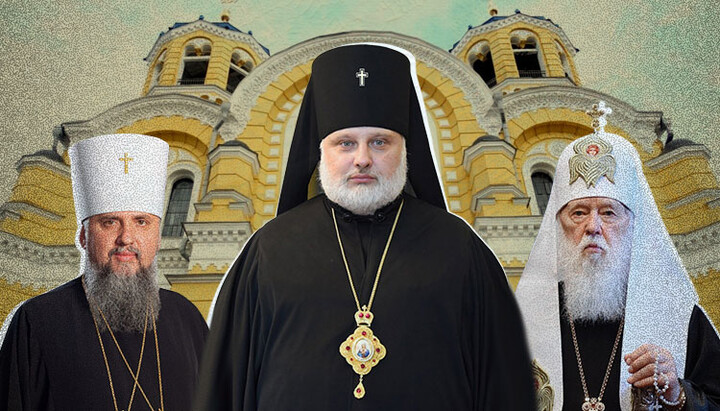
"Patriarch" Nikodym continues Filaret's work. Photo: UOJ
After the death of Filaret Denysenko, many expected that the UOC-KP would inevitably dissolve into the OCU and finally sink into oblivion. But already on March 21, 2026, the day after the "patriarch's" death, UOC-KP structures announced the election of Nikodym Kobzar as the new "patriarch". The voting took place online, since the "episcopate" of the Kyiv Patriarchate, according to them, was not allowed into St. Volodymyr's Cathedral. Today it is already clear: the UOC-KP did not die with Filaret. But what kind of life is it living? Let's try to understand.
The UOC-KP project before and after Filaret
The ideology of the UOC-KP from the very beginning was based on the idea of Ukrainian statehood. "An independent church for independent Ukraine" – under this slogan in June 1992, Filaret went into schism with the UOC and created the Kyiv Patriarchate, attempting to unite with the Ukrainian Autocephalous Orthodox Church (UAOC). This ideology was supported by many in Ukraine, particularly by then-President L. Kravchuk and a significant part of the political elite. But this slogan only concealed the true reason: Filaret spent all his remarkable organizational talents to make the UOC-KP a numerous organization claiming the role of the national Ukrainian church. Such a reason was Filaret's own patriarchal ambitions. Having failed to become Moscow Patriarch in 1990, he decided to be Kyiv Patriarch at any cost.
Thus, the UOC-KP is largely a personalist project of Filaret himself. It is no secret that this religious organization relied heavily on Denysenko's authority, his leadership qualities, connections with those in power, political instinct, and the image of a wise elder.
While Filaret was alive, even his opponents had to reckon with his biography, age, experience, symbolic capital, and role in Ukrainian church history. Filaret's followers, and Nikodym Kobzar in particular, do not have such capital. Therefore, he has to supplement nationalist ideology with other methods. Let's see what exactly.
The conflict around Nikodym
The OCU claims that the UOC-KP ceased to exist on December 15, 2018, and fully joined the OCU. Moreover, the names "Ukrainian Orthodox Church Kyiv Patriarchate" and "Kyiv Patriarchate" were assigned to the Kyiv Metropolis of the OCU as the successor.
However, in May 2019, Filaret essentially accused Serhiy (Epifaniy) Dumenko of betrayal and left the OCU amid scandal. Since then, he tried to revive the UOC-KP, "ordained" new bishops, defended rights to St. Volodymyr's Cathedral in Kyiv and his "patriarchal" residence. After his death, the OCU immediately took both the cathedral and the residence, and declared the newly appointed "Patriarch" Nikodym along with other "hierarchs" of the UOC-KP defrocked.
But Nikodym did not surrender to the mercy of the "victor." On April 3, 2026, the press service of the Kyiv Patriarchate stated that any decisions by Serhiy (Epifaniy) Dumenko's structure regarding the UOC-KP are "canonically null", and Nikodym himself "never joined the OCU" and since 1993 belonged only to the Kyiv Patriarchate.
The conflict also emerged within the UOC-KP itself. Andriy Marutsak, former UOC-KP Chancellor, declared a "canonical coup" and usurpation of power after Filaret's death and refused to recognize Nikodym as the legitimate head of the UOC-KP.
Against this background, Nikodym urgently needed to show that the UOC-KP under his "patriarchate" not only exists on paper but is developing. And he found this development abroad.
Foreign turn: How Nikodym proves the UOC-KP is alive
In spring 2026, Nikodym began actively accepting foreign communities and creating new structures. In the Czech Republic, on April 16, 2026, he accepted under his jurisdiction a group of individuals who recognized him as their leader and justified this by the desire of the Ukrainian diaspora to preserve unity with the UOC-KP. On April 25, 2026, the UOC-KP appointed Eugen Sigismund Freimann as "patriarchal vicar" in Teplice (Czech Republic), and on April 26 "ordained" him as "Bishop of Teplice".
However, in the registry of the Czech Ministry of Culture, which records registered religious communities, there is no entry for the UOC-KP.
On May 2, 2026, Nikodym announced the creation of a Greek eparchy of the UOC-KP and appointed Iakovos Yannakis as its head with the title "of Simferopol and Evpatoria." This structure included a monastery and several parishes in Attica. Nikodym characterized this as: "Step by step we affirm the Kyiv Patriarchate!"
In Spain on May 7, 2026, Nikodym signed a decree on accepting into his structure the community of Christ the Savior in the Spanish city of Denia. Community representatives recognized him as "Patriarch of Kyiv and all Rus-Ukraine" and pledged to promote the development of the Kyiv Patriarchate.
In Romania on May 17, 2026, Nikodim accepted cleric Constantin Cernușcă and the association "Abode of All Saints" located in the village of Săgasa under direct subordination.
In Uganda on June 26, 2026, Nikodym accepted Fr. Charalambos Otsen with the St. Joseph community.
At first glance, this looks like a remarkable success and rapid growth, something that was not even seen under Filaret. But the main question is not how many locations have appeared on the map. The main question is who exactly is coming under Nikodym’s omophorion.
Who Nikodym gathers under his banners
If we were talking about one dubious case, one could speak of coincidence. But it is already clear that Nikodym's UOC-KP is developing at the expense of people and groups with conflicted, unrecognized, or reputationally problematic church backgrounds. Let's consider several of the most striking examples.
Eugen Sigismund Freimann: the Czech case
The Czech press wrote about Freimann long before his appearance in Nikodym's project. The resource Aktuálně.cz reported that Eugen Freimann had long been in conflict with the leadership of the Orthodox Church of the Czech Lands and Slovakia registered in the Czech Republic. According to Protopresbyter Jan Beránek, in 2013 then-Metropolitan Krishtof banned Freimann from the priesthood due to "gross violation of church discipline and behavior inappropriate to spiritual status". After this, in 2014 Freimann tried to register his own religious organization using forged signatures, and after failure continued serving in Teplice despite the ban.
Iakovos Yannakis: the Greek case
According to information from Greek sources of the UOJ, Iakovos Yannakis (in the world, Nikolaos) is a fraudster. He was banned in the Church of Greece in 2010. Until 2015, Yannakis posed as Archbishop of Athens and All Greece in a marginal group of Old Calendarists who are not recognized by other Old Calendarists of Greece.
In 2015, he was arrested for fraud and document forgery, having performed more than 90 illegal marriages between Africans and unsuspecting Greek citizens. The purpose of the marriages was to obtain residence permits for foreigners.
The Greek press also wrote about this. The publication DirectNews reported in 2015 that Yannakis was a defendant in a case involving usurpation of religious authority, document forgery, fictitious marriages, aiding illegal stay of foreigners, child pornography, and drug law violations.
A search of Yannakis revealed a mobile phone with child pornography, 32 narcotic pills, six seals of dubious authenticity, two plastic metropolitan plates, and digital equipment. Later he posed as a Bulgarian bishop and Archbishop of Cyprus.
For any church structure, this would be enough to at least postpone appointing such a person to a leadership position. But Nikodym acted differently.
The Old Calendarist case
Nikodym is not original; his current personnel policy did not appear out of nowhere. Even Filaret sought support among various unrecognized and conflicted church groups, particularly Old Calendarists.
Filaret accepted the first Greek schismatic Old Calendarists into the UOC-KP back in 1996. In October 2021, Kyiv was visited by the former head of the "Auxentian" synod of the Church of Genuine Orthodox Christians of Greece, Auxentios Marines, former "Archbishop of Athens and All Greece." He concelebrated with Filaret at St. Volodymyr's Cathedral, and then was accepted into the Kyiv Patriarchate with the title "Metropolitan of Chersonesos and Aegina".
Another example is Chrysostomos Kallis. From 1997–2020, he was a cleric of the Church of Greece, but for falling into Old Calendarist schism he was defrocked. In December 2021, he was accepted into the UOC-KP through "re-ordination".
All this shows continuity of the model. Under Filaret, the UOC-KP already gathered various schismatics under its "omophorion," and under Nikodym this line becomes almost the main way of existence.
Nikodym's inner circle
The problematic nature of the personnel approach concerns not only foreign figures. The OCU negatively evaluates the "hierarchs" of the UOC-KP "ordained" by Filaret after the break with the OCU in 2019. Criticism reaches direct accusations of fraud and adventurism. And despite the fact that the OCU leadership consists of the same fledglings from Filaret's nest, such accusations look quite credible.
On May 11, 2026, the OCU stated that Nikodym Kobzar, Mykhailo Kovaliuk, and Nikon Hrabliuk were previously banned from ministry, and now defrocked, that they were never bishops, although they call themselves "patriarch" and "metropolitans".
But the intriguing aspect of the situation is that all these individuals, regardless of their moral character, received their "ordinations" from Filaret after his "reunification" with the Church of Constantinople. This is in contrast to Serhii (Epifaniy) Dumenko, Ivan (Yevstratiy) Zoria, and others, who received their "ordinations" from Filaret when he was under an anathema recognized by all the Local Churches. And the newly minted "Patriarch" Nikodym does not miss an opportunity to remind everyone of this.
What's next?
Essentially, what the UOC-KP is now doing under Nikodym's leadership is called mutual legitimation. Nikodym gives people an "omophorion" and the name "Kyiv Patriarchate," titles, and the opportunity to position themselves as part of an international church structure. In return, these people give Nikodym beautiful photographs from "services," new parishes and eparchies, foreign points on the map, and the illusion of development. All this works for Nikodym's authority and legitimation of his "patriarchate."
But the problem is that all these people are marginals who were expelled from the Church for various offences. And instead of repenting and trying to return to the church fold, they began to pretend to be what they actually are not. And often their activity takes grotesque forms.
For example, the same Nikodym in a decree on Anthimos from Attica calls him "Reverend."
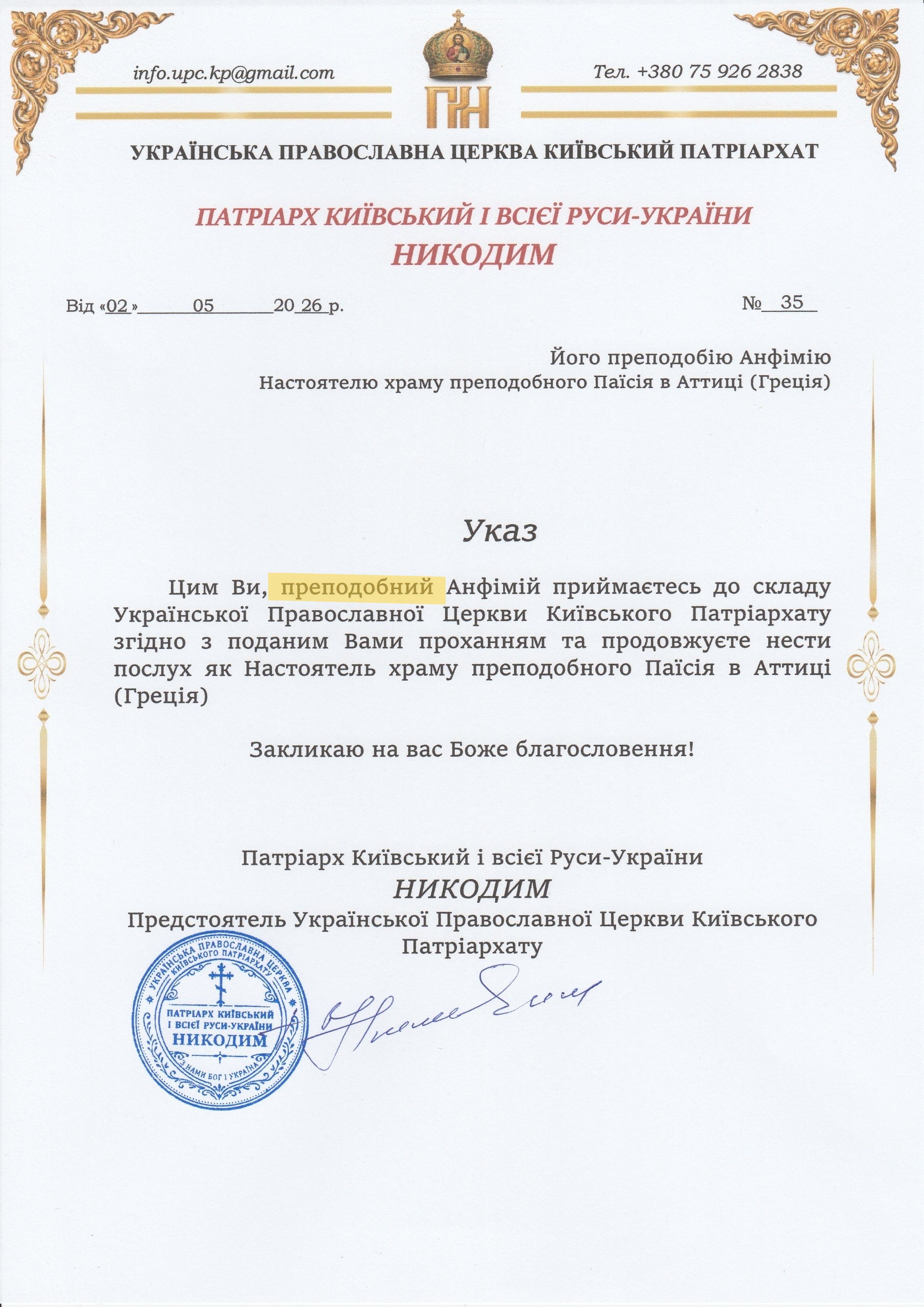
We know that the address "Reverend" is common in Catholicism and Protestantism. But in Orthodoxy, "Venerable" (Reverend) refers to monks and nuns canonized by the Church who pleased God with righteous ascetic life.
However, one could overlook this as a certain "peculiarity" of the UOC-KP, as well as the practice of wearing rings by its "patriarch" and "bishops." This is not so important. What is important is different: Christ's Church does not exist to serve a national project, state idea, or be a jurisdictional brand that can be sold abroad. The Church exists to lead man to Christ: to repentance, salvation, Eucharist, and life in the Holy Spirit.
However, behind these loud words about salvation and spiritual life stand concrete people: Eugen Freimann, suspended from service for document forgery, and Iakovos Yannakis, convicted of fraud, drug trafficking, and distribution of child pornography. Can a church structure that gathers such people under its omophorion lead anyone to Christ?
The path to Christ lies through repentance: "Repent, for the Kingdom of Heaven has come near" (Mt. 4:17). However, repentance is not the best tool for those concerned with legitimizing "patriarchate," expanding jurisdiction, and serving state ideology. Completely different things serve these goals – and this is exactly what "Patriarch" Nikodym is engaged in today.
How successful will he be? In the near future, the UOC-KP under Nikodym is unlikely to become a serious church force in Ukraine. He lacks Filaret's scale, recognition, a stable institutional center, and the main activity has shifted abroad.
But trading the "Kyiv Patriarchate" brand can still bring profit for a long time. Demand for legitimation, even such a questionable one, is quite high. An alternative jurisdictional "roof" is needed by many: Old Calendarists, banned clerics, unrecognized "hierarchs," people who need quick church status, and others. And as long as there is demand, there will be corresponding supply.
Read also
Why nation-first advocates do not call for peace
Ukraine’s population is declining by nearly one million people a year, and experts are warning of the nation’s demographic extinction. Yet the leaders of the Orthodox Church of Ukraine (OCU) and the Ukrainian Greek Catholic Church (UGCC) continue to call for war and mobilization.
The deception that decided the fate of the Tomos
In 2008, the "Filaret problem" derailed Yushchenko's plan. In 2018, Poroshenko solved it in just one hour – with a police escort for the Greeks and verbal promises to Filaret.
Lawyers in the crosshairs: How UOC is being stripped of its right to defense
Activists harass UOC lawyers outside courthouses, call them “traitors” on air, and promise them a “warm welcome” at hearings. The Church’s right to a legal defense is at stake.
How to respond to persecution: Lessons from St. Silouan the Athonite
The Church can and should be defended, but without malice. Why love for persecutors is not weakness but the only way to preserve the Spirit of Christ in the midst of the struggle.
Where the Spirit of the Lord is, there is freedom
Reflections on the controversies surrounding the creation of the OCU.
Pentarchy with Rome: A return to the roots or a new schism?
Patriarch Bartholomew wants to revive a council of five patriarchates, including Rome. What would reunion with Catholics look like, and what role would be left for the other Churches?