The mystery of the Heavenly King prayer and the power of human will
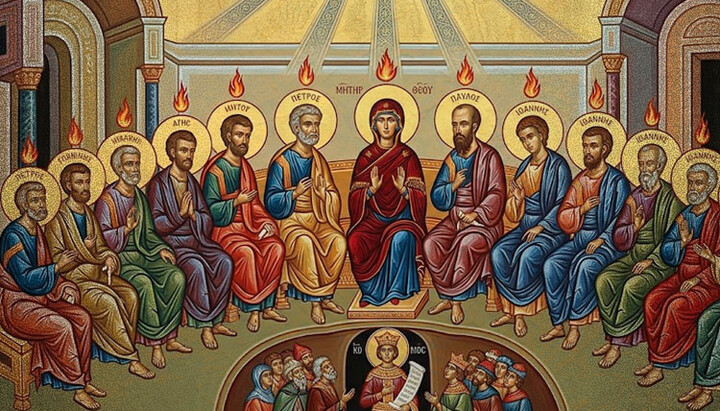
The Descent of the Holy Spirit upon the Apostles. Photo: UOJ
In the first part, we examined the words used to express the idea that God the Holy Spirit is omnipresent. Continuing from there, a simple, almost “childlike” question may arise: “How can the One who is already everywhere come and dwell within us, within a particular person, that is, within me?” What is this mystery that God fills all things, yet also dwells in a human being? And furthermore, why has the Church established the practice of asking God for this at the beginning of every undertaking? Each of us can and indeed should ask ourselves such questions, for they are the fundamental questions of life and death.
Saint Gregory the Theologian writes that by creating man, God creates a world, great in the small. Why is this world "small"? Because by the Providence of the Creator it is securely hidden within each of us, this is the image of God. Why is this world "great"? Because God Himself became man. What modern science and philosophy often conceal behind the rather vague term “consciousness,” and what the ancients more commonly described as the inner person – his soul and spirit, his heart and mind – are precisely manifestations of the greatness of every human being in the very possibility of such activities. These are our inner reflections of the external world through the organs of sense, this is our never-ceasing capacity for thought, free within its limits and governing the will to action, these are our emotions and moods.
Finally, this is the experience of Divine Light that surpasses all understanding: God the Holy Spirit – the Only One who dwells, fills us with purpose, meaning and life, endows the image of God with His likeness.
Thus the small world becomes truly great in action: "the hidden man of the heart in the incorruptible beauty of a gentle and quiet spirit, which is precious before God" (1 Pet. 3:4). "For behold, the kingdom of God is within you" (Luke 17:21).
Sometimes the question arises of how to understand the words "within (ἐντὸς) you." We see the explanation in the very text of the Gospel: we cannot point to external, noticeable signs, obvious to all, the coming of the Holy Spirit – this is a mystery of the inner man. "And when he was demanded of the Pharisees, when the kingdom of God should come, he answered them and said, The kingdom of God cometh not with observation: Neither shall they say, Lo here! or, lo there!" (Luke 17:20–21).
Saint Gregory of Nyssa writes: "And what does [the Lord] call the 'Kingdom' which is 'within' us (Luke 17:21)? What else but the joy born in souls by the [Holy] Spirit? For it is like a likeness, earnest and sign of eternal joy, which the souls of the saints will experience in the age [we] hope for. Through the action of the Holy Spirit the Lord comforts us in all our affliction, to save and make us partakers of spiritual goods and His gifts. For [the apostle] says: 'Who comforteth us in all our tribulation, that we may be able to comfort them which are in any trouble' (2 Cor. 1:4). Also it is said: 'My heart and my flesh rejoice in the living God' (Ps. 84:2) and: 'Let my soul be satisfied as with marrow and fatness' (Ps. 63:5). These words symbolically point to the joy and comfort [given here] by the Spirit" (On the Goal [of Life] According to God and on True Asceticism. Section VIII, 4).
We often define ourselves through what we do, but God needs man himself, to act through him according to His Divine Economy just as Christ made His apostles out of fishermen.
The phrase of the Gospel that the Omnipresent God comes to man in a special way as to His dwelling, temple, reveals to us the deep meaning of creation, the very purpose of man. Therefore the prayer to the Holy Spirit – "O Heavenly King" – precedes all our undertakings, and every manifestation of free will: at that very moment, the deed is dedicated to God, in faith in His providential care over us.
Freedom of human will
Man is created so that his expression of will – and this word means the manifestation of free will outwardly, in the real world, and not in dreams – has a decisive significance for how he will live: from the side of the "inner man", a certain effort is required in order to meet God.. In the Gospel we read: "If ye love me, keep my commandments. And I will pray the Father, and he shall give you another Comforter, that he may abide with you for ever; Even the Spirit of truth; whom the world cannot receive, because it seeth him not, neither knoweth him: but ye know him; for he dwelleth with you, and shall be in you" (John 14:15–17).
The expression of will, the inclination to keep the Gospel commandments, which are the fulfillment and completion of the Old Testament commandments, is the condition for God's dwelling in man, a condition for the new life in Christ through the action of the Holy Spirit.
The commandments of Christ the Savior can be considered the entire Gospel in its fullness – and precisely when man accepts the Gospel with all his heart and prays to God from all his heart.
Saint Ignatius Brianchaninov explains in detail the features of the New Testament commandments in his work "On the Gospel Commandments," the chief of which are love for God and for neighbor. Saint Ignatius also frequently warns against false movements of the soul known as prelest (spiritual deception or delusion). Within the framework of our study it is important that the practical side of Christian life is inseparably connected with with an understanding of its foundations, including the structures of language by which the meaning of prayers and hymns is conveyed. Understanding the meaning of prayers tunes man like a musical instrument requires tuning for preparing the performance of a symphony – under the direction of the One Conductor.
Our Lord Jesus Christ Himself in the Gospel spoke of Himself as the Fulfiller of the commandments (Matt. 5:17), as the Fulfiller of all righteousness (Matt. 3:15). He is the Lamb of God who took upon Himself the sin of the world (John 1:29), the Messiah-Christ, whose crucifixion feat granted the Comforter the Holy Spirit, to make partakers of eternal life all who believed in Him, gathered into the Church from all nations. This mystery was not understood and not accepted by the Jewish scribes and Pharisees, except for a few because they did not labor to prepare, to tune their inner world to receive the Savior.
For what purpose then are we commanded to constantly, daily ask that the Holy Spirit come to us? Again it is about the expression of will, but the accent is placed on unceasing expression of will, as the rhythm of life itself.
Man brings his God-given freedom of will to the Living God in the form of prayer as a sacrifice of praise, thereby showing his readiness, his desire to unite with the life-giving source.
Does God need our prayers? The All-perfect God lacks nothing. It is we ourselves who need prayer, so that our striving toward God may correspond to His love for us, so that the gifts of eternal life may not be trampled in the vanity of life but may instead find human acceptance and a desire to preserve these good things, allowing God to act through the powers of the soul: "come and dwell in us." The verb "dwell," σκήνωσον, is of the same root as the word denoting the Tabernacle of the Old Testament – the repository of the greatest holy things and the true treasury of the ancient world.
The Divine action is one for the Hypostases of the Most Holy Trinity, the Father and the Son and the Holy Spirit. The very sanctification of the not-made-with-hands temple of God – man, is accomplished by the incomprehensible, mysterious dwelling of the Holy Spirit: not violating human freedom, but with the expression of will to keep the commandments. He who fills all things and is present everywhere, God the Holy Spirit comes into His temple, the dwelling of the Most Holy Trinity – the inner world of man, great in the small, – cleansing it by His very coming and dwelling: "And cleanse us from every defilement, and save, O Good One, our souls."
The true meaning of spirituality
In modern society, the word “spirituality” has acquired so many shades of meaning that its original sense has been almost lost. A thoughtful and attentive reading of the prayer “O Heavenly King” makes it possible to recover this lost foundation, a solid basis for a worldview. Spirituality, the spiritual, is the entire sum of the actions of the Holy Spirit directed toward human beings. This direction, when read in reverse – from human being to God in the form of supplications– is expressed in the prayer by four verbs: come (ἐλθὲ), dwell (σκήνωσον), cleanse (καθάρισον), and save (σῶσον). It should be noted that these verbs follow a specific order, corresponding to the goal of the Divine Economy of salvation – the fulfilment and completion of the work of the Incarnation of the Word of God, our Lord Jesus Christ.
Church Slavonic often refers to a word as a “verb” (glagol), since the ancient understanding of speech was more as a call to action than as a description of the properties of an object. "Give ear to my words (glagoly), O Lord, consider my meditation" (Ps. 5:1), and such a construction is a literal translation from the ancient Greek language. Living speech in everyday activity also centers around verbs: to take, to carry, to give, and others. There are not as many of these verbs as there are objects that we take, carry, give: when it is important for us to accomplish a deed, we accent our speech precisely on verbs: take, carry, and give.
The very essence of prayer as petition dictates the form of speech – verbs: "Grant, [O Lord]." From this it follows that in pronouncing prayer, including in public worship, the semantic accent on verbs makes our words more living and effective: this especially concerns often repeated and familiar prayers, as well as the reading of the Psalter.
The verb "cleanse," καθάρισον ["katharison"], like the other three verbs, is placed in the aorist form, that is, the action comes not as a lengthy process, "be cleansing," but as a momentary act, here and now, aimed at a result: cleanse once and for all. The Psalmist uses this same word: "...cleanse me from my sin" (Ps. 51:1).
And finally, the verb “save” (σῶσον) crowns and completes the action of the Spirit. Its ancient meaning is connected with health and wholeness, when a warrior on the battlefield is preserved "safe and sound," according to the familiar expression of the Russian language. A reader educated on ancient texts will see in this verb an even more archaic form – σάος, used in Homer's "Iliad": "βούλομ᾽ ἐγὼ λαὸν σάον ἔμμεναι ἢ ἀπολέσθαι." Literally: "I wish that the people be whole (unharmed) rather than perish." In one literary translation, the phrase reads: “I would rather see the salvation of the people than their destruction,” exclaims King Agamemnon.
The name Savior (Σωτήρ) is attributed to our Lord Jesus Christ. The roots of the ancient Greek language convey the meaning of the appeal "save" as "preserve in health and wholeness," or, by opposition, "deliver from decay, death." Understanding Christ the Savior as God-Healer, preserving life, more accurately corresponds to the original meaning of the word Σωτήρ.
Ancient philosophy passed on to Greek Christian theology the teaching of the four basic virtues: wisdom, courage, temperance and justice. One of the authors of the collection "Philokalia," Saint Peter of Damascus writes in the 5th Word: "There are four forms of wisdom: wisdom itself, that is, knowledge of what one should and should not do, and vigilance of the mind; courage, that is, strength and endurance in labors undertaken for God and in temptations; temperance, that is, when the mind is whole and able to restrain itself from every deed, word, and thought that is not pleasing to God; justice, that is, the ordering which gives to each of these (virtues) its due measure."
The four verbs – come, dwell, cleanse and save – fit completely into this patristic form and convey man's expression of will for receiving the gift of virtues from God.
In order for the Holy Spirit, the Wise Heavenly King, to come to us, we must make an effort to learn what ought to be done and what ought not to be done, that is, we must learn. In order for the Courageous Comforter to dwell in us and grant us strength and confident joy, we must show patience in labors undertaken for God and in temptations. The purifying action of the Spirit preserves within us the gift of chastity, while the Righteous and Good God gathers the soul into unity, heals it, and saves it.
Although the action of the Spirit is revealed in four components, this action is one in its essence: God cleanses and saves by His very coming and dwelling. The unity of all manifestations of the soul, acting in harmony with God, is realized by the unceasing giving of life, like the harmonious singing of a choir. Such harmony in theology has taken the name "synergy," the cooperation of God and man, which defines the true meaning of the term "spirituality."
The law of reverse perspective
In conclusion of our brief study, let us look once more at the general structure of the prayer "O Heavenly King." The text follows a form typical of Sacred Scripture: a double or intensified repetition of thought, also called a dialogical structure or poetic parallelism, in which the second part of a verse serves as a repetition or explanation of the first. The possibility, characterized by the first part, becomes action, realization in the second part.
In liturgical worship, this feature is often used in antiphonal chanting in churches with two choirs: the thought of the hymn flows from the right choir to the left and back again, directing our attention. The repetition of meaning through new verbal means is not regarded as an aesthetic competition, but as a means of spiritual healing from distraction.
Analyzing the parallelism of the verse "I cried unto the Lord with my voice, and he heard me out of his holy hill" (Ps. 142:1), Saint John Chrysostom explains the didactic necessity of such literary repetitions. "Do you see how the prophet often does this, begins speech in such a way, and twice repeats here: 'with my voice' and 'with my voice'? He does this not in vain, but to instill in us through twofold repetition two actions, living zeal and intense attention.... Whoever is careless and inattentive to what he says does not cry out to God, but speaks in vain and uselessly..... 'Voice,' as I have often said before, means not the force of breath but intense attention" (Commentary on the Psalms. Homily 51).
In the prayer "O Heavenly King" we can distinguish five paired verses, the second part of each of them being a brief interpretation, fulfillment of the first part.
Heavenly King is the Comforter in possibility; the Comforter and Spirit of Truth is the Heavenly King in action. He fills all things, because He is Omnipresent. He is the Giver of life, because He is the Treasury of goods. He dwells coming to us, and saves cleansing.
Read also
A lesson from a speechless donkey
The famous seer struck his donkey three times for refusing to go forward. All the while, she was saving his life – and seeing what he could not.
The time when the soul ripens
Modern society has turned youth into a cult and old age into a period of merely “living out one’s days.” The Christian perspective reveals the profound spiritual meaning of our later years.
Faith is not a checker piece in a spectator sport
Arguments about faith on social media increasingly resemble no-holds-barred fights. We turn to a saint who, sixteen centuries ago, knew how to speak to those interested only in turning theology into a combat arena.
The metropolitan who fought with a pen
St. Cyprian of Kyiv was robbed, expelled, and barred from his see. He answered with letters, books, and canons – and before his death, forgave everyone.
Loneliness under one roof
Spouses can share a home for years, raise children, and faithfully attend church – yet remain strangers to each other.
The cross – the deepest healing of the human soul
Emotional exhaustion and anxiety have become a way of life. Ancient Christian tradition offers an unexpected way out – embracing one's own cross.