The saint who was mocked by the entire capital
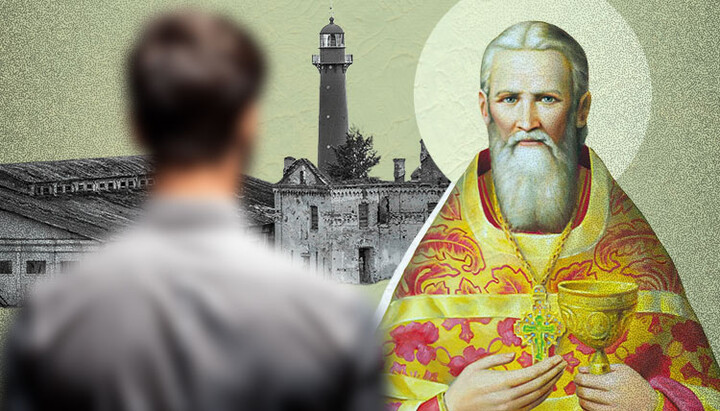
Saint Kronstadt Outcast. Photo: UOJ
We know all too well what it feels like to live under informational siege. We are mocked, caricatured, and cast as social outcasts for remaining faithful to the Church. Under such pressure – compounded by the exhaustion of war – it is easy to lose heart. At times, it seems as though we have been thrust into a unique historical moment in which words have lost their meaning and Truth itself is about to be trampled into the dust unless we rush to organize a twenty-four-hour public-relations campaign in its defense.
In such moments, our gaze falls upon an old photograph of a man with piercing, deep-set eyes. It is the righteous John of Kronstadt. We are accustomed to seeing him on icons, bathed in the radiance of sanctity, yet we often forget the suffocating atmosphere in which he lived. If we return to the closing decades of the nineteenth century, we can almost hear the shrill, near-hysterical roar of the secular press.
A century-old cancel culture
The intelligentsia of that era launched what we would today call a full-scale “cancel culture” campaign against Fr. John, long before such a term existed.
In the fashionable salons of St. Petersburg and on the pages of freshly printed morning newspapers, contempt for the “Kronstadt priest” was considered a mark of sophistication and enlightenment. Journalists sharpened their pens on him with venomous delight. They mocked the silk cassocks gifted to him by grateful admirers, published cartoons depicting him traveling in luxurious railway cars, and openly sneered at the passionate, tear-filled manner in which he celebrated the Divine Liturgy.
To them, he was a fanatic, a performer, an obscurantist.
The celebrated writer Nikolai Leskov lampooned him in his satirical novella The Midnight Watchers. Leo Tolstoy himself – the unquestioned moral authority of the age, the ruler of intellectual minds – openly dismissed Fr. John’s faith as crude superstition.
An ordinary parish priest found himself opposed by the full media machinery of a vast empire. The finest literary talents of the age competed to see who could wound him most deeply.
Had we, the children of the internet age, faced such a barrage of slander, we would immediately have hired lawyers. We would have published open letters, convened press conferences, struggled to drown out the crowd, and desperately tried to prove our respectability.
Fr. John simply went on serving.
The mechanics of redirected hatred
He never established a press office. He never wrote a single newspaper article in his own defense. His answer to an ocean of media filth was silence before the Chalice.
In his spiritual diary My Life in Christ, he describes a remarkable spiritual principle he had discovered:
“The enemy sometimes acts through evil people... Yet the loving Lord is here. How, then, can I allow even the shadow of malice into my heart? Let every trace of bitterness die within me. Malice is exceedingly destructive to both soul and body – it burns, crushes, and torments.”
The saint saw something that we often fail to notice in the heat of controversy.
When insults are hurled at us, the attacker’s true objective is not to prove a historical, political, or ideological point. The goal is to infect us with the same hatred that consumes him.
The moment we begin defending Christ with foaming indignation, descending into reciprocal insults and hostility, we have already lost. The devil uses one person as a transmitter of malice in order to infect another heart. And we obediently cooperate with his design, disguising our anger as “zeal for the faith.”
Yet in reality, we are defending nothing but our wounded pride.
The dirt that falls away on its own
Fr. John left us sober counsel on how to endure social contempt:
“Do not say in your heart to the one who has offended you: ‘What? After insulting me, he dares speak to me? I do not even consider him worthy of speaking with me. I reject him. I despise him. Let him learn what it means to offend me.’ Do not be proud or resentful. Speak not in this way, lest the Lord be angered by the hardness of your heart.”
There is no call here to cowardly surrender. Rather, this is Christianity at its most noble.
Mud thrown onto a white cassock has a peculiar property. If you frantically try to scrub it away at once – explaining yourself, protesting, and anxiously defending your reputation – the stain only sinks deeper into the fabric. But if you remain silent, continue on your path, and wait, the mud will dry and fall away by itself.
While the newspapers of St. Petersburg filled their pages with mockery and satire, Fr. John was distributing thousands of rubles to crowds of the poor every day. He rescued the homeless, fed the hungry, established houses of industry, and poured his immense energy into works of mercy.
He redirected all the strength that could have been wasted arguing with his detractors into acts of tangible Christian love.
A secular world governed by publicity and self-interest can never truly grasp the mystery of the Liturgy. Fr. John willingly accepted being ridiculous in the eyes of the elite in order to remain faithful to God.
For truth does not depend upon our likes, shares, or online approval.
Once we understand this, our clenched fists begin to relax, and peace returns.
We no longer feel compelled to prove ourselves to strangers online. We no longer need to win arguments against those who never intended to listen in the first place.
Instead of exhausting ourselves reading yet another stream of sneers and taunts, we can simply close the laptop.
What appears to be a verbal surrender becomes an inner victory.
And in the silence that follows, across the span of time, we hear the simple yet desperately needed voice of the pastor of Kronstadt:
“Understand, brethren, what spirit you are of. Offend no one for any reason. Love your enemies, bless those who curse you, do good to those who hate you, and pray for those who mistreat you.”
Read also
The help God never asked for
Uzzah wanted only to keep the Ark of the Covenant from falling into the dust. Why did this well-intentioned act cost him his life, and who was really responsible for his death?
Freedom begins when there's nothing left to take
Fear of persecutors takes root in our attachment to possessions. We turn to St. Basil the Great to understand why the prefect's threats held no power over him.
The bride in the window frame
The author of the earliest account of St. Thecla’s life was defrocked. Yet it was his book that preserved the only ancient description of the Apostle Paul’s appearance.
Drinking priest, or the flip side of parish life
In his epistle, the Apostle Jude describes a scene familiar to anyone who has seen a church meal turn into a drinking party.
A lesson from a speechless donkey
The famous seer struck his donkey three times for refusing to go forward. All the while, she was saving his life – and seeing what he could not.
The time when the soul ripens
Modern society has turned youth into a cult and old age into a period of merely “living out one’s days.” The Christian perspective reveals the profound spiritual meaning of our later years.