The saint with an unbearable temper
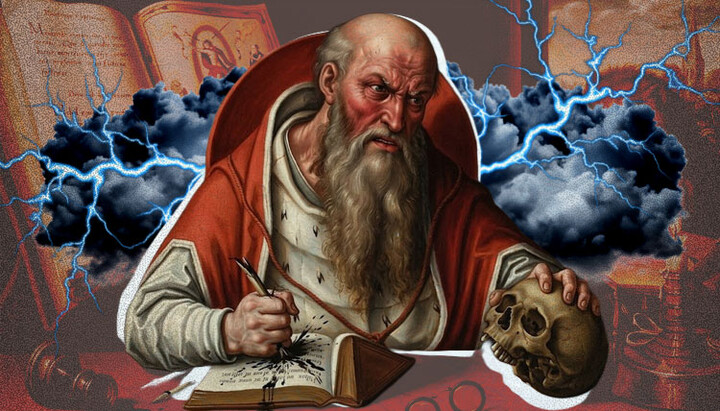
Blessed Jerome of Stridon in anger. Photo: UOJ
In a Bethlehem cave carved into limestone, an old man sits at a low table dictating a letter, while the scribe’s stylus races to keep up with his voice. The letter is bound for North Africa, to a young and promising bishop who has dared to question one of his biblical interpretations.
The old man does not mince words. Do not, in your youth, presume to argue with a veteran of Scripture, he scolds him, sealing the rebuke with a proverb: “A tired ox treads more firmly.”
The young bishop’s name was Augustine. The very same Blessed Augustine.
And the old man who dressed him down like an overconfident student was Jerome of Stridon. In that cave, he was translating the Bible. And his character, to put it mildly, was difficult.
A man impossible to live with
Jerome was hot-tempered and merciless in argument. He knew how to break a friendship beyond repair. He and Rufinus of Aquileia had been friends since youth: they had studied together in Rome and embraced ascetic life together. But once the old companions differed over the legacy of Origen, Jerome fell upon his former friend with such fury, and in such language, that their written quarrel is still uncomfortable to read today.
He made it personal. He chose the most humiliating Latin he knew – and he knew Latin brilliantly.
Augustine fared better only because he refused to answer rudeness with rudeness. The young bishop of Hippo cautiously objected to Jerome’s interpretation – and received in reply the irritated rebuke of an elder who did not wish to be corrected.
The correspondence of two of the greatest minds of the age sometimes reads like a duel: one strikes wildly and hard, while the other struggles to preserve Christian calm.
Today, such a man would quickly be labeled unsafe and avoided. And indeed, he was hard to be around. But the question is different: where, in this unbearable scholar, did that thing come from which made him a saint?
The burning desert
To understand Blessed Jerome’s anger, one must return to the Syrian desert near Chalcis, where he spent several years as a hermit long before Bethlehem.
His letter to Eustochium, his spiritual disciple, was written not from books but from the lived experience of ascetic struggle. The sun in Palestine burned so fiercely that his skin, by his own account, became black “like an Ethiopian’s.” Fasting beyond all measure, he reached the point where his dried-out bones barely held together and struck the ground when sleep overcame him. His neighbors in the desert were scorpions and wild beasts; his drink was cold water.
There was no cozy scholar’s cell with a skull on the table, as Renaissance artists loved to paint him.
That is why Jerome’s anger was not the petty touchiness of a quarrelsome man. It burned from within with the same fire that had scorched him in the desert – only now it was turned against carelessness with the Word of God.
He threw himself at heretical statements like a watchdog at a stranger by the gate: fiercely, indiscriminately, and sometimes rashly. For the truth of God preserved in Holy Scripture, he was ready to sacrifice friendship and reputation alike.
Twenty years of hard labor
Before Jerome, the Latin Old Testament traced back to the Greek Septuagint – in effect, a translation of a translation. Jerome undertook the unthinkable: he sat down with the Hebrew original, which he called the “Hebrew truth,” and spent years comparing it, questioning Jewish scholars about textual subtleties.
In the Hebrew text of that time, vowels were not written at all. Before the translator stood a fence of consonants, where the same combination of letters could be read this way or that, and the correct reading could only be guessed by someone who understood the language almost like a native speaker.
He sat before that fence for more than twenty years. The desert wind ground sand between his teeth and settled on the damp parchment. The heat dried the ink on the reed pen. His eyes, inflamed from hours of reading by a smoking lamp, failed him by nightfall. This was asceticism of another kind: suffering over a single line, invisible to everyone else.
And this is what matters. Only an obsessed man, the kind of man one could not live with, could break through that wall of incomprehension – the foreign alphabet, the unfamiliar vocalization, the text without vowels.
A more agreeable man would long since have abandoned the work and returned to the familiar Septuagint. Jerome’s unbearable stubbornness became the drill with which he pierced through where more accommodating men would have retreated.
The reckoning came at once. His translation of the Bible enraged many. Believers clung to the old Latin words they had heard since childhood, and the new ones seemed to them a substitution and a sacrilege.
It even led to unrest. In the African city of Oea, a bishop read Jerome’s translation of the Book of Jonah during the service and stumbled over a single word: instead of the familiar “gourd” under which the prophet took shelter, Jerome had “ivy.” The church erupted in anger. Parishioners shouted that the translation was false, accused the translator of “Judaizing,” and the affair nearly cost the bishop his see.
It is almost impossible to imagine: a scholar in a distant cave changed the name of one plant – and a thousand kilometers away, Christians nearly tore a church apart over it.
And yet this very text, the Vulgate, became the Bible of the Latin West for more than a thousand years.
Time to lay down the pen
In 410, news reached the Bethlehem cave that stunned the fiery translator of Scripture. Alaric’s Visigoths had taken Rome. Jerome had just begun writing a commentary on the Prophet Ezekiel – and the shock left him unable to continue.
He described this paralysis himself. For several days, he admitted, he could think of nothing except the fate of those close to him, and he could not open his mouth. “In one city,” he wrote in the preface to that very commentary, “the whole world perished.”
Among the killed and captured were people he knew and loved. According to his own account, soldiers beat the elderly noble widow Marcella, his spiritual disciple, demanding that she hand over hidden gold – gold she had long since given to the poor.
And soon they began arriving at the mouth of the Bethlehem cave: yesterday’s Roman patricians, ragged, dusty, stripped of everything, begging for bread.
And the irascible old man, who had just been ready to tear an opponent apart over a wrong preposition, pushed aside the scroll of Ezekiel. There was no time left to interpret Scripture: refugees had to be fed and sheltered.
“There is not a single hour when we are not receiving crowds of holy brothers; the quiet of the monastery has been turned into the bustle of an inn,” he wrote.
The man who had spent his life warring with words laid those words aside and turned to deeds.
The stylus came to rest on the table beside the unfinished line of the prophet. Outside, in the heat, stood a line of the hungry; and the hands that had written the most venomous letters of that century now broke bread for them.
Thus God called to service a difficult and unyielding man. He called the one with whom it was impossible to live.
And yet it was through his hands that those abandoned to their fate were fed.
Read also
From love spells to bishop's throne
Antioch’s most powerful sorcerer sent demons against a devout young Christian woman three times – and failed every time. In the end, a demon himself revealed the truth that led to his conversion.
The Weeping Queen of Blachernae
On the night of the Feast of the Protection, only two people witnessed the miracle in the Church of Blachernae. Everyone else prayed and saw nothing. Yet they, too, received grace.
Deadly spiral of human hatred
The tragedy of Lebanon's civil war lays bare how dehumanization and fear can turn human beings into monsters.
Woe to expectant mothers – or to those of little faith?
God commanded one prophet not to have children, yet told his people in exile to bear sons and daughters. What does this apparent contradiction tell us today?
The help God never asked for
Uzzah wanted only to keep the Ark of the Covenant from falling into the dust. Why did this well-intentioned act cost him his life, and who was really responsible for his death?
Freedom begins when there's nothing left to take
Fear of persecutors takes root in our attachment to possessions. We turn to St. Basil the Great to understand why the prefect's threats held no power over him.