Zelensky and the strike on the Lavra: grief for export?
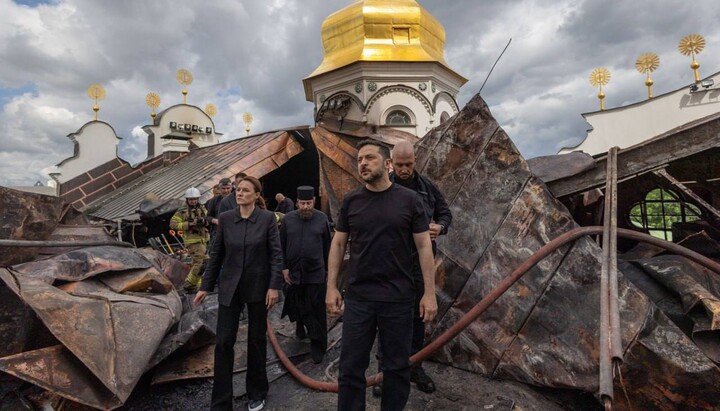
Zelensky at the Lavra. Photo: Zelensky's press service
After a Russian drone struck the Dormition Cathedral, Zelensky promptly arrived at the Lavra and promised to restore the damaged church. He called what happened “barbarism” and “an open attack on the Christian community.”
And here, one cannot help but feel a certain bewilderment.
The Dormition Cathedral, like any other church, was built for prayer. From the point of view of the “Christian community,” it is no different from the most modest little church in some remote village. In both, the same Liturgy is served and the same Bloodless Sacrifice is offered.
Today, Zelensky and Ukraine’s leadership are making loud statements for an international audience and ostentatiously expressing grief over the “destruction of a shrine.” Yet just a couple of years ago, Zelensky just as ostentatiously remained silent when, under police protection, municipal workers demolished another shrine – the Tithes Monastery. Yes, that church did not have the same historical or architectural value as the Dormition Cathedral. But for any Christian, it was no less precious. And the Tithes Monastery was not an exception, but part of a system. Under Zelensky’s presidency, the UOC’s Transfiguration Church in Ivano-Frankivsk was demolished, as was St. Volodymyr’s Church in Lviv. Now the rector of the Transfiguration Church in Kyiv is sounding the alarm: his shrine, too, is facing the threat of destruction.
If Russia’s strike on the Dormition Cathedral is, in Zelensky’s words, “barbarism,” then what should we call the destruction of UOC churches by the Ukrainian authorities? Is that not barbarism? Or is that somehow “different”?
In recent years, the churches of the Lavra have hosted rock concerts, cooking show shoots, performances by folk dance ensembles, government conferences, and other events that had nothing spiritual about them. For some reason, no one then said that the Lavra is a shrine, not a cultural center or a conference hall. Today, Zelensky suddenly remembered it. Why? It seems everyone knows the answer: because the Lavra is a Christian center known throughout the world. Because this topic can generate powerful hype.
Of course, attacks that destroy holy places are a crime. But that is what the enemy does. When churches were demolished by one’s own side, did that make it any easier for their parishioners?
Grief for export.
Read also
Ternopil post on Feast of Intercession: Has calendar reformn failed?
A significant number of believers have rejected the new church calendar introduced by the OCU and UGCC with government support.
Shoulder straps or a cassock: who writes the script for UOC "fighters"?
Everything indicates that both Veliar and Pshenychny are ordinary performers of someone else's script. There is only one question – does the scriptwriter wear shoulder straps or a cassock?
Why is it legal to kill a person before birth but not after?
Children are the most privileged members of society. Yet that same society officially permits children to be killed – and on a massive scale.
Honoring the Bolsheviks’ successors at Kyiv Lavra
It was under the Reserve that the relics of the saints were desecrated, Lavra churches were turned into an atheism museum, and toilets were installed in sanctuaries.
"Degenerates" and "stupid animals": anti-UOC activists turn on children
Future historians will wonder how a vast country’s information agenda could have been shaped for so long by people so petty, vicious, and utterly contemptible.
Zelensky sees murder of Polish priest but not of Sviatohirsk monk
Why does Zelensky react so emotionally and swiftly to the murder of a Catholic cleric while remaining completely silent about the murder of an Orthodox monk?