The story of taming the steppe beast
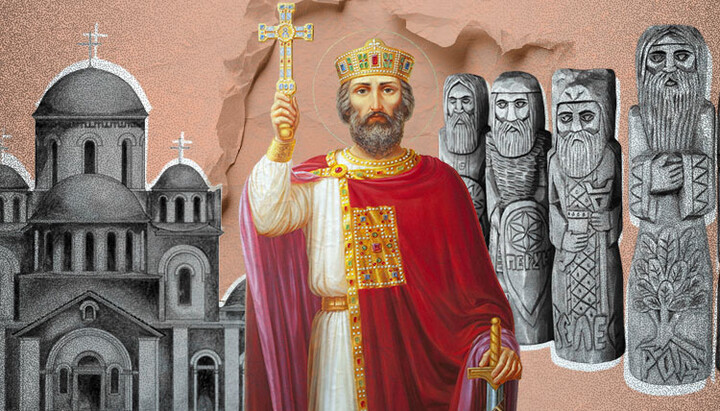
The spiritual turning point of the great prince. Photo: UOJ
Dig into the earth on the slope of Starokyivska Hill, and you will find a strange kind of soil. It is gray, dense, greasy-looking, mixed with charcoal and tiny fragments of burnt bone. There is a great deal of ash there, compressed by time into a hard cushion.
This layer was uncovered in 1908 by archaeologist Vikentiy Khvoyka. Beneath it appeared a structure made of rough boulders, laid out in the shape of an ellipse with four projections clearly oriented toward the cardinal points. Nearby stood a massive pillar of fired clay. Animal bones lay all around it. The site was immediately identified as a pagan shrine, though historians still debate its precise dating.
A bloody pantheon on the hill
The chronicle paints a deliberately terrifying scene on this hill. In 980, Prince Vladimir, having just seized the Kyiv throne from his brother, erected here a grand pagan pantheon of six idols, headed by a wooden Perun with a silver head and golden moustache. The Tale of Bygone Years says that blood flowed before these idols. And not only the blood of animals.
In 983, after returning from a victorious campaign against the Yotvingians, the prince’s retinue decided to thank the gods with a human sacrifice. The lot fell on the young John, son of the Varangian Christian Theodore, who had lived for a long time in Byzantium and secretly believed in the Crucified Christ. His father refused to hand over his son. He stepped out onto the wooden platform of his house and hurled a fiery challenge at the enraged crowd: “These are not gods, but wood: today they exist, and tomorrow they will rot... They were made by human hands.” The Varangians’ courtyard was torn down, and father and son were swiftly killed. Thus the first martyrs for Christ appeared on Kyiv soil.
The man who ordered these idols to be erected and silently approved the killing of the Varangians had come to power through monstrous violence.
Vladimir murdered his own brother Yaropolk after luring him to negotiations. Rogneda, the princess of Polotsk, who had dared to call him “the son of a slave woman,” he took by force before the eyes of her bound parents, whom he then ordered to be killed. The chronicle counts hundreds of concubines in the prince’s country residences and calls him insatiable in lust.
The monks who wrote the life of the holy prince could have retouched this filth, hidden it, softened its sharp edges. But they deliberately left it in. They preserved these facts as the measure of the abyss from the bottom of which the grace of God pulled a man, handing down to us the honest story of the resurrection of the soul of the Equal-to-the-Apostles Baptizer.
Blindness at the walls of Chersonesus
The tragedy of 983 on the Kyiv hill, where Theodore and John were killed, marked the beginning of the end for Vladimir himself. The bloody triumph of paganism turned into inner devastation. The prince, endowed with a colossal practical mind, suddenly felt that service to Perun led only to a dead end. The massacre of the Varangians did not strengthen his power. On the contrary, it exposed the deep rot of the entire pagan system.
A painful search began. What textbooks dryly call the “choice of faith” was, for Vladimir, a question of personal survival. He was not simply looking for a state ideology, but for a living power capable of taming both his rebellious soul and his vast country.
The Chersonesus legend says that shortly before his Baptism in captured Chersonesus, Vladimir suddenly went blind. His eyes were covered by a thick, dark veil. It was a visible image of his inner condition. The man who had conquered everything that could be conquered in this world found himself utterly helpless and lost in the midst of his own triumph.
And when the Byzantine princess Anna sent him a brief message – “If you wish to be healed of this sickness, be baptized without delay” – Vladimir agreed. At the moment when the bishop laid his hand upon him in the baptismal font, the veil fell away. A different man emerged from the water. It was not only the prince’s name that changed, but the very nature of this furious steppe wolf.
The astonishing renunciation of the sword
The strongest proof of this transformation was what happened after Vladimir returned to Kyiv: he ordered the pagan shrine to be destroyed. Perun was tied to a horse’s tail, dragged through the mud under blows of whips, and thrown into the Dnieper. But this was only the outward act. The real change had taken place inside the prince himself.
The man who had spent his whole life resolving every question by sword and violence categorically refused, after his Baptism, to execute criminals.
The chronicle preserves this astonishing dialogue. Vladimir abolished the death penalty in Rus, telling the Greek bishops who had arrived from Constantinople: “I fear sin.”
For Byzantium, where the blinding of deposed emperors and brutal executions were part of normal state life, this was madness. The bishops had to persuade the newly baptized prince to restore courts and punishments so that brigands would not tear the country apart. It is simply astonishing: Byzantine intellectuals are teaching yesterday’s barbarian to exercise harshness in government, while he stubbornly clings to the Gospel, refusing to shed blood.
He began distributing food and clothing to the poor, ordering provisions to be carried through the streets of Kyiv for all the sick and infirm. The princely palace became a center of mercy. The old Vladimir died in the baptismal font of Chersonesus. In his place appeared a ruler who seriously tried to build the life of the state on the law of mercy.
Lime mortar over old graves
Between 989 and 996, Greek architects came to that very hill where, only recently, gray ash from Perun’s shrine had still smoldered. Vladimir gave a tenth of his income for the construction of the first stone cathedral – the Church of the Tithes, dedicated to the Dormition of the Most Holy Theotokos.
It was built by Byzantine craftsmen from plinthos – thin bricks fired red-hot. The bricks were laid in a mortar made of lime and crushed brick, a mixture that hardened over centuries into a monolith. And this mortar was poured directly over the trenches of the old pagan shrine.
During the 1908 excavations near the altar of the cathedral, archaeologists discovered the remains of a wooden log structure – the very house where the Varangians Theodore and John had made their stand and died. The church was built upon the remains of the first martyrs.
If one were to clean a vertical section of the excavation on Starokyivska Hill from top to bottom today, our entire history could be read there without a single word.
Amazingly, our faith rests precisely on this scorched earth – earth that a cruel prince once claimed as his own, and then blessed with the Cross. The ash of the pagan shrine did not disappear from beneath the cathedral’s foundation. Of course, one cannot rule out that, at any moment, a shrine to idols could once again be arranged on the site of the cathedral. But this history can no longer be erased from the face of this land. It is forever sealed in the faith of the steppe beast who made the decision to become a Christian.
Read also
Honest atheism vs. spiritual hypocrisy
The 70th anniversary of Albert Camus’s Nobel Prize recalls an uncompromising challenge to Christianity. An honest unbeliever brings theology back to the mystery of the Cross.
The valley of trouble and the gateway of hope
One soldier buried an expensive cloak and some gold beneath his tent. Because of this, all Israel lost a battle. Why did one man’s sin bring disaster upon an entire nation?
From love spells to bishop's throne
Antioch’s most powerful sorcerer sent demons against a devout young Christian woman three times – and failed every time. In the end, a demon himself revealed the truth that led to his conversion.
The Weeping Queen of Blachernae
On the night of the Feast of the Protection, only two people witnessed the miracle in the Church of Blachernae. Everyone else prayed and saw nothing. Yet they, too, received grace.
Deadly spiral of human hatred
The tragedy of Lebanon's civil war lays bare how dehumanization and fear can turn human beings into monsters.
Woe to expectant mothers – or to those of little faith?
God commanded one prophet not to have children, yet told his people in exile to bear sons and daughters. What does this apparent contradiction tell us today?