Church celebrates feast of Holy Foremost Apostles Peter and Paul
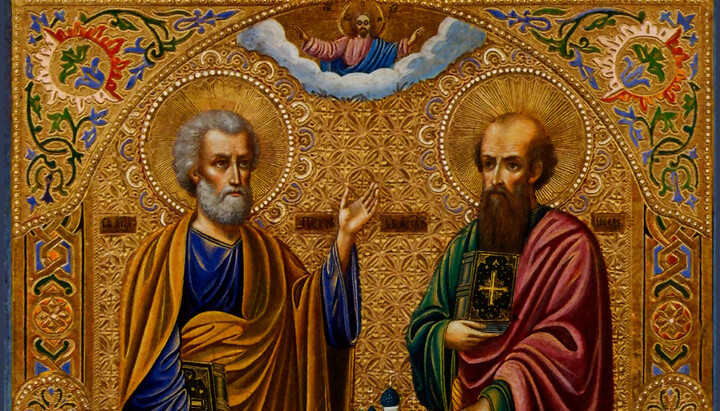
The Icon of the Holy Apostles Peter and Paul. Photo: blagovist.info
The Feast of the Holy Chief Apostles Peter and Paul is celebrated on 12 July according to the New Calendar. It is dedicated to the Apostles Peter and Paul, who preached Christianity throughout the world. Both apostles suffered martyrdom for their faith, a year apart.
Before becoming a disciple of Christ, Peter was a fisherman. The Lord called Peter and his brother, the future Apostle Andrew the First-Called, while they were fishing on the Sea of Galilee.
It was Peter who was the first among the disciples to call the Teacher the Christ, that is, the Messiah. For this, the Lord gave him the name Rock (which is what the name Peter means). Upon this rock of Peter's faith, the Lord promised to build His Church, which the gates of hell shall not prevail against.
When Christ was taken into custody by the chief priests before His Crucifixion, Peter denied the Lord three times, just as Christ had foretold. Yet Peter repented of his denial and redeemed it by becoming a fervent preacher of the Christian faith. He truly became a foundation stone of the Church – the community of those who remain faithful to the Saviour.
Two Catholic Epistles of the Apostle Peter have survived to our day. They are included in the New Testament. In his Epistles, Peter addresses Christians in the provinces of Asia Minor, strengthening them in the faith and warning them against the influence of false teachers.
Toward the end of his life, Peter returned to Rome, where he was arrested and executed for preaching the Gospel. This took place in AD 67. At his own request, the apostle was crucified upside down, considering himself unworthy to be crucified in the same manner as the Lord.
Paul was not a disciple of Christ during the Savior's earthly life. Moreover, Saul (as Paul was known before his conversion to Christianity) was a persecutor of Christians.
Saul was born in Asia Minor, in a city where many inhabitants, being Jews, possessed Roman citizenship. This status granted them real privileges, including the right to special protection from the state and the right to have any accusations against them heard in the imperial Roman court. For the Jewish people, this was a relatively rare privilege. Saul received a profound education in Jerusalem and apparently was preparing to become a rabbi. After completing his studies, he was given authority to officially persecute Christians even beyond the borders of Palestine, in Damascus.
It was on the road to Damascus that the Lord called Saul to apostolic ministry. During the journey, a brilliant light from heaven shone around the future apostle, and he fell to the ground, blinded by it. He heard a voice saying: “Saul, Saul, why are you persecuting Me?” When he asked, “Who are You, Lord?” the Lord replied: “I am Jesus, whom you are persecuting.”
Christ commanded Saul to go to Damascus. His companions heard the voice of Christ but did not see the light. The blinded Saul was led to Damascus, where he was instructed in the faith and baptised on the third day. At the moment he was immersed in the water, Saul regained his sight. From that time onward, he became a zealous preacher of the Risen Christ.
The Jews were outraged by his conversion to Christ, and Saul had to flee to Jerusalem. There he joined the Christian community and became acquainted with the apostles. Once again, the anger of the Jews followed, along with threats against his life, from which his Roman citizenship ultimately saved him.
But Jerusalem had to be left behind. Saul set out on his first apostolic journey, which lasted from 45 to 51 AD. The apostles traveled throughout the entire island of Cyprus; it was during this period that Saul came to be called Paul. Together with Saint Barnabas, he founded Christian communities in several cities of Asia Minor.
Paul undertook several more apostolic journeys. He enlightened people with the teaching of Christ in Macedonia, Greece, and other lands. Over the many years of his life and preaching, the Apostle Paul wrote 14 epistles, which are included in the New Testament.
Paul was arrested several times, and after his final imprisonment he suffered martyrdom by the sword. He was not crucified because he was not a slave but a Roman citizen. This took place near Rome in AD 67, during the reign of Emperor Nero.
The UOJ previously reported that a large-scale international forum on the legacy of the Apostle Paul was held in Greece.
Read also
Receding Dniester in Khmelnytskyi region exposes foundation of flooded church
The foundation of St. John the Theologian Church, submerged during the construction of a hydroelectric power plant, has emerged for the first time in 45 years.
Kyiv’s Vvedensky Monastery damaged in shelling, two injured
A cluster munition struck the monastery, injuring a cook and a kitchen assistant and damaging the facade, the roof of the monks’ residential building, and several monastic cells.
Medieval сhurch сrumbles as Culture Ministry сites missing agreement
The 14th–15th-century St. Nicholas Church in Chesnyky, Ivano-Frankivsk Region, is falling into disrepair.
Poland сondemns Lviv Regional Council's decision to declare 2007 year of UPA
Polish Prime Minister Donald Tusk says the Lviv Regional Council's decision to dedicate 2027 to the UPA and Roman Shukhevych is harmful to Ukraine.
OCU seeks court recognition of ownership of seized Cherkasy cathedral
The Cherkasy Regional Commercial Court will hear an OCU lawsuit seeking ownership of St. Michael's Cathedral, which was seized from UOC believers.
Lithuanian bishop: Ukraine is no model for believers' rights
Vicar of Vilnius Diocese voices concern over attempts to import Ukraine's religious conflict into Lithuania.