Avraamiy and the void: Why the OCU dismissed its "abbot of the Lavra"
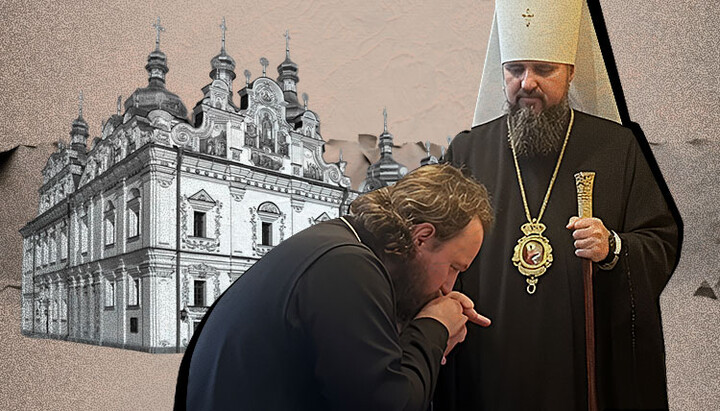
Dumenko dismissed Avraamiy Lotysh. Photo: UOJ
On July 16, 2026, it became known that Avraamiy Lotysh had been dismissed as the OCU’s “abbot of the Lavra.” The organization’s press service published the decisions adopted by its synod at a meeting held on July 13. Buried among numerous lines was an apparently inconspicuous sixth item – the provision for which, it seems, the entire meeting may have been convened. Formally, it does not mention a single name. In practice, however, it draws a line under the three-year “Ukrainian Lavra” project and places the country’s principal monastery under the control of one person alone – OCU head Epifaniy Dumenko himself.
Let us examine what actually happened and why the deliberately bureaucratic wording conceals a far more serious story than an ordinary personnel reshuffle.
What exactly did the Synod decide?
The decision refers to the long-standing Synodal Resolution No. 30 of May 23, 2022, “On the Holy Dormition Kyiv-Pechersk Lavra.” Under that resolution, the religious organization known as the “Holy Dormition Kyiv-Pechersk Lavra – Men’s Monastery of the Ukrainian Orthodox Church (Orthodox Church of Ukraine)” is directly subordinate to the OCU head in his capacity as the monastery’s “sacred archimandrite,” or titular abbot.
The Synod has now effectively established that the “primate” himself – Epifaniy Dumenko personally – is the head of this religious organization.
Then comes the peculiar wording that deserves particularly close attention. The Synod recommended that Epifaniy issue a decree appointing the “Right Reverend Vicar Bishop of Boryspil” as dean of the Lavra – “the monastery’s senior official after him.”
Two important points are concealed here beneath a layer of routine official language.
First, the “Vicar Bishop of Boryspil” is Avraamiy Lotysh. He has held this title since February 2, 2024, when the OCU Synod elected him “bishop” of Boryspil, vicar of the Kyiv Eparchy, and appointed him “abbot” of its Lavra structure. In practice, he had performed the duties of “abbot” since March 2023.
In other words, the decision does not even refer to Lotysh by name – it treats him merely as the holder of an office. Formally, he has not simply been removed but carefully demoted: from an “abbot” with his own standing and administrative weight to a dean – a subordinate administrator.
Second, this is merely a recommendation, not an appointment. The Synod does not appoint Lotysh as dean – it only advises Dumenko to do so. In other words, Avraamiy’s future has been placed entirely at Epifaniy’s discretion. If he wishes, he may retain him as the second-ranking official. If he does not, he will not.
It should also be noted that the change has already appeared in public registers. As of July 15, 2026, the head – or “director” – of the religious organization known as the Holy Dormition Kyiv-Pechersk Lavra is no longer listed as Lotysh but as Dumenko.
In other words, Epifaniy simply took the top position for himself – and did so quietly, without the pomp that accompanied Avraamiy’s appointment as “abbot.”
The conclusion is simple: this is not a routine reshuffle but the concentration of control over the Lavra in one pair of hands.
The “Ukrainian Lavra” project: three years of emptiness
To understand why Dumenko decided to bring the monastery under his personal control, one must assess the results of Avraamiy’s three years in charge. He headed the OCU’s Lavra structure from March 2023, initially as acting abbot and later as its formal “abbot.”
The results were a failure.
The central task for which Lotysh was brought into the OCU was perfectly clear: to fill the Lavra with monks. He was expected to persuade members of the brotherhood to defect, create a living monastery, and demonstrate that the “Ukrainian Lavra” was not merely a signboard but a genuine monastic community.
It was for this purpose that the former UOC archimandrite was accepted into the OCU. It was for this purpose that he was “consecrated” as a “bishop.” It was for this purpose that a major media campaign was built around him.
Yet during those three years, not a single UOC monk joined the brotherhood of the “Ukrainian Lavra.”
Not one.
Dumenko’s “brotherhood” remained a handful of people who could be counted on one’s fingers. This despite the fact that, within the same walls, a genuine monastic community of more than one hundred monks continues to live.
The members of the OCU “monastery” are formally employed by the state reserve. What exists, therefore, is less a monastic brotherhood than the staff of a publicly funded institution.
Under these circumstances, Maksym Ostapenko, director of the Kyiv-Pechersk Lavra National Reserve, effectively behaves as the owner of the site, while spiritual life is replaced by media events – filming sessions, “community cleanups,” conferences, and concerts.
Over three years, a shrine of universal Church significance was not filled with prayer. It was turned into a public relations venue.
And this may well be where the main problem lies for Dumenko.
As long as Lotysh was listed as “abbot,” he was the one held responsible for the emptiness of the Lavra churches. Now Dumenko himself will be responsible for that emptiness.
Why is this a problem? Because nothing will change – there is nothing from which change could come.
It is obvious that UOC monks who refused to join the OCU under Lotysh will not suddenly do so under Dumenko. Nor is there any source from which to recruit new monks – the OCU has virtually no monastics.
This means that every empty church and every Sunday service attended by only a handful of worshippers will now be Epifaniy’s personal failure rather than Avraamiy’s.
Can a primate serve as abbot of the Lavra without a deputy abbot?
The structure created by the OCU Synod also deserves separate examination. The OCU “primate” is simultaneously the “sacred archimandrite,” or titular abbot, and the head of the religious organization – in other words, the monastery’s actual owner.
There is no longer an abbot directly overseeing the brotherhood. There is only a “dean,” who in practice is an ordinary administrator.
From the standpoint of centuries-old monastic practice, this arrangement is unnatural.
Traditionally, the roles in the Lavra were divided. The sacred archimandrite – the honorary, titular abbot – was always the primate, such as Metropolitan Volodymyr of Kyiv and later Metropolitan Onuphry.
The actual deputy abbot, who led the brotherhood from day to day, managed the monastery’s affairs, celebrated the Liturgy, tonsured monks, received visitors, and heard confessions, was a separate hierarch.
In the UOC, this obedience has been carried out since 1994 by Metropolitan Pavlo of Vyshhorod and Chornobyl.
This division is not a formality. A primate is physically incapable of managing a monastery as its daily abbot – he has a vast range of other responsibilities and his own administrative workload. A monastery needs someone who lives its everyday life.
By abolishing the post of abbot and leaving only the “primate” and a “dean” above the Lavra, the OCU has created an absurd situation.
Formally, everything now runs through Dumenko. In reality, day-to-day management will inevitably fall either to the same “dean” – the demoted and humiliated Lotysh – or, far more likely, to the secular administration of the reserve, as is already happening in practice.
The monastery will be managed not by an abbot but by an official.
The criticism directed for years at the “Ukrainian Lavra” – that it is not a monastery but a branch of a state institution with religious scenery – has thus received final confirmation in the structure of its own administration.
In other words, the “primate without an abbot” arrangement is an admission that no living monastery exists and that there is neither anyone nor anything for an abbot to govern.
It is easier to place empty walls directly under one’s own authority than to admit that the project has failed.
Why was Lotysh really removed?
Now to the reasons.
The official explanation attached to the event – alleged “contacts between Lotysh and the authorities” and some supposed “confrontation with the primate” – looks more like a cover than a complete explanation of what happened.
Judging by the totality of the facts, there were two real reasons, both far more mundane.
The first was money.
Over the past month, the Lavra has gone from being a problematic asset to an institution around which major financial flows are beginning to circulate.
On the night of June 15, 2026, a Russian drone struck the Dormition Cathedral, damaging the roof of the Lavra’s principal church.
The state responded immediately and at the highest level. President Zelensky and Prime Minister Svyrydenko personally visited the site, while the government announced the urgent allocation of money from its reserve fund.
The sums involved are of an entirely different order from those previously seen at the reserve. Approximately 26 million hryvnias was allocated for emergency conservation of the roof alone, while the preliminary estimate for the cathedral’s complete restoration exceeds half a billion hryvnias.
International partners are also becoming involved. Switzerland, Greece, and Japan, among others, have expressed readiness to assist with the restoration, while the Ministry of Culture and the Foreign Ministry are coordinating the process.
At the same time, in early July, the government decided to establish a National Pantheon on the grounds of the Upper Lavra, where prominent Ukrainians, including those buried abroad, would be reinterred.
The project will be financed from the state budget “and other sources not prohibited by law.” This represents another long-term and costly stream of funding tied to the monastery.
Now recall that only recently Avraamiy complained that the OCU had to pay substantial rent to use the Lavra churches.
Then suddenly came millions from the state budget, international donations, and the enormous financial prospects associated with constructing the Pantheon.
The Lavra went from a burden to a highly desirable asset.
The OCU leadership could hardly leave such financial flows under the control of someone it did not trust.
From the standpoint of internal power politics, the logical solution was to place the organization – and therefore the financial flows – directly under Dumenko’s personal control.
Where there is money, only trusted insiders may be allowed near it. As we shall see, Avraamiy never truly became one of the OCU’s own.
This is, of course, a reconstruction of possible motives rather than an excerpt from the Synod’s minutes. Officially, the Synod says nothing about money.
But the timing – a surge in Lavra funding coinciding with its transfer to Dumenko’s personal control – is too telling to dismiss as mere coincidence.
Lotysh began playing his own game
The second motive was political.
Lotysh ceased to be a convenient and controllable figure and began pursuing an independent course, establishing direct ties with the country’s highest officials while bypassing Dumenko.
He made no attempt to conceal those connections – on the contrary, he displayed them.
After his dismissal, Lotysh publicly thanked Head of the Presidential Office Kyrylo Budanov “for his support and wise advice” and published a photograph of the two together.
A week earlier, Lotysh had posted an even more sensational photograph with Zelensky at the Presidential Office – even though Serhii Dumenko himself had never been invited there.
It was this photograph that apparently became the trigger.
According to the Ukrainian outlet DSnews, which cited several independent sources within the OCU, the decision to remove Avraamiy was linked to Lotysh’s meeting with Zelensky.
In other words, the theory that he was removed after independently gaining access to the president is not an invention. Ukrainian journalists reported it on the basis of information from insiders within the OCU itself.
There is another indirect but highly revealing piece of evidence.
At almost the same time as the dismissal – around July 14 – the OCU issued an internal circular restricting the independence of its “hierarchs.”
Under the new rules, bishops wishing to participate in government, public, or cultural events in Kyiv and the surrounding region must obtain Dumenko’s approval and “blessing.” The document also specifically regulates how “hierarchs” may interact with central government bodies.
It would be difficult to find more direct evidence.
A circular prohibiting bishops from contacting government officials without Epifaniy’s authorization appeared at precisely the moment when the Lavra’s “abbot” was seen cultivating independent ties with the Presidential Office and the president. This is no longer merely a chronological coincidence – it is a reaction.
Dumenko did not simply remove Lotysh. He tightened control over the entire “episcopate” to ensure that no one else would engage in similar independent maneuvers.
The Lavra merely became a public demonstration of what happens to those who disobey.
Why did Lotysh’s close relations with state officials trouble Dumenko so deeply?
Because an abbot with an independent channel to the country’s top leadership poses a direct threat to Dumenko’s own monopoly on “representation.”
In a structure built entirely around Dumenko’s personal chain of command, anyone with personal access to the Presidential Office, independent resources, and their own money automatically becomes dangerous.
And if that person also controls the financial flows surrounding the Lavra, the danger becomes greater still.
Hence Lotysh’s removal.
A defector who never became one of them
This brings us to a crucial point.
Avraamiy joined the OCU from the UOC – and within the OCU, he remained an outsider and a traitor. Traitors are trusted nowhere – not in the Church, not in government bureaucracy, and not in the military.
The logic is exactly the same as in high-profile political cases involving figures such as Zaluzhnyi, Fedorov, and others whom the system alternately draws close and pushes away. If you are not active enough, you are removed for being useless. If you are too active and independent, you are removed for acting on your own.
Only those who obey their superior unquestioningly and remain humbly in his shadow survive.
Lotysh managed to fail on both counts. He did not complete his principal assignment – he failed to fill the Lavra with monks – and he began playing his own game. For someone already regarded as an outsider, that amounted to a sentence.
There is another detail in this story that says a great deal about Avraamiy himself – and which OCU spokesman Eustratiy Zoria and Dumenko almost certainly noticed.
When Lotysh was “consecrated” as a bishop in February 2024, the rite was not performed solely by OCU “hierarchs.”
On February 3, 2024, Metropolitan Emmanuel of Chalcedon of the Patriarchate of Constantinople and the Phanar’s exarch in Ukraine, Bishop Michael of Koman, participated in his “consecration” at St. Sophia Cathedral.
The presence of Phanar hierarchs was not merely a matter of protocol. It appears to have been a deliberate safeguard sought by Avraamiy himself. It reveals something Lotysh may never have said aloud but evidently understood perfectly well: a “consecration” performed exclusively by OCU “bishops” could appear questionable. He needed the participation of canonical hierarchs to give his appointment at least some weight in the eyes of the Orthodox world.
In other words, through his own actions, he testified to the fragility of the legitimacy conferred by the OCU alone.
Such things are not forgotten within the OCU establishment. A man who is not fully convinced of the legitimacy of his own colleagues is, by definition, not someone to whom the Lavra and millions in funding will be entrusted without concern. His own caution ultimately worked against him. It exposed both his distrust of the structure he had joined and the vulnerability of his position within it.
Lotysh is not giving up – and hints that something is amiss
It is telling that Avraamiy did not respond to events with humility. He did not withdraw into the shadows or remain silent. Instead, he began replying – albeit through hints.
On the one hand, he displayed ostentatious loyalty to the state and the president. His posts included declarations such as, “As long as the Kyiv-Pechersk Lavra stands, Ukraine will stand,” and, “We pray for our invincible army and the future of Ukraine,” alongside public expressions of gratitude to the head of the Presidential Office.
This amounts to a signal that behind him stands not merely a church superior but something more powerful – the favor of the state.
On the other hand, he issued transparent hints that all is not well within the Church itself.
For example, he wrote that “during the years of war, the enemy of human souls manages to sow seeds of hatred and hostility even in the hearts of believers,” and that “preserving the light within ourselves is our most difficult but most important test.”
These words are not about Moscow. They are directed at his own leadership. The implication is that he was removed not for legitimate reasons but because of internal intrigue and hostility.
He presents himself as the victim of a struggle behind the scenes – and, judging by reports of a “struggle for influence,” there may be truth in that. Avraamiy is effectively confirming that behind the elegant Synodal formula lies not concern for the Lavra but an internal power struggle.
This is yet another argument against the claim that the change was merely routine.
In the end, Lotysh’s removal represents an admission that the “Ukrainian Lavra” project has failed – and an attempt to retain control over at least its material shell.
When major sums of money began circulating around the Lavra, Dumenko simply brought the asset under his personal authority, stripped yesterday’s “abbot” of his status, and left him, at best and merely “upon recommendation,” with the post of dean.
Dumenko himself is now responsible for the empty walls. And that may be the only truly honest outcome of the entire story: the void finally has a name.
Read also
Where the Spirit of the Lord is, there is freedom
Reflections on the controversies surrounding the creation of the OCU.
Pentarchy with Rome: A return to the roots or a new schism?
Patriarch Bartholomew wants to revive a council of five patriarchates, including Rome. What would reunion with Catholics look like, and what role would be left for the other Churches?
Concubine or daughter? On words that cannot be used about the Church
An archon of the Church of Constantinople likened the UOC to Moscow’s “concubine.” But for St. Epiphanius of Cyprus, “concubines” are heresies.
Shameful chronicle of one week: how the OCU was born
Exarchs under escort, a call from the operations room, and 36 votes for Epifaniy: what a member of the Phanar delegation revealed about the 2018 "Council".
Can UOC eparchies be dissolved before court ruling on Metropolia?
DESS is launching separate proceedings against UOC eparchies, monasteries, and institutions while the case involving the Kyiv Metropolia is still pending.
Two murders, one silence
Zelensky condemned the killing of a Catholic priest in Poland the very same day. A month earlier, a UOC monk was murdered at the Sviatohirsk Lavra – and the president has remained silent ever since.