The Pharisee did not lie – he was simply a good actor
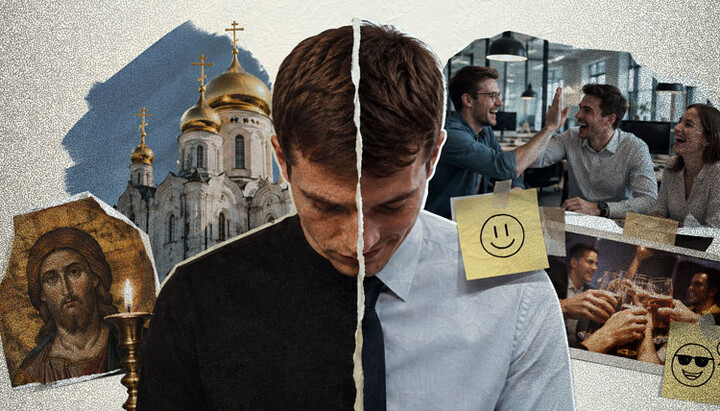
The social masks of a Christian. Photo: UOJ
There is a sin for which I cannot accuse anyone without first accusing myself. It is not envy or anger – that would be too too commonplace. It is the habit of presenting ourselves to others in the costume of a prosperous, well-adjusted Christian, even when inside there has long been nothing but scorched earth.
We probably all do this. We smile politely at the entrance to the church, even though all week we have been suffocating from exhaustion and resentment. "Thank God, everything is fine," we tell someone close to us, when what we really want is to tell them the truth. We keep up appearances because showing our true face is more frightening than lying.
Hypocrisy is inherent in us. It is a basic setting of a person who fears being rejected by society. We wear a mask not because we want to deceive but because we are tormented by the thought: what if, when they see the real me, they reject me?
An actor who never stops playing the role
The word “hypocrite” used in the Gospel has theatrical roots. It referred to an actor performing a role in a mask. When Christ rebukes the Pharisees – “outwardly you appear righteous to men, but within you are full of hypocrisy and lawlessness” (Matt. 23:28) – He is not speaking about a set of bad deeds. He is speaking about a man who has become so absorbed in his role that he can no longer step out of his falsely pious image.
An actor steps onto the stage and speaks someone else’s words. This is normal as long as he remembers that it is a role written by a playwright.
But then the applause dies down, the curtain falls, and the actor is still standing in makeup, speaking in a rehearsed voice. The mask has ceased to be a theatrical prop and has become the performer’s true face.
The Pharisee in the Gospel parable is precisely such an actor. He is not a cynical deceiver rubbing his hands behind the scenes. He may himself sincerely believe that his role is his true nature.
The naked tax collector
Two men entered the temple to pray. One was a Pharisee, who kept the fast impeccably, paid tithes to the Temple, and observed the Law. The other was a tax collector, bearing a permanent stigma of public shame. And Christ declares that the tax collector went home more justified than the Pharisee.
Why? Not because the tax collector’s sins were less serious. But because the Pharisee came to the temple already dressed in his theatrical costume. Everything about him was pressed and buttoned up. His well-being had no need of God’s mercy. Indeed: why show mercy to one who is already blameless?
The tax collector came to God naked. His wrongdoings had not a single excuse. And it turned out that this very nakedness became the spiritual garment by which God recognizes His children.
The physician comes only to the sick
The Apostle Paul asked the Lord three times to deliver him from the “thorn in the flesh” – some painful affliction whose nature remains a matter of debate to this day. And he received an answer he did not expect: “My grace is sufficient for you, for My strength is made perfect in weakness” (2 Cor. 12:9).
Christ did not say to him: "Your infirmity will pass if you pray more fervently," or "Grace will come only when you have corrected yourself."
The power of God is made perfect in weakness – where Paul’s human strength is insufficient, God makes up for what is lacking.
And the Apostle makes an unexpected decision: he stops hiding his weakness and begins to boast of it. But not out of pride – rather out of an awareness of God’s unconditional supremacy over man.
This is the truly Christian approach to self-examination, which we persistently ignore. We think: first I will recover, heal my inner wounds, and only then will I present myself before God as a decent person. We forget that the physician comes only to the sick (Matt. 9:12). As long as the bleeding wound is hidden beneath bandages and clothing, the physician cannot see it.
Hypocrisy – discord with oneself
St. John Climacus wrote that “hypocrisy is a disposition in which the body and soul are at odds with each other, interwoven with every kind of invention.” The body says one thing, the soul knows another – and the relationship between them is strained.
The holy ascetic calls simplicity the opposite of hypocrisy. “Simplicity is an established habit of the soul that has become a stranger to all duplicity and incapable of guile,” he says. A habit is always something developed over years, like building muscle.
St. Theophan the Recluse was convinced that a person knows what God requires of them and sees the discrepancy between their life and those requirements. Instead of changing their heart, however, they try to appear pious to draw attention to themselves, win praise, or conceal impure intentions behind a respectable façade.
Hypocrisy does not begin where a person has just acknowledged his sinfulness. It begins where a person, who already knows everything about himself, chooses to wear a mask instead of working on himself.
How Christianity beat Western science
In modern psychology, there is a term known as "face-saving." It was developed in the West in the middle of the last century.
But as early as 1944, the Chinese anthropologist Hu Hsien-Chin published an article in which she was the first to systematically break down the Chinese concept of "face" into two layers: lian – moral reputation and one’s conscience before oneself, and mianzi – social status and prestige in the eyes of others. A decade later, sociologist Erving Goffman drew on this work when formulating his famous theory of “face-work.”
This leads to a remarkable conclusion.. Chinese and Western scholars explained scientifically what might be called a "mask show" centuries after Christian culture had already recognized in Pharisaism a threat to the human psyche and spirituality.
A Potemkin village within the human soul
There is a metaphor used to describe elaborate façades behind which there is nothing. It is called a “Potemkin village.”
That is precisely what preserving a respectable appearance at all costs amounts to: building such a village within the soul. Over time, we ourselves begin to believe that the impeccably clean streets we have painted, brightly lit and perfectly presentable, are real.
Only God does not pass through these streets in a motorcade, gazing indifferently out of a car window. He stops and enters the depths of our soul. And where a habitable room should have been prepared for Him, He finds only painted canvas.
Difference between confession and performance
True spiritual poverty requires no audience and no applause. It is directed toward the One before Whom there is neither reason nor possibility to hide.
A mask that has become ingrained in the face is not removed by a single effort or in a single attempt. To be freed from it, one does not need penitential monologues or hysterical analyses of one’s own sins.
Start small: stop putting on a different face when you fear that others might see the real you.
To tell God, in private, the unflattering truth about oneself. And then, perhaps for the first time in a long while, the Physician will see the festering wound and deliver us forever from its tormenting pain.
Read also
Weeping Queen at Blachernae
On the night of the Feast of the Intercession of the Mother of God, only two people witnessed the miracle in the Church of Blachernae. Everyone else was praying and saw nothing. Yet the grace was bestowed upon them, too.
Deadly spiral of human hatred
The tragedy of Lebanon's civil war lays bare how dehumanization and fear can turn human beings into monsters.
Woe to expectant mothers – or to those of little faith?
God commanded one prophet not to have children, yet told his people in exile to bear sons and daughters. What does this apparent contradiction tell us today?
The help God never asked for
Uzzah wanted only to keep the Ark of the Covenant from falling into the dust. Why did this well-intentioned act cost him his life, and who was really responsible for his death?
Freedom begins when there's nothing left to take
Fear of persecutors takes root in our attachment to possessions. We turn to St. Basil the Great to understand why the prefect's threats held no power over him.
The bride in the window frame
The author of the earliest account of St. Thecla’s life was defrocked. Yet it was his book that preserved the only ancient description of the Apostle Paul’s appearance.