How a psalm full of mistakes saved a soldier from demons
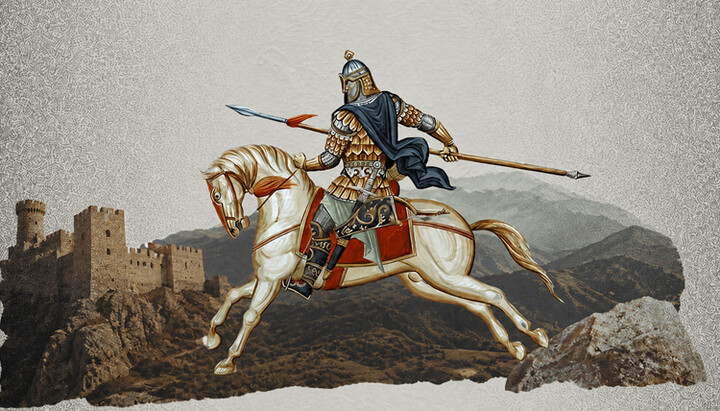
Byzantine frontier guard. Photo: UOJ
In 1937, archaeologist Harris Dunscombe Colt was excavating the ruins of the small town of Nessana in the southern Negev Desert when he stumbled upon an unexpected find. Beneath the rubble of one of the churches lay a bundle of nearly two hundred papyri.
They turned out to be the business archive of a Byzantine garrison that had lain buried for thirteen centuries. The documents span the years 505 to 689 – from the heyday of Justinian’s empire through the Persian invasion and into the period of Arab rule.
For years, historians painstakingly pieced together the story contained in these papers. What eventually emerged was a unique and remarkably detailed portrait of ordinary soldiers living on the very edge of the Christian world.
Who guarded this frontier?
Nessana was a kastron – a fortified settlement with a garrison of camel troops, a local militia serving the empire in return for allotments of land. In the documents, the military unit is called the “Theodosians” – loyal sons of Emperor Theodosius.
Military service ran in families: a son took his father’s place, and a grandson his grandfather’s. These men were not professional legionaries sent out from the capital. They had been born in these same desolate sands. Here they married, traded camels, and guarded the caravan route along which pilgrims traveled to Mount Sinai.
That is precisely why their archive bears so little resemblance to an official chronicle. There are no heroic dispatches reporting victories. There are only IOUs, marriage contracts, wills, and lawsuits over inheritances. And in almost every document requiring a witness, a military rank appears beside the name – dromedarius, decurion, prior of the kastron.
In these documents, Christianity is not confined to some dry entry under “religion” – it permeates virtually every line.
Deals are sealed in the name of Christ, money is bequeathed to the Church, and the archive itself was kept beneath a church roof for decades – as though there were no safer place for important documents.
A protective charm full of spelling mistakes
These soldiers also had another, far more personal kind of faith – one meant to protect not merely their property, but their very lives. Papyri from Egypt and neighboring regions show that small amulets containing the text of Psalm 90 – “He that dwelleth in the help of the Most High” – were widespread at the time.
Scholars call it the most frequently copied biblical text of the late antique world. One such papyrus in the Duke University collection, dating from the late sixth century, has been clearly identified by specialists as belonging to a soldier.
It looks like a tiny scroll, with the psalm written on one side and the Lord’s Prayer on the other – riddled with spelling mistakes. It was plainly written not by a professional scribe from some city chancery, but either by its owner himself or by whatever literate person he could find for a modest fee.
The psalm promises protection from “the arrow that flieth by day” and from “the pestilence that walketh in darkness.” For a soldier standing guard in the desert, where the dangers came not only from unseen demons but from very real bandits and thirst, these were hardly abstract poetic metaphors. The scroll might be sewn into clothing, worn around the neck, or kept beside a weapon. Church prayer and a humble everyday protective charm shared the same pocket.
Documents that outlived an empire
The camel garrison was disbanded around the year 600, when the empire could no longer afford to maintain its frontier units. A few decades later, the Arab conquerors arrived. One might reasonably expect the documentary record to end there.
But it does not.
Among the later papyri is a requisition for deliveries of wheat and oil dating to 675, drawn up in two languages – Greek and Arabic – on behalf of the new governor. The town continued paying taxes to the new authorities just as it had to the old ones. The churches remained open, and pilgrims continued passing through Nessana on their way to Sinai.
The soldiers whose names these papyri preserved left behind not a single sermon and performed no feat worthy of a chronicle of its own. Yet the quiet heroism of their faith can still be seen in the very pattern of their lives.
They kept important papers in churches, signed their names as witnesses to other people’s transactions in the name of Christ, and carried worn little scrolls riddled with spelling mistakes. The empire that had armed them and taken them into its service collapsed before their eyes. But what they believed in remained with them to the end of their earthly lives – and into eternal life.
Read also
Facade of bones and facade of light
Antoni Gaudí spent forty-three years building a church in Barcelona, knowing that this construction was for the ages.
Trial of a dead pope
Once in Rome, the body of a deceased pope was seated on the throne and put on trial. The accusation relied on a church canon that had once saved his see.
Monastery built in defiance of king
When Orthodox believers in Minsk were left with just one church, townspeople decided to build another – and even a royal decree did not stop them.
Young Mother and Sleeping Christ
Michelangelo carved a Virgin Mary who looks younger than her Son – and signed his name in marble for the only time in his life. Neither of these peculiarities was accidental.
Orthodox books from a Uniate printing press
In the 18th century, Uniate monks at Pochaiv printed books used in prayer by Orthodox Christians and Old Believers alike.
The story of the honey brotherhood
The Mogilev Brotherhood began with members pooling money to brew honey drinks for feast days – and eventually grew to have its own printing press.