The mask that came alive in theological disputes
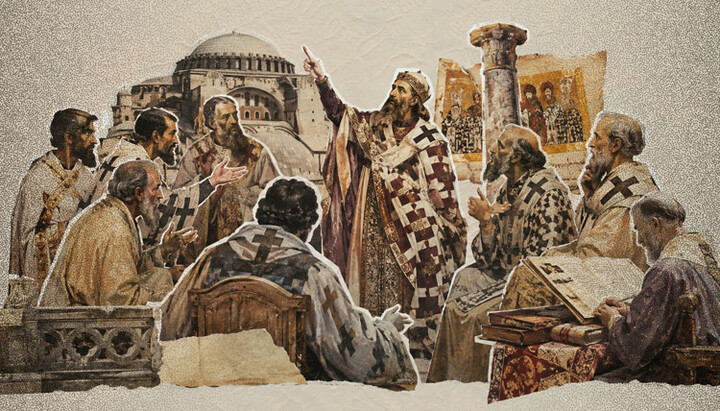
Theological disputes. Photo: UOJ
Before the fourth century, the word “person” meant nothing. More precisely, it did mean somethingbut not at all what it means today. The Greek and Latin terms referred to a theatrical mask: a wooden or linen covering with openings for the eyes that an actor put on before going on stage. Persona comes from per-sonare – “to sound through”: the mask was designed to amplify the actor’s voice.
Any actor could put on a mask. The same role in different performances was played by different people. Personhood, in the ancient understanding, was a role, not the essence of the one who performed it.
Then came a dispute that contemporaries regarded as a minor theological subtlety, and which some skeptics later mocked outright as a quarrel over a single letter. Yet this dispute, unbeknownst to its participants, gave rise to a philosophical category without which modern psychology is unthinkable.
A dispute over a single letter
In 325, the First Ecumenical Council was convened at Nicaea to address the teachings of Arius, a presbyter from Alexandria. Arius claimed that God the Son was not equal to the Father in nature, but was created – that is, there was a time when He did not exist. The Council condemned this teaching and affirmed the term “of one essence” (homoousios). Opponents of the Council of Nicaea, unwilling to acknowledge Christ as fully equal to the Father but also reluctant to openly repeat the heresy of Arius, proposed a compromise term: “of similar essence” (homoiousios). The difference between the two words was a single Greek letter, iota. But the dispute dragged on for decades and spread throughout the entire empire.
Behind the outwardly absurd quarrel lay a genuine theological catastrophe. To acknowledge the three Persons of the Trinity as merely three manifestations of one and the same God is already the heresy of Sabellius, in which the Father, Son, and Spirit are three masks that the one God puts on in turn for different roles in the history of salvation. To acknowledge them as three separate gods is no longer Christianity but paganism. The philosophical vocabulary of the time truly offered no way to describe the one nature of God.
A tool for saving the dogma
The solution was proposed by three theologians from Cappadocia — Saints Basil the Great, his brother Gregory of Nyssa, and their friend Gregory the Theologian. Before the Cappadocians, the words ousia (essence) and hypostasis (person) were used as synonyms — both denoting simply abstract "being." The Cappadocians deliberately distinguished them, defining each separately.
Essence, St. Basil explains, is what denotes the general. The word "human" points not to a specific person but to the nature shared by all people without exception. Hypostasis, on the other hand, denotes something concrete and singular: not "a human being in general," but specifically Paul or specifically Timothy.
Here is the key move in the saint’s thought: Paul and Timothy possess the same human nature – neither is more or less human than the other. Their difference lies not in nature but in something else, something personal.
Applied to the dogma of the Trinity, this reasoning worked flawlessly. The Father, Son, and Spirit possess a fully identical, indivisible divine nature — one essence. Yet at the same time, they are three hypostases, distinguished not by qualities (the Son cannot be «less» divine than the Father) but by mode of being. Thus, the Father is unbegotten, the Son is begotten, and the Spirit proceeds. It turned out that a person cannot be reduced to the sum of their properties. A person remains unique even when all the properties of the whole have already been named.
A philosophical bomb inside a theological formula
This is precisely where the philosophical revolution occurred. Ancient thought knew the individual as a unit that could be counted, compared, and replaced by another unit. The person, in the new Cappadocian sense, could not be counted.
How much this theological insight influenced the later idea of the uniqueness of each individual person remains an open question to this day.
Some believe that, since human beings are created in the image of the Triune God, a person is not simply homo sapiens but a unique individual. Others consider this view too simplistic and find that the Cappadocian Fathers themselves were far more interested in exploring the common nature than the individual person. This unique debate, which began with a dispute over a single letter, remains unresolved to this day.
The mask that ceased to be a mask
What is beyond dispute is the thorny path the word "person" has traveled. From the actor’s mask, which could be removed and handed to another performer, to a concept denoting something that cannot be removed or passed on.
The modern person, uttering the well-worn words "every individual is unique in their own way," rarely recalls that behind this phrase lie centuries of debate about whether Christ was begotten or created.
Yet it was precisely in that dispute that philosophy was first able to affirm: behind a simple set of qualities stands one who cannot be exhausted by those qualities, for he is created in the image and likeness of God.
Read also
Facade of bones and facade of light
Antoni Gaudí spent forty-three years building a church in Barcelona, knowing that this construction was for the ages.
Trial of a dead pope
Once in Rome, the body of a deceased pope was seated on the throne and put on trial. The accusation relied on a church canon that had once saved his see.
Monastery built in defiance of king
When Orthodox believers in Minsk were left with just one church, townspeople decided to build another – and even a royal decree did not stop them.
Young Mother and Sleeping Christ
Michelangelo carved a Virgin Mary who looks younger than her Son – and signed his name in marble for the only time in his life. Neither of these peculiarities was accidental.
Orthodox books from a Uniate printing press
In the 18th century, Uniate monks at Pochaiv printed books used in prayer by Orthodox Christians and Old Believers alike.
The story of the honey brotherhood
The Mogilev Brotherhood began with members pooling money to brew honey drinks for feast days – and eventually grew to have its own printing press.