The mystery of forgotten catacomb symbols
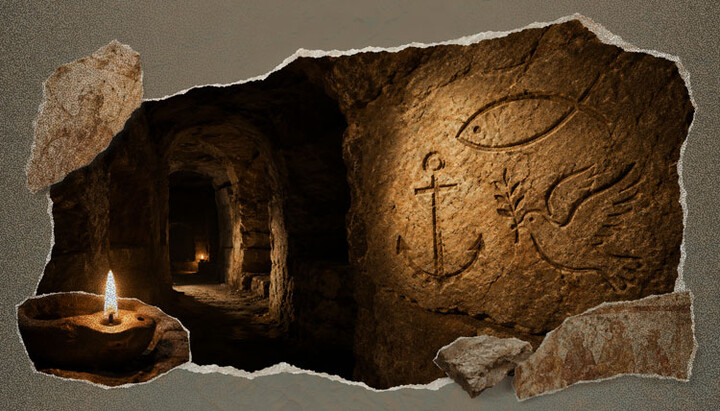
Christian symbolism in the catacombs. Photo: UOJ
The cross is constantly present in the everyday life of a Christian: we usually wear a baptismal cross around our necks, make the sign of the cross over ourselves, crosses crown the domes of churches, and a cross is placed in the “red corner” alongside icons in our homes, and so on. The cross protects us and shields us from the devil’s wickedness; liturgical services are dedicated to the cross; and fragments of the true Cross are regarded as among the greatest Christian relics. The cross is depicted on national flags and coats of arms, and sometimes even on tanks, aircraft, and other weapons.
But let us look at how the first Christians regarded the Cross of Christ itself and its visual representation.
The paradox of victory through defeat
Even before His crucifixion, Christ spoke of the cross: “And He said to all, ‘If anyone desires to come after Me, let him deny himself, and take up his cross daily, and follow Me’” (Luke 9:23). In the Roman world, taking up a cross meant accepting the fate of a condemned person. Therefore, Christ speaks here above all of self-denial and the willingness to follow Him even unto suffering and death. Bearing the cross did not mean victory in war, the triumph of any state, or protecting oneself from all hardships and troubles. Quite the opposite – it meant humbly accepting those hardships, disgrace, and defeat in the worldly sense of the word.
The theme of the Cross appears in many books of the New Testament, but the Apostle Paul presents it most systematically: “For Christ did not send me to baptize, but to preach the gospel, not with wisdom of words, lest the cross of Christ should be made of no effect. For the message of the cross is foolishness to those who are perishing, but to us who are being saved it is the power of God” (1 Corinthians 1:17–18).
Power in what? In superiority, in rising above others, in the ability to impose one’s will? No, quite the opposite. Power lies in humility, self-denial, and obedience to God.
To this the followers of Christ were called: "And they that are Christ's have crucified the flesh with the affections and lusts" (Gal. 5:24); this was the boast of the Apostle Paul: "But God forbid that I should glory, save in the cross of our Lord Jesus Christ, by whom the world is crucified unto me, and I unto the world" (Gal. 6:14).
Our salvation was accomplished on the Cross: "...Blotting out the handwriting of ordinances that was against us, which was contrary to us, and took it out of the way, nailing it to His cross; and having spoiled principalities and powers, He made a show of them openly, triumphing over them in it" (Col. 2:14–15). Here the Apostle deliberately used the Greek verb θριαμβεύω — "to lead in triumph," "to triumph over the vanquished" — that is, he employed familiar images of military victory. The Cross is a victory, but a victory over what or whom?
By no means over earthly states, principalities, and powers does Christ triumph, "for we wrestle not against flesh and blood, but against principalities, against powers, against the rulers of the darkness of this world, against spiritual wickedness in high places" (Eph. 6:12).
In the Epistle to the Hebrews we see the same logic, although the word "cross" is not used in this passage: "...that through death He might destroy him that had the power of death, that is, the devil; and deliver them who through fear of death were all their lifetime subject to bondage" (Heb. 2:14–15).
This is a formula for existential victory over death through one’s own death, rather than through military or political victory.
Christ conquers the one who holds "the power of death" not by slaying the adversary, but by passing through death Himself. Christ "humbled Himself, and became obedient unto death, even the death of the cross" (Phil. 2:8).
Victory over death through earthly defeat, exaltation to Heaven through a shameful death on the cross. "...Jesus, who for the joy that was set before Him endured the cross, despising the shame, and is set down at the right hand of the throne of God" (Heb. 12:2).
The Cross was from the very beginning one of the central themes of Christian preaching in the early centuries, which cannot be said of the cross as a visual symbol. As the central element of Christian symbolism, the cross came into use only from the mid-fourth century.
The richness of early Christian symbolism
The symbolism of Christians in the first three centuries corresponded to the Gospel and other texts of the New Testament. It was considerably more diverse than the later culture centered on the cross. On tombstones, seals, and the walls of catacombs one could find a fish, a dove, a ship, an anchor, loaves of bread, a praying figure, the prophet Jonah, and the Good Shepherd.
Around the year 200, Clement of Alexandria advised Christians to choose for their personal seals "a dove, a fish, a ship running before the wind, a lyre, or a ship's anchor."
It is noteworthy that in this list Clement does not mention the cross. This does not mean that the image of the cross was unknown to Christians of that time. However, it shows that the cross was not among the images that Clement deemed it necessary to recommend to a Christian.
Another telling point in the writings of Clement: he wrote that a Christian should not depict "a sword or a bow, since we follow peace." That is, Christian symbolism was emphatically peaceable, and pastors were quite scrupulous about not depicting symbols that might be interpreted in the context of earthly power, violence, or anything of the kind.
One of the oldest and most widespread Christian symbols was the fish. It recalled the Gospel miracles, Baptism, and the Eucharistic meal. The Greek word ΙΧΘΥΣ was understood as a confession of faith: "Jesus Christ, Son of God, Saviour."
Another ancient symbol was the anchor. It expressed hope, which, as the Apostle Paul writes in the Epistle to the Hebrews, is for the soul "as an anchor of the soul, both sure and steadfast" (Heb. 6:19). On Christian monuments these images were often combined: the fish pointed to Christ, the anchor to saving hope.
One of the most widespread images was the Good Shepherd. This image was known even from pre-Christian times, but in Christianity it became a depiction of Christ saving mankind and leading it to eternal life. "I am the good shepherd: the good shepherd giveth his life for the sheep" (Jn. 10:11).
The earliest evidence of the cross sign
The image of the cross was, of course, also known to the ancient Christians. Tertullian, writing at the beginning of the third century, noted that believers mark their foreheads with the cross at every step when entering and leaving, dressing, washing, sitting down to eat, and beginning their ordinary activities. It should be emphasized that Tertullian bears witness to the gesture of making the sign of the cross, rather than to the widespread use of the cross as an independent visual symbol.
The earliest surviving graphic reference to the Crucifixion is considered to be the staurogram – a combination of the Greek letters "tau" and "rho." It appears in papyri from the late 2nd to the first half of the 3rd century in the abbreviated writing of the word σταυρόν ("cross") in Lk. 14:27.
This staurogram is considered by many scholars to be the earliest surviving visual reference to the Crucifixion of Christ. But it is part of a text, not an independent graphic symbol, and still less a visual object of veneration.
The study of Christian symbolism in the first centuries is complicated by the fact that the dating of the earliest images is often disputed. Researchers are particularly cautious about attempts to date Christian images to before AD 200.
The meaning of the cross victory for the faithful
Does this mean that Christians of the early centuries did not use the visual image of the cross as a symbol? The sources available to us do not allow for a definitive answer to this question. But we can say with reasonable certainty what the Cross of Christ meant to them.
The Cross signified the shameful death that Christ voluntarily accepted "for our salvation", extreme humility, obedience to God, patient endurance of sorrows, sacrifice for a neighbor, death to sin, faithfulness amid persecution, and hope in the resurrection.
At the same time, early Christians already spoke of the Cross as a victory, using military terminology familiar to people of that era. But it was a paradoxical victory: Christ conquers not an earthly adversary, but sin, death, and the spiritual forces of evil. And He conquers them by doing nothing other than accepting death Himself.
But at the beginning of the fourth century, this symbol became involved in an entirely different context. The cross, or a Christian monogram closely associated with it, was meant not only to remind people of Christ’s sacrifice, but also to promise one emperor a military victory over another in a civil war.
More on this in our next publication.
Read also
Trial of a dead pope
Once in Rome, the body of a deceased pope was seated on the throne and put on trial. The accusation relied on a church canon that had once saved his see.
Monastery built in defiance of king
When Orthodox believers in Minsk were left with just one church, townspeople decided to build another – and even a royal decree did not stop them.
Young Mother and Sleeping Christ
Michelangelo carved a Virgin Mary who looks younger than her Son – and signed his name in marble for the only time in his life. Neither of these peculiarities was accidental.
Orthodox books from a Uniate printing press
In the 18th century, Uniate monks at Pochaiv printed books used in prayer by Orthodox Christians and Old Believers alike.
The story of the honey brotherhood
The Mogilev Brotherhood began with members pooling money to brew honey drinks for feast days – and eventually grew to have its own printing press.
Golgotha in the midst of a pogrom
In the autumn of 1938, the Jewish artist Marc Chagall painted the crucified Christ. Synagogues burn and refugees flee around the cross, while the Crucified One Himself is wrapped in a prayer shawl.