Archaeologists reconstruct landscape around Holy Sepulchre in Jerusalem
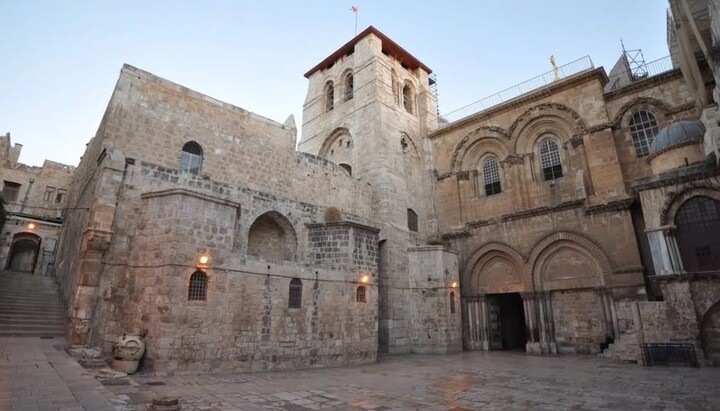
Church of the Holy Sepulchre. Photo: Jerusalem Institute for Strategy and Security
A team of archaeologists led by Sapienza University of Rome has reconstructed the ancient landscape around the Church of the Holy Sepulchre in Jerusalem, Basilica.ro reports.
The present-day church was built over part of an ancient quarry on Gareb Hill. After stone extraction ceased, some areas were used for agriculture and others for burials. Researchers found traces of plots enclosed by low walls, into which soil had been deliberately brought for growing plants. Analysis revealed remains of figs, grapes, and cereals, as well as evidence of grapevines and olive trees. According to the Sapienza team, this is “the first archaeobotanical study in Jerusalem to cover such an extensive chronological period – from the middle of the Iron Age to modern times.”
The researchers also confirmed that the area was used for burials: tombs were cut into the rock exposed by quarrying at a time when the site lay outside Jerusalem’s city limits. This configuration corresponds with the Gospel of John’s description of the place of the Savior’s Crucifixion and burial as being near a garden.
Excavation director Francesca Romana Stasolla said the team had found “evidence of a funerary landscape alongside small plots planted with grapevines and olive trees.” The findings do not make it possible to archaeologically identify the traditional tomb as Christ’s burial place, but they do show that the landscape features described in the Gospel – cultivated land and rock-cut tombs outside the city – did in fact exist in this part of Jerusalem.
The Sapienza study now covers nearly half the area of the present-day basilica. In addition to plant remains, specialists are analyzing wood, charcoal, and pollen to reconstruct how Jerusalem’s vegetation changed and how people used natural resources over the centuries. The landscape underwent a radical transformation in the fourth century, when construction of the Church of the Holy Sepulchre began at the initiative of St. Constantine the Great, Equal-to-the-Apostles. Archaeologists have also uncovered a large circular marble structure associated with an early phase of the shrine’s development.
As the UOJ reported, scientists in Jerusalem uncovered new evidence related to the burial of Christ.
Read also
Persecuted Intercession parish celebrates patronal feast in Hostomel
Archbishop Spyridon of Dobropillia and Bishop Arkadiy of Hostomel celebrated the Liturgy in adapted premises for the feast of the Intercession of the Most Holy Theotokos.
Stefanchuk discusses Pope's visit to Ukraine with Vatican Secretary of State
Ruslan Stefanchuk said the Pope's arrival would be a powerful sign of spiritual support and solidarity for Ukraine.
Khmelnytskyi Eparchy holds motorcade procession on Feast of Protection
During the motorcade procession, Metropolitan Victor blessed the roadside crosses at the entrances to Khmelnytskyi with holy water.
UOC hierarchs lead patronal feast at Intercession Monastery in Molodiia
Metropolitan Meletiy of Chernivtsi and Bukovyna led the festive Liturgy at the Intercession Convent in the village of Molodiia.
DESS declares UOC Zaporizhzhia Eparchy affiliated with ROC
The Zaporizhzhia Eparchy has become the fourth UOC religious organization to be declared affiliated with the Russian Orthodox Church by Ukrainian authorities.
Metropolitan Onuphry leads patronal feast at Kyiv’s Intercession Monastery
The UOC Primate ordained a priest and a deacon at St. Nicholas Cathedral of the Intercession Monastery.