The battle for power under the banner of heaven
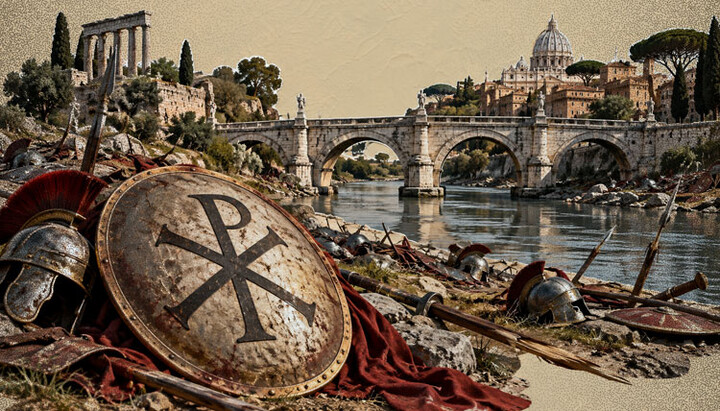
Christogram on Roman shields. Photo: UOJ
As a result of that war, the Cross became a symbol of earthly power, and Christianity eventually became the state religion. Yet neither the war itself nor its consequences were quite what we have grown accustomed to thinking.
In the familiar Church-historical account, the story goes something like this. In the fall of 312, Emperor Constantine marched on Rome against his rival, the usurper Maxentius. On the eve of the decisive Battle of the Milvian Bridge, he received a sign from above: he saw a cross and was promised victory – “In this sign, conquer.” Constantine ordered the Christian symbol to be placed on his military standards and his soldiers’ shields, and he defeated Maxentius.
A pagan emperor turns to Christ, goes into battle under His sign, and emerges victorious. Soon afterward, the Church gains freedom and state support and recovers its confiscated property. The Cross, only recently an instrument of shameful execution, begins to appear alongside symbols of imperial power.
But a closer look at these events reveals a somewhat different picture.
A tangled struggle for power
At the beginning of the fourth century, the Roman Empire was governed under the system of the Tetrarchy established by Diocletian: rule over the single empire was divided among four rulers. Two held the senior title of Augustus, while the other two held the junior title of Caesar. Broadly speaking, they formed eastern and western pairs. When an Augustus died, the corresponding Caesar was to take his place, while a new Caesar was appointed to fill the vacancy – and that person did not necessarily have to be a son or relative. According to one interpretation, this was precisely Diocletian’s intention: to eliminate the dynastic principle of succession.
In 305, the eastern Augustus Diocletian and the western Augustus Maximian abdicated simultaneously and transferred power to their respective Caesars, Galerius and Constantius Chlorus. New Caesars were appointed at the same time: Severus in the West and Maximinus Daia in the East. Constantius Chlorus’ son Constantine and Maximian’s son Maxentius, despite belonging to imperial families, were left outside the new ruling college. They were deliberately passed over.
The death of Constantius Chlorus in July 306 triggered a crisis in the Tetrarchic system created by Diocletian.
Under the established order, Severus should have become Augustus. Instead, the troops formerly under Constantius Chlorus proclaimed Constantine Augustus that same month. A little later, in October 306, the Roman garrison and part of the capital’s population proclaimed Maxentius Augustus, although he initially assumed the title of princeps and only later styled himself Augustus. Thus, at this stage both Constantine and Maxentius came to power outside the legitimate succession and were, in essence, both usurpers.
Their status subsequently changed. Constantine was recognized as Caesar and allowed to govern his father’s territories – primarily Britain, Gaul, and Spain – while Maxentius remained unrecognized. Moreover, Severus, now Augustus, went to war against him but was defeated and killed.
Meanwhile, Constantine entered into a political and dynastic alliance with Maxentius’ camp. In 307, Maxentius’ father, the former Augustus Maximian, recognized Constantine as Augustus and gave him his daughter Fausta – Maxentius’ own sister – in marriage. The future enemies thus became relatives. The alliance did not last long, however, and after a series of political upheavals, by 312 Constantine and Maxentius were enemies leading their armies against one another in a struggle for power.
Church tradition tells us that even before 312 Constantine pursued a policy of tolerance toward Christians. And this is indeed true.
His father, Constantius Chlorus, had already enforced Diocletian’s orders to persecute Christians rather halfheartedly. Church buildings were destroyed in his territories, but harsher measures – systematic mass coercion into offering sacrifices and executions – were not pursued. Constantine put an end even to these measures and returned confiscated property to Christians.
The problem is that Maxentius did much the same thing. After coming to power, he ordered an end to the persecution of Christians in Italy and Africa, permitted Christian worship, and later also began returning confiscated property to the Church.
It is true that under Maxentius the bishops of Rome Marcellus I and his successor Eusebius were sent into exile. But this was not the result of persecution of Christians. Rather, it stemmed from fierce clashes within the Roman Christian community over whether those who had fallen away during the persecutions should be readmitted to the Church. The conflict escalated into street violence, and in an effort to restore order in the capital, Maxentius first exiled Marcellus. When the unrest continued, he sent the leaders of both factions – Eusebius and Heraclius – into exile.
The familiar formula of “Constantine, defender of Christians, versus Maxentius, persecutor of Christians” therefore does not correspond to reality. By 312, both rulers were pursuing policies of religious tolerance. Their confrontation was not a battle between Christianity and paganism but a Roman civil war between two rivals competing for power in the West.
The testimony of the earliest witnesses
It should be said at the outset: the story that Constantine saw a cross in the sky before the battle and heard the words “In this sign, conquer” is not confirmed by any document contemporary with the battle itself.
The earliest account comes from the Christian writer and apologist Lactantius, writing approximately several years after the events. His version contains no cross in the sky, no inscription, and no vision witnessed by the entire army. He says only that Constantine had a dream in which he was instructed to mark his soldiers’ shields with the “heavenly sign of God.”
It was unquestionably a Christian symbol, since Lactantius goes on to say that Constantine “marked Christ on their shields,” but precisely what the sign looked like is difficult to determine. Lactantius describes it as a modified letter X with its upper part bent over. Scholars reconstruct it either as a Chi-Rho ☧ or as a symbol resembling the staurogram – but not as the familiar four-armed cross. This was entirely consistent with Christian symbolism of the period.
No artifacts are currently known that can be identified as depictions of Constantine’s shields from 312. There is, however, a coin minted in 322–323, just ten years after the battle. It depicts Constantine’s son Crispus holding a shield bearing a Christogram.
Another source describing events before the battle with Maxentius is Eusebius of Caesarea’s Ecclesiastical History, written not long after Constantine’s victory. Eusebius recounts the campaign against Maxentius, Constantine’s prayer, and divine assistance, but says nothing about a cross above the sun, an appearance of Christ, or symbols placed on the shields. This is particularly significant because Eusebius was a bishop and Church historian who was very close to Constantine.
There are two other sources containing information about these events. One is a panegyric to Constantine delivered by an unknown orator in Trier in 313 – a source almost contemporary with the events themselves. It describes Constantine’s campaign in considerable detail and speaks of an extraordinary divine impulse that moved Constantine to undertake it, but it mentions neither Christ, the Cross, nor the Christogram. Indeed, the panegyric contains no Christian interpretation of the events at all.
The second source is a panegyric by the orator Nazarius from 321. Written nine years after the battle, it too gives a detailed account of Constantine’s Italian campaign. Yet it tells an entirely different story: an army from heaven was supposedly seen in Gaul marching to Constantine’s aid. The heavenly warriors were said to proclaim: “We are going to Constantine; we are going to Constantine’s aid.” Here again, there is no mention of Christ, the Cross, or any Christian symbol.
As is well known, history is written by the victors. And victors generally want their triumph portrayed not merely as a military victory, but as the triumph of legitimacy over tyranny and, in religious terms, as the victory of the true God over His enemy.
And so, in 337, after Constantine’s death, Eusebius wrote his panegyric to the late emperor, Life of Constantine, in which he substantially expanded the account of the Battle of the Milvian Bridge. Now the emperor is said to have seen in broad daylight, above the sun, “a trophy of the cross composed of light,” accompanied by the words “By this, conquer,” with the entire army witnessing the miracle. That night, Christ supposedly appeared to him and commanded him to make a likeness of the sign he had seen. And anticipating the obvious question – “Why did you not write about this earlier in your Ecclesiastical History?” – Eusebius offers an ironclad explanation: he heard the story from Constantine himself “a long time afterward.”
The familiar pattern of heavenly aid
We have no grounds simply to dismiss Church tradition or the testimony of ancient authors concerning the signs said to have accompanied Constantine’s victory. But neither can we ignore the fact that the motif of “heavenly powers aiding the victor” appears in a great many historical traditions. It is characteristic of very different cultures and periods: victory is explained as the result of assistance from God, gods, heroes, or heavenly powers. Such accounts are frequently accompanied by signs, visions, and miracles.
Here are several examples.
- Pharaoh Ramesses II against Muwatalli II, Battle of Kadesh, 13th century BC. The Egyptian version of the battle tells how Ramesses, surrounded by enemies, prays to Amun, who hears his prayer and replies: “Forward! I am with you; I am your father; My hand is with you.” The pharaoh crushes his enemies, and the Poem of Kadesh subsequently describes the role of Amun-Ra in the battle. Yet the actual outcome of the battle was far less clear-cut, with both sides claiming victory.
- Themistocles, Eurybiades, and others against Xerxes, Battle of Salamis, 480 BC. Herodotus relates that an earthquake occurred before the battle, after which the Greeks prayed to the gods and invoked the Aeacid heroes as allies. In another episode, he recounts the story of an Athenian named Dicaeus, who supposedly saw a huge cloud of dust and heard a mysterious voice coming from Eleusis. This was interpreted as a divine power coming to the aid of the Athenians and their allies. After their victory, the Greeks publicly thanked the gods by making dedications at their sanctuaries.
- Octavian Augustus against Mark Antony, Battle of Actium, 31 BC. This historical episode offers a particularly interesting parallel, both in the ideological reinterpretation of events and in the signs associated with the battle, as well as in the way the story accumulated new details over time.
It was a typical civil war between two leaders, each supported by part of the Roman army and part of the Senate. But Octavian managed to portray it not as an internal Roman conflict but as a confrontation between Rome and Egypt, formally declaring war not on Mark Antony but on Cleopatra. The war subsequently acquired a religious dimension as well: the Roman pagan gods were portrayed as fighting on Augustus’ side against the gods of Egypt.
Several years after the battle, Virgil described it in Book VIII of the Aeneid. He writes that Apollo looks down upon the battle, then draws his bow, causing Octavian’s enemies to flee. Around 16 BC, another poet, Propertius, embellished the story further. An extraordinary flame like lightning supposedly appeared above Augustus’ ship, while Apollo himself appeared over the vessel, addressed Augustus, and promised the support of his bow. Over the following centuries, various authors added descriptions of an entire series of signs, omens, and miracles said to have foretold Augustus’ victory.
After his triumph, Octavian significantly strengthened the cult of Apollo: he expanded Apollo’s sanctuary at Actium, dedicated trophies there, revived the Actian Games, and so on.
- Aurelian against Zenobia, Battle of Emesa, 272. This took place only 40 years before the Battle of the Milvian Bridge. The late Roman collection of imperial biographies known as the Historia Augusta contains an account in which Aurelian’s troops begin to retreat, only for a mysterious divine figure suddenly to appear and rally the army. After his victory, Aurelian enters a temple in Emesa and recognizes there the very deity that had helped him in battle.
In the post-Constantinian era, the motif of religion as a factor in military victory continued to flourish, except that Christian heavenly powers now took the place of pagan gods in the corresponding narratives. Here are several more examples.
- Theodosius against Eugenius, Battle of the Frigidus, 394. This too was a typical civil war for power following the death of the western emperor Valentinian II in 392. Theodosius was a committed Nicene Christian. Eugenius was also a Christian, although politically he relied in part on influential pagans. Their armies were religiously mixed: Christians fought on both sides – in other words, Christians killed one another – while Theodosius’ forces also included pagans and Christians of other persuasions.
Immediately after Theodosius’ victory, Ambrose of Milan wrote a series of letters linking the triumph to Theodosius’ faith and to special divine assistance. He speaks of “divine aid in battle ...> through ancient miracles” like those God had performed for Moses, Joshua, Samuel, and David. But he does not specify what those miracles were.
Then, around 396, the court poet Claudian offered an even more vivid description: a north wind crashes into Eugenius’ troops and drives their own weapons back against them. Addressing Theodosius’ son Honorius, he writes: “O, how beloved you are by God! For you Aeolus unleashes armed storms from his caves; heaven itself fights for you, and allied winds answer the call of the battle trumpets.” But there is an important nuance here: Claudian was not a Christian, and he was speaking not of the Christian God but of Aeolus, the pagan ruler of the winds.
Ambrose continued to develop the theme of divine assistance. In his writings there also appears a sudden wind that tears away shields and drives weapons back against the enemy army – now, of course, interpreted in Christian terms. Theodosius is portrayed as a man who trusts in the Lord, while his opponents are called “unbelievers and sacrilegious men.”
Later, still more details emerged. Around 402–403, Rufinus of Aquileia, in his continuation of Ecclesiastical History, describes Theodosius seeing his forces being defeated, throwing down his weapons, climbing to an elevated place, and praying: “You, Almighty God... in the name of Christ, Your Son...” At that moment, the same powerful wind rises and turns the enemy’s weapons back against them.
And later still, through the efforts of various Christian authors, the Battle of the Frigidus was transformed from a civil war into the final battle between Christianity and paganism.
But when Roman emperors suffered defeats – at the hands of Zoroastrians, for example – pagan traditions likewise attributed victory to pagan “higher powers.” Thus, the Zoroastrian epic Fravardin Yasht says that when a ruler finds himself surrounded by enemies, he calls upon the fravashis – mighty benevolent spirits – who descend from above and help him prevail.
After his major victories over Rome, Shapur I of the Sasanian dynasty left his famous inscription on the Ka'ba-ye Zartosht at Naqsh-e Rostam. In it, he writes that the gods made him their “instrument” and that it was “with the help of the gods” that he acquired and retained the peoples under his rule. In the Christian era, the Persians likewise repeatedly defeated the Christian Byzantine Empire.
The political benefits of a sacred victory
For a victor, winning is not enough. He must also explain to his contemporaries and to posterity why he won. And he must create an appealing image of himself. After all, “I killed my fellow citizens in a civil war because I wanted power” does not sound particularly noble. “I fought for the true faith against wicked sacrilegious men” sounds considerably better.
And one of the most powerful explanations for victory has always been the same: “God was with us.” Military victory thus becomes proof that one was in the right, while the victor receives a kind of “heavenly legitimation” of his authority. But if Egyptians, Greeks, Romans, Christians, Zoroastrians, and others all explained their victories in much the same way, an unavoidable question arises: Is God really always on the side of the victor – or does the victor all too often put God on his own side?
To repeat: we have no grounds to dismiss Church tradition concerning Constantine’s victory. But it is worth asking whether that victory changed the emperor’s policies, the conduct of the empire’s rulers, or the laws by which the empire lived. We will examine this – along with how the symbol of the Cross was used in the Roman Empire after 312 – in the next article.
Read also
Trial of a dead pope
Once in Rome, the body of a deceased pope was seated on the throne and put on trial. The accusation relied on a church canon that had once saved his see.
Monastery built in defiance of king
When Orthodox believers in Minsk were left with just one church, townspeople decided to build another – and even a royal decree did not stop them.
Young Mother and Sleeping Christ
Michelangelo carved a Virgin Mary who looks younger than her Son – and signed his name in marble for the only time in his life. Neither of these peculiarities was accidental.
Orthodox books from a Uniate printing press
In the 18th century, Uniate monks at Pochaiv printed books used in prayer by Orthodox Christians and Old Believers alike.
The story of the honey brotherhood
The Mogilev Brotherhood began with members pooling money to brew honey drinks for feast days – and eventually grew to have its own printing press.
Golgotha in the midst of a pogrom
In the autumn of 1938, the Jewish artist Marc Chagall painted the crucified Christ. Synagogues burn and refugees flee around the cross, while the Crucified One Himself is wrapped in a prayer shawl.