A conversation with a great theologian about doubt
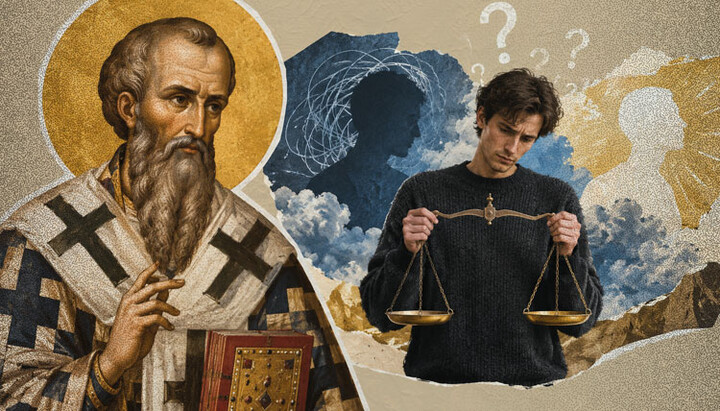
The scales of doubt. Photo: UOJ
There are times when the task before us seems overwhelming, and our own strength painfully inadequate. Thoughts begin to creep in: I’ll make a mistake. I’m not ready. I don’t know how. I’ll only ruin everything.
In the Christian life, this anxiety can become even more acute. We imagine that the true ascetics were always spiritual giants – people whose hands never trembled and whose hearts never tightened with fear. But Church history tells a different story.
Let us read closely the lines of the Apologetic Oration/In Defense of His Flight to Pontus and, across the centuries, put our questions to its author. Through the distance of time emerges the image of a deeply sensitive, vulnerable and uncompromisingly honest man. This is St. Gregory the Theologian. And so we begin another conversation with him.
Flight from ministry into the forests of Pontus
– Tell us, Your Grace, what is it like to suddenly feel the cross of the priesthood placed on your shoulders when you are completely unprepared for it?
The archpastor looks at us with the gentle sadness of a man who has endured a profound inner crisis. The events in Nazianzus still echo in his memory with sharp pain. His elderly father, Bishop Gregory the Elder of Nazianzus, ordained his son to the priesthood against his will.
– “I was especially overwhelmed by the suddenness of it, like a man struck by an unexpected thunderclap. I could not collect my thoughts, and so I departed from the restraint in which I had trained myself all my life,” the voice of the great teacher of the Church reaches us across the centuries.
In later poems, the saint would call his father’s decision “tyranny,” yet in his address to his flock he used a remarkable phrase – “benevolent tyranny.” The tension between the two is striking. But do we not experience something similar when God’s Providence tears us away from our familiar comfort and calls us to serve others – whether at the altar or in an ordinary workplace?
After ordination, young monks would normally throw themselves zealously into ministry. St. Gregory did something that might look like desertion instead. He abandoned everything and fled into the remote forests of Pontus to his friend St. Basil the Great.
– Why did you run away, Gregory? Did you not believe that the Lord would help you carry the cross of pastoral ministry?
“It was my timidity,” the saint answers candidly. “I confess that I was too weak for such a struggle, and so I turned my back and hid my face in flight.”
He makes no attempt to present himself as a great ascetic. The bishop openly calls his behavior weakness and fear. He was ashamed of those who pushed their way into the priesthood with unclean souls simply to secure a piece of bread.
The art of guiding the human soul
Listening to these candid admissions, we realize how accustomed we are to hiding our own doubts behind a mask of outward piety. Yet this great theologian is not afraid to call himself weak.
– But pastoral ministry means caring for people. It is God’s work. Why were you so afraid?
“I did not think then, and I do not think now, that tending a flock of sheep or cattle is the same thing as governing human souls... For to govern man, the most cunning and changeable of creatures, is, in my view, truly the art of arts and the science of sciences,” the archpastor says.
St. Gregory describes the foundation of spiritual ministry: first one must be purified oneself, and only then purify others; first become wise, and only then impart wisdom; first become light, and only then enlighten others. If you have no spiritual stability yourself, how can you lead anyone else?
There in the wilderness, the saint sought in Holy Scripture an explanation for his flight. He recalled the ancient prophets and found a striking parallel:
– “Jonah too fled from the presence of God – or rather, thought he could flee – but he was stopped by the sea, the storm, the casting of lots, the belly of the whale and his three-day burial,” the Church teacher reminds us.
Each of us has our own Pontus and our own belly of the whale where we try to hide from the Creator’s call. But flight from God always ends the same way – He finds us through circumstances and returns us to the path we tried to leave.
The right to doubt before the Creator
– Tell us, Your Grace, is doubt always a sin? Must a Christian always be confident in himself?
St. Gregory stops us and invites us to look at the pages of the Old Testament from a different angle.
– “Of all those whom grace ever chose for the office of leader or prophet, some readily followed the call, while others hesitated to accept the gift; yet neither were condemned for their response,” the saint says. “Aaron showed readiness, while Moses resisted. Isaiah obeyed willingly, while Jeremiah feared because of his youth.”
These words offer us consolation. God does not stamp people out according to a single mold. One person is immediately ready to serve; another resists for a long time and weeps, feeling utterly unfit. And the Creator condemns neither.
For himself, St. Gregory found a middle way:
“For a long time I wrestled with my thoughts, trying to decide what to do. I was more fearful than those who seize every position of authority, and bolder than those who avoid all of them.”
There is remarkable pastoral wisdom in these words. Fear of responsibility can serve as a bridle on our pride. It is precisely through weak and doubting people that God accomplishes His greatest works. The Apostle Paul writes of the word he received from the Creator: “But He said to me, ‘My grace is sufficient for you, for My strength is made perfect in weakness’” (2 Cor. 12:9).
St. Gregory carried this sense of his own inadequacy throughout his life. In 372, after being consecrated Bishop of Sasima, he once again withdrew into solitude rather than fight for the see. And in 381, after helping restore Orthodoxy in Constantinople, he voluntarily left the Ecumenical Council, resigned the patriarchal throne and returned to his native Arianzus. His retreat was not an act of cowardice – it was the choice of a man for whom the silence of prayer always mattered more than earthly recognition.
Our conversation draws to a close. We look at the ascetic and ask him for one final word for each of us – for anyone who at this very moment feels crushed by a sense of inadequacy while staring at a heavy cross in life.
St. Gregory the Theologian smiles through his sadness and speaks the words with which he once concluded his address after returning from Pontus:
– “I will not resist, nor will I turn back. I bow and humble myself beneath the mighty hand of God, and ask forgiveness for my former hesitation and disobedience... I was silent, but I will not always remain silent. I withdrew for a little while, as long as was necessary to look at myself from the outside. I was overcome by doubt, and I acknowledge that victory over myself. ‘Submit yourself to the Lord and hope in Him’” (Ps. 36:7).
Read also
Honest atheism vs. spiritual hypocrisy
The 70th anniversary of Albert Camus’s Nobel Prize recalls an uncompromising challenge to Christianity. An honest unbeliever brings theology back to the mystery of the Cross.
The valley of trouble and the gateway of hope
One soldier buried an expensive cloak and some gold beneath his tent. Because of this, all Israel lost a battle. Why did one man’s sin bring disaster upon an entire nation?
From love spells to bishop's throne
Antioch’s most powerful sorcerer sent demons against a devout young Christian woman three times – and failed every time. In the end, a demon himself revealed the truth that led to his conversion.
The Weeping Queen of Blachernae
On the night of the Feast of the Protection, only two people witnessed the miracle in the Church of Blachernae. Everyone else prayed and saw nothing. Yet they, too, received grace.
Deadly spiral of human hatred
The tragedy of Lebanon's civil war lays bare how dehumanization and fear can turn human beings into monsters.
Woe to expectant mothers – or to those of little faith?
God commanded one prophet not to have children, yet told his people in exile to bear sons and daughters. What does this apparent contradiction tell us today?