The beheaded truth of a holy prophet
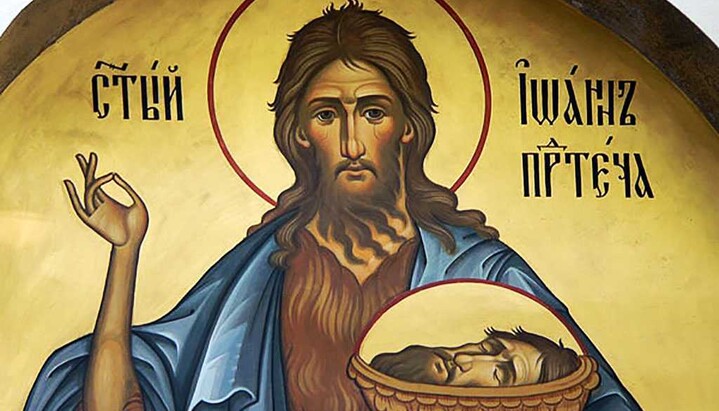
St. John the Forerunner. Photo: open sources
The Church calendar contains many feasts, but the Beheading of St. John the Forerunner stands apart. It is a feast of the spirit’s victory over the flesh, of eternity over the temporal – the birth into Eternity of the last and greatest prophet of the Old Testament.
The Gospel preserves only fragments of his life – stark, concise, stripped of everything mundane and secondary. Yet those fragments are more than enough to reveal the unbreakable core of his character: an absolute and unequivocal rejection of evil.
No “perhaps we can work something out.” No “we need to understand the context of the times.” For the Forerunner, there was only one system of coordinates: on one side, the Law of God; on the other, the laws of the fallen world, locked in a constant, if often hidden, war against the Creator. John’s entire life, preaching, and martyrdom proclaim the total absence of diplomatic “channels of communication” between these two legal orders.
To live by one or the other inevitably determines a person’s eternal status. If God’s Law is your compass, you become His son. If you choose the laws of the world, you make yourself His enemy. After Christ, the apostles would draw this uncompromising dividing line just as clearly. “Friendship with the world is enmity with God” (James 4:4), the Apostle James would write. No one can serve two masters without beginning to betray one of them.
The lie disguised as love
John the Prophet took a position utterly out of step with his age. The subtlety and sophistication of Eastern diplomacy have always consisted in the art of greasing the “camel” so lavishly with verbal oil that it can somehow be squeezed through the narrow eye of any prohibition. It is a form of acrobatics: maneuvering so that the wolves are fed while the sheep remain devoutly convinced that they are safe.
But there was no room in John the Baptist’s logic of life for half-tones, gray areas, or carefully blurred formulas. His inner world was arranged with uncompromising clarity: either black or white; either yes or no.
And yet from the standpoint of ordinary worldly wisdom, he could easily have struck a deal. Herod Antipas did not merely tolerate the Prophet – he listened to him with a strange fascination, protected him from enemies, and even sincerely feared his spiritual power (Mark 6:20). So why did John refuse to act, as we might say today, “like a normal human being”? Why did he refuse to act “out of love”?
Yes, Leviticus contains a specific commandment forbidding a man to take his brother’s wife (Lev. 20:21). But how long ago was that written? And is it really appropriate to invoke ancient canons when the feelings of powerful people are involved?
By the standards of the fallen world, everything forbidden by God is quickly branded “unloving.” Our age knows this substitution all too well. When a priest or theologian today refuses to perform or bless what spiritual law directly forbids, secular society immediately accuses him of “coldness, lack of love, and basic compassion.” When the Church resists the normalization of moral deviations and sinful passions in public life, the world erupts in outrage: “That’s not Christian! They’re people too!”
But let us be clear: no one is stripping the sinner of human dignity. The real question is something else entirely – what human dignity actually consists in, and what it was meant to be according to the Creator’s design. True human dignity lies in restoring the Image of God, not in legitimizing one’s passions.
The illusion of a saving missionary compromise
Herod and Herodias were people too. And they had love. Passionate love, at that. Herod fell so madly in love that he was prepared to shed blood for it, wage war against the father of his lawful wife, and risk his throne. Between them there may well have flared the tenderest, sincerest, deepest emotions imaginable.
So why couldn’t John simply “show some understanding”?
All the more because the Forerunner’s authority was enormous. Herod feared him, but Herodias feared him even more. Had she not been seized by this near-panic terror before his truth, she would have asked the king for half his kingdom – not for a severed head on a platter. Her fear was profound, existential: as long as John was alive, her sin remained exposed to the light, and no luxury could bring her peace.
All John had to do was become “a little kinder,” “a little more merciful” – and everything would have changed overnight. The rulers’ fear would have turned into sincere reverence; hatred into awe. John’s authority among the people was so great that even after his martyrdom they continued to believe in his spiritual power. Herod imagined that Jesus was John risen from the dead (Mark 6:16), and many Jews thought the same (Matt. 16:14). And when the Savior asked the chief priests, “The baptism of John, whence was it? from heaven, or of men?” they were afraid to answer “of men,” because the people might simply stone them for insulting the Prophet (Matt. 21:23–26).
With that kind of authority and potential influence, John could have made a brilliant political and missionary move. All he had to do was condescend “to the weakness of two poor lovebirds” and deal with them “in a loving way,” and the Prophet would not merely have saved his life.
He could have become a wise royal advisor.
Imagine how many “good deeds” he might have accomplished for his people. He could have preached not in a harsh, sun-scorched wilderness on the Persian frontier, but at the very heart of the Jewish world – in the great Temple of Solomon. And from the summit of influence and power he could have proclaimed to everyone that Jesus of Nazareth was the long-awaited Christ.
Strange, isn’t it? Why did John reject such an astonishing opportunity to “serve God and people”?
The answer is both simple and profound: because he wanted to remain a son of God rather than become a slave of men.
More than anyone, he understood the metaphysical truth the apostles would later formulate: “We ought to obey God rather than men” (Acts 5:29). You cannot build the preaching of Truth on a foundation of lies and compromise with sin. It was for this uncompromising faithfulness that God Himself, having become Man, called John “the greatest among those born of women” (Matt. 11:11).
A living example of Christian courage
If John the Forerunner is called the greatest, then we are given the only true model for how to respond to the violation of any Divine Law in him. And that model is addressed first of all to those invested with rank, spiritual authority, or state power.
History gives us vivid examples of men who followed it. This is exactly what St. Philip, Metropolitan of Moscow, did when he openly rebuked Tzar John the Terrible’s bloody tyranny toward the Church – and received a martyr’s crown for it. Sadly, St. Philip has often proved more the exception than the rule in history.
Today’s Moscow hierarchs sing hymns of praise to Herod and are ready to justify any atrocity he commits. They have traded conscience, honor, and episcopal dignity for palaces, yachts, and bank accounts. Serving Herod has become the central meaning of their lives.
This is not even fear of the sword – no sword actually threatens them. No one is going to lead them before a firing squad. It is merely fear of losing comfort.
A pitiful, cowardly, petty, servile fear – worthy only of contempt, including Herod’s own.
Of course, the earthly Church is made up of all kinds of people. Yet within it there have always burned lamps of uncompromising faithfulness – men such as John Chrysostom, exiled from the capital for rebuking the empress, or Patriarch Tikhon, who stood unyielding against the godless regime.
St. Luke (Voino-Yasenetsky) was the same kind of man – a living “generator of hatred” toward himself. The Soviet authorities could not stand the fact that he refused to bend his back before them.
Such people shattered the comfortable logic of sin.
The stern judgment of unrepentant pride
The secular world likes to comfort itself with the illusion that God is an infinitely soft, unprincipled form of “universal forgiveness” that ultimately legitimizes whatever choice a person makes.
Scripture says otherwise.
Contrary to the rosy fantasies of this world, God will deal with unrepentant rebellion against Him with absolute severity.
One need only reread the Second Epistle of Peter and the Epistle of Jude. God “spared not the angels that sinned, but cast them down to hell, and delivered them into chains of darkness, to be reserved unto judgment.” He “spared not the old world” when He brought the flood upon the ungodly. He turned “the cities of Sodom and Gomorrah into ashes” and condemned them to destruction, “making them an example unto those that after should live ungodly.”
Nor will He spare those who, in their pride and spiritual arrogance, place their own passions, their own “love,” and their own laws above the Law of God.
For those who choose the comfortable compromise with evil, the end is the same: “There shall be weeping and gnashing of teeth” (Matt. 8:12).
And only those who, together with John the Forerunner, remain faithful to Truth to the end – unafraid to become “inconvenient” to this world – “shall shine forth as the sun in the kingdom of their Father” (Matt. 13:43).
Read also
Prayer commemorations instead of loving embraces
At every Orthodox wedding, the choir sings a hymn to the martyrs. For families separated by war, these words carry a special meaning.
Honest atheism vs. spiritual hypocrisy
The 70th anniversary of Albert Camus’s Nobel Prize recalls an uncompromising challenge to Christianity. An honest unbeliever brings theology back to the mystery of the Cross.
The valley of trouble and the gateway of hope
One soldier buried an expensive cloak and some gold beneath his tent. Because of this, all Israel lost a battle. Why did one man’s sin bring disaster upon an entire nation?
From love spells to bishop's throne
Antioch’s most powerful sorcerer sent demons against a devout young Christian woman three times – and failed every time. In the end, a demon himself revealed the truth that led to his conversion.
The Weeping Queen of Blachernae
On the night of the Feast of the Protection, only two people witnessed the miracle in the Church of Blachernae. Everyone else prayed and saw nothing. Yet they, too, received grace.
Deadly spiral of human hatred
The tragedy of Lebanon's civil war lays bare how dehumanization and fear can turn human beings into monsters.