Sentinel over the Syrian Desert
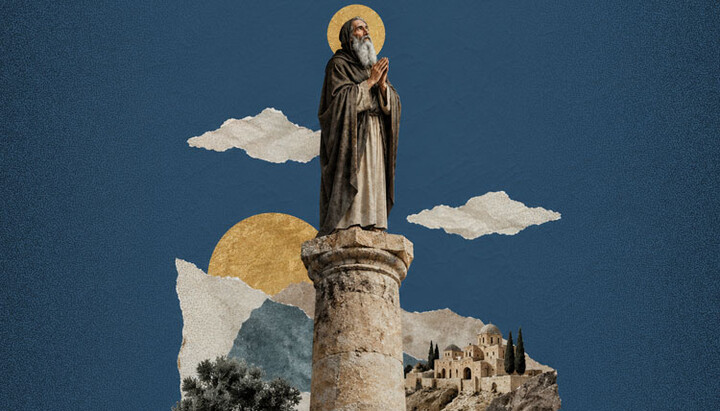
St. Simeon the Stylite. Photo: UOJ
Small clay images hung on the heavy doors of Roman workshops in the fifth century. Shoemakers and blacksmiths in the capital displayed these amulets to protect their homes. They depicted a bearded man standing atop a tall column. Even during his lifetime, the fame of this extraordinary ascetic spread from misty Britain to scorching Ethiopia. That man was St. Simeon the Stylite.
The Roman Empire had finally recognized Christianity as the state religion. Those who only recently had been persecuted confessors were now respected citizens. No one was required to shed blood in the circus arena anymore. An age of spiritual comfort had begun.
But true seekers of the Spirit withdrew into waterless deserts for a bloodless form of self-crucifixion. Their contemporaries called this new path “white martyrdom.”
Blood beneath the monastic robe
The extraordinary path of the ascetic Simeon began when, as a young shepherd from a poor family, he heard the Gospel Beatitudes read in a village church. The Savior’s words pierced his heart. He gave his share of the family inheritance to the poor and entered the Syrian monastery of Teleda.
At the age of eighteen, the young monk secretly wrapped a rough rope made of sharp palm fibers around his bare body. Ten days later, his flesh had begun to rot and worms swarmed in the open wounds. The abbot noticed blood on his monastic robe and ordered the cords, which had cut all the way to the bone, to be forcibly removed. They were torn away together with pieces of dead flesh.
After Simeon recovered, the abbot expelled the novice from the community. He feared for the other brothers, worried they might die trying to imitate such a radical ascetic feat. The young monk’s uncompromising zeal proved excessive even for seasoned monastics. Rejected, he quietly departed into the desert.
The saint settled in a dried-up cistern near a neighboring mountain. Five days later, the remorseful abbot sent a search party after him. The monks managed, with great difficulty, to pull the sufferer out.
After returning to the monastery, Simeon dug a deep pit in the garden and spent an entire summer there. Later, he found a round log and balanced on it at night in order to remain awake.
Under the supervision of his spiritual father — the priest Bassus — the ascetic observed a forty-day fast without water or food, emulating the Old Testament prophets.
Bassus would find him lying as if dead, moisten a sponge with life-giving water and give him Holy Communion, after which the ascetic would revive.
A tower above the sand
The saint did not stop there, but continued searching for new forms of self-denial. He chained his right leg to a huge stone with a long chain. But a traveling church official named Meletius told him that iron restraints were useless when an ascetic’s will was strong.
Simeon immediately accepted the rebuke and asked a village blacksmith to remove the chain. Beneath the iron, they reportedly found some twenty large worms.
In the end, the saint decided to ascend on high in order to find solitude from the crowds of pilgrims. He gradually increased the height of the stone platform upon which he stood in prayer. In his final decades, he stood at a dizzying height of forty cubits (approximately 18 meters).
Eventually, the saint decided to rise above the ground in order to escape the crowds of pilgrims. He gradually increased the height of the stone platform on which he stood in prayer. During the final decades of his life, he remained at the dizzying height of forty cubits – about 18 meters.
The physical consequences of such prolonged standing were horrifying. A festering wound formed on Simeon’s left leg and became infested with worms. When they fell to the ground, the saint would pick them up and put them back, saying, “Feed on what the Lord has given you.”
Three joints in his spine were completely dislocated from the extraordinary number of prostrations he made. One astonished observer tried to count them but gave up after Simeon had touched the ground 1,244 times.
Egyptian desert monks once decided to test the Syrian eccentric’s humility. They sent an official delegation demanding that he come down immediately. A proud man, they reasoned, would certainly resist such an order.
St. Simeon descended to the first rung of the wooden ladder without the slightest hesitation. Convinced of his obedience, the Egyptian fathers tearfully asked him to continue his unprecedented ascetic feat.
A gift that never reached its intended recipient
Unending crowds of suffering people came to the foot of Simeon’s tower. They brought him not only spiritual problems, but economic ones as well. The saint persuaded local moneylenders to reduce annual interest rates to six percent. Through his fiery preaching, many peasants were also granted complete relief from crushing taxes.
Pagans came to the saint in groups of two hundred, three hundred and even a thousand. Arabs smashed their idols at the foot of the column and were baptized on the spot.
The ascetic’s voice reached the highest levels of power. Surviving letters attest to his correspondence with leading figures of the Byzantine Empire. Emperor Theodosius II sought his prayers before the convening of a Church council. Empress Eudocia turned to him with difficult questions.
Yet Simeon used his spiritual authority solely for peacemaking and did not involve himself in political intrigue.
In the summer of 459, a powerful earthquake struck Antioch. Terrified residents rushed to their protector.
But the ascetic fell gravely ill and soon peacefully surrendered his soul to the Lord. His lifeless body remained standing on the pillar for another 20 days, becoming a living monument to his superhuman feat.
But the ascetic had fallen gravely ill and soon peacefully surrendered his soul to the Lord. His lifeless body reportedly remained standing atop the pillar for another twenty days, a final monument to the almost unbearable ascetic labor of his life.
Later, the saint’s relics were solemnly transferred to Antioch. Simeon’s disciple Sergius brought his teacher’s rough mantle to Constantinople as a precious gift for the emperor.
Emperor Leo I delayed granting him an audience. Unable to wait any longer, Sergius gave the worn garment to St. Daniel the Stylite instead. After receiving the sacred relic, Daniel himself ascended a pillar, carrying forward the tradition of stylitism.
The Syrian ascetic shattered forever the model of safe and comfortable piety toward which we so often gravitate, stepping heavenward for his long-awaited meeting with the Creator.
Read also
Brother of tax collector and brother of Lord
The Gospel is silent about the son of Alphaeus, and commentators have argued for centuries over who he was. And the Church commemorates two apostles named James in close proximity.
Prayer commemorations instead of loving embraces
At every Orthodox wedding, the choir sings a hymn to the martyrs. For families separated by war, these words carry a special meaning.
Honest atheism vs. spiritual hypocrisy
The 70th anniversary of Albert Camus’s Nobel Prize recalls an uncompromising challenge to Christianity. An honest unbeliever brings theology back to the mystery of the Cross.
The valley of trouble and the gateway of hope
One soldier buried an expensive cloak and some gold beneath his tent. Because of this, all Israel lost a battle. Why did one man’s sin bring disaster upon an entire nation?
From love spells to bishop's throne
Antioch’s most powerful sorcerer sent demons against a devout young Christian woman three times – and failed every time. In the end, a demon himself revealed the truth that led to his conversion.
The Weeping Queen of Blachernae
On the night of the Feast of the Protection, only two people witnessed the miracle in the Church of Blachernae. Everyone else prayed and saw nothing. Yet they, too, received grace.