The theologian's weariness with the capital's intrigues
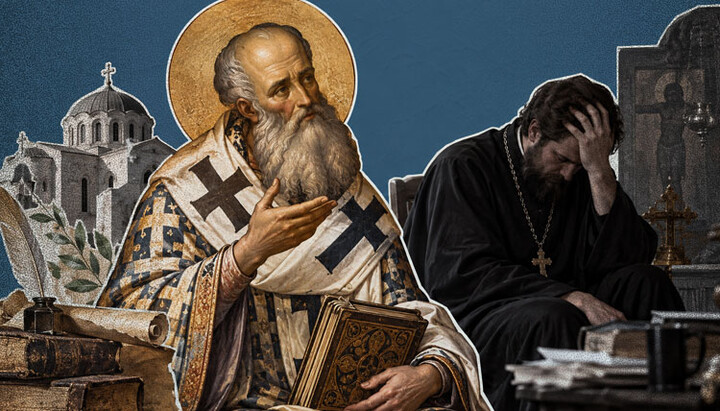
Pastoral burnout. Photo: UOJ
We often think of burnout as an affliction of our hectic age, brought on by deadlines and constant stress. We imagine that people of earlier centuries somehow possessed an ironclad defense against despondency. Especially when their work was for the Church, when they were defending the faith or carrying the lofty burden of episcopal ministry...
We look at icons, majestic churches and the writings of the Fathers – and picture unshakable heroes who never doubted, never wept at night from hurt and never wanted to abandon everything halfway through.
But open the pages of Church history, and there stands St. Gregory the Theologian – a man who desperately sought to escape human malice.
Hot debates about God
In the late 370s, the capital of the Byzantine Empire was at boiling point. St. Gregory of Nyssa remarked caustically that in the streets, marketplaces and crossroads, every former laborer had suddenly imagined himself a professor of theology, while servants who had escaped slavery lectured passersby on the incomprehensibility of the Divine essence. Everyone argued. Everyone denounced everyone else. And into this seething cauldron of ideological warfare came a frail man from the provinces to lead a tiny community.
All the city’s major churches were controlled by his opponents. Bishop Gregory had no cathedral with gilded domes. He began his ministry in an ordinary room in a relative’s villa, converted into a house church. He called this tiny sanctuary “Anastasia,” hoping that from here a crushed Orthodoxy would begin to rise again.
But his hopes were shattered within the first year. On Holy Saturday, a crowd of opponents burst into the church during the Sacrament of Baptism. Monks and enraged townspeople hurled stones at the bishop. He was marched through the streets to the local authorities like a criminal. The threat of physical violence hung over him every day.
A triumph like the capture of a city
Time passed. The situation changed, Emperor Theodosius sided with the Orthodox, and the day came when St. Gregory was solemnly escorted into the magnificent Hagia Sophia. The streets were filled with enormous crowds. Soldiers stood in rows, holding back the press of people.
How did the bishop himself describe this moment of triumph in his autobiographical poem? He compared the solemn procession to the capture of a city by an enemy. The crowd roared, and the streets resembled a besieged stronghold. Even at the height of his recognition, when the emperor personally handed him the keys to the immense cathedral, the pastor’s soul knew no peace. Everywhere there was commotion, tears and shouting. The air was so charged with tension that it seemed there would never be peace.
This inner strain reached its breaking point at the Second Ecumenical Council. Intrigue behind his back, the ambitions of delegates, constant accusations whispered behind the scenes and attempts to remove him from his see finally broke the great teacher of the Church.
In our mind’s eye, we approach him – exhausted, gaunt, stooped beneath the weight of the episcopal omophorion.
– Vladyka, we say, quietly approaching him during a break in the Council’s proceedings, couldn’t you have endured it for the sake of the common cause? The emperor is on your side, the people are rejoicing, and victory is behind you. Why abandon everything at the height of your glory?
The saint raises his weary eyes, filled with nothing but immeasurable pain.
– What glory? he replies. You think an episcopal throne is a consolation? I was brought here not to pray, but to be torn apart. Everyone around me speaks of the Trinity, yet in their eyes I see only a thirst for power. Every bishop pulls in his own direction, divides up sees and weaves intrigues. I came to save the faith from heresy and found myself caught in a web of human malice. Is this why Christ went to the Cross?
– But you were president of the Council... You could have put things in order.
– Order? the saint smiles bitterly. At the Council they accused me of violating ancient canons, as though I had arbitrarily transferred myself from one see to another. The same people who shouted “Hosanna” yesterday demand my expulsion today. I am tired of proving the obvious. I did not rejoice when I ascended the throne, and now I step down from it willingly.
“I bow to Councils from afar”
In June 381, Bishop Gregory delivered his farewell address before the Fathers of the Council. It is the speech of a man voluntarily laying down the heavy burden of authority. He told the assembled bishops that the question of his own position was secondary. He asked only one thing of them: to remember his humble labors for the sake of the Holy Trinity.
He left. He returned to his native Nazianzus and later withdrew to the quiet family estate at Arianzus. He no longer attended noisy Church gatherings.
In his letters to friends, he wrote a remarkable line: “I bow to councils and conferences from afar, since I have experienced much evil from them.” It was a deliberate setting of boundaries for the sake of self-preservation.
There, far from the clamor of the capital, amid silence and physical frailty, he wrote theological works and a detailed autobiography. His retreat from Church turmoil, it turns out, was not a defeat, but the only way for him to remain faithful to Christ without losing love along the way.
We are often afraid to admit to ourselves that we are tired of endless struggle. We think that leaving a position or walking away from an argument means showing weakness. But sometimes the highest form of wisdom is knowing when to withdraw to a place where we can finally hear the voice of God, no longer drowned out by the shouting of the crowd.
Read also
The bride in the window frame
The author of the earliest account of St. Thecla’s life was defrocked. Yet it was his book that preserved the only ancient description of the Apostle Paul’s appearance.
Drinking priest, or the flip side of parish life
In his epistle, the Apostle Jude describes a scene familiar to anyone who has seen a church meal turn into a drinking party.
A lesson from a speechless donkey
The famous seer struck his donkey three times for refusing to go forward. All the while, she was saving his life – and seeing what he could not.
The time when the soul ripens
Modern society has turned youth into a cult and old age into a period of merely “living out one’s days.” The Christian perspective reveals the profound spiritual meaning of our later years.
Faith is not a checker piece in a spectator sport
Arguments about faith on social media increasingly resemble no-holds-barred fights. We turn to a saint who, sixteen centuries ago, knew how to speak to those interested only in turning theology into a combat arena.
The metropolitan who fought with a pen
St. Cyprian of Kyiv was robbed, expelled, and barred from his see. He answered with letters, books, and canons – and before his death, forgave everyone.