Why does God remain silent in times of trial?
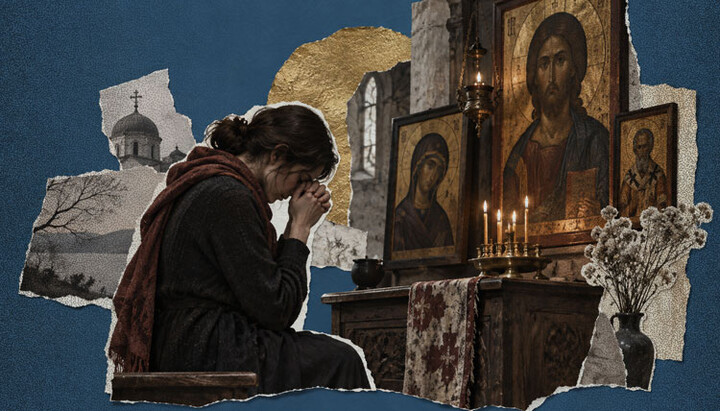
God’s silence. Photo: UOJ
Human life is filled with moments when our prayers to God seem to meet an impenetrable wall. A person prays for a sick child, for a husband’s safe return from the front, or for a son who is falling into a spiritual abyss. Days, weeks, and years pass. We light vigil lamps, read akathists, and pour our wounded souls into every petition. Yet nothing comes in response. Only the cold emptiness of a room and the oppressive silence.
At such moments, a sense of abandonment takes hold. It seems as though our words dissolve somewhere beneath the ceiling, never reaching the One to whom they are addressed. An unsettling thought begins to creep in: perhaps the Creator has turned away from human suffering.
Yet the Bible is full of accounts of people who spent years knocking on closed doors, their prayers seemingly unanswered. When we examine their experiences, a remarkable pattern emerges. The absence of a visible miracle does not mean that God is indifferent to our troubles. Rather, it signals the beginning of a different kind of dialogue with Him.
The thorn in the flesh and God’s refusal
The Apostle Paul also wrote in his epistles about prayers that do not receive the answers we seek. He suffered from a severe affliction, metaphorically described as a “thorn in the flesh.” The apostle did not immediately resign himself to the pain. He fell to his knees and fervently begged the Lord to bring his suffering to an end. Three times he pleaded for the same thing (2 Cor. 12:8).
Paul possessed colossal faith. He raised the dead, healed the lame, and preached throughout the empire. It would seem that healing himself would have been no great effort for him. Yet he was not granted this from above.
The Lord did not heal Paul of his illness. He gave him a different answer, one that completely overturned the original request: "My grace is sufficient for you, for my power is made perfect in weakness" (2 Cor. 12:9).
This marks a crucial turning point in the spiritual life. Paul asked to be relieved of his cross, but instead received the strength to carry it. His prayer was heard, though the answer came in a form entirely different from what the apostle had expected. God did not grant the literal request, but He fulfilled its deeper purpose, giving Paul something greater – a share in His divine strength through human weakness.
A gentle whisper instead of a mighty storm
The Prophet Elijah fled into the wilderness to escape the wrath of the king, utterly exhausted. He sat beneath a bush and prayed for death, weary of his struggle for the true faith. In despair, he ascended Mount Horeb, expecting the Creator to reveal Himself through mighty displays of the elements (1 Kings 19:11).
A violent wind tore the rocks apart, the earth shook beneath his feet, and fire consumed everything around him. Elijah searched these terrifying signs for God. But Scripture tells us that the Lord was not in the wind, not in the earthquake, and not in the fire (1 Kings 19:11–12).
God revealed His presence only when the elements had subsided. He came in the sound of a gentle, barely audible breeze (1 Kings 19:12).
People often expect God to act with a thunderous display of power, bringing radical change and intervening immediately in their troubles. It seems to us that the Creator’s love must manifest itself as a storm capable of sweeping away every obstacle. Yet God comes in a gentle breeze. He does not stage grand spectacles to strengthen human faith. His presence becomes apparent when the noise of the outside world falls silent and a person is left alone with his wounded conscience.
Two decades of a mother’s tears
St. Monica prayed for the spiritual conversion of her son Augustine for nearly two decades. The young man spent nine years in heresy, wandering down the dead ends of various philosophical paths, while his mother continued to bathe the stones of the churches she visited in her tears. In despair, she sought counsel from Bishop Ambrose of Milan. The holy bishop comforted the weeping woman with simple words: “It is impossible that the son of these tears should perish.”
Augustine was baptized many years later. In his famous Confessions, he would write that God had heard his mother’s prayers but had not answered them immediately, leading the entire family through a crucible of prolonged trials. Consolation came only when their human strength had been completely exhausted.
There is another example of extraordinary human perseverance. The Canaanite woman pleaded with Christ to heal her daughter, only to be met with what seemed like cold silence: “He answered her not a word” (Matt. 15:23). Metropolitan Anthony of Sourozh interpreted this divine delay as a test of the foreign woman’s faith, behind which lay divine love.
Christ Himself on the cross utters the words of the psalm: "My God, My God, why have You forsaken Me?" (Matt. 27:46).
Even the Only-Begotten Son was not spared the experience of abandonment by God.
If Christ, in His human nature, passed through the experience of Heaven’s silence, then our own faltering courage in times of trial is not a sign of unbelief, but part of the path we share with God.
Prayer that receives no immediate answer becomes a school of trust. When our plans collapse and God remains silent, He teaches us to love Him for who He is, not merely for the gifts He bestows. Behind His seeming deafness lies a profound, compassionate love, guiding us toward salvation along paths beyond the reach of human understanding.
Read also
Brother of tax collector and brother of Lord
The Gospel is silent about the son of Alphaeus, and commentators have argued for centuries over who he was. And the Church commemorates two apostles named James in close proximity.
Prayer commemorations instead of loving embraces
At every Orthodox wedding, the choir sings a hymn to the martyrs. For families separated by war, these words carry a special meaning.
Honest atheism vs. spiritual hypocrisy
The 70th anniversary of Albert Camus’s Nobel Prize recalls an uncompromising challenge to Christianity. An honest unbeliever brings theology back to the mystery of the Cross.
The valley of trouble and the gateway of hope
One soldier buried an expensive cloak and some gold beneath his tent. Because of this, all Israel lost a battle. Why did one man’s sin bring disaster upon an entire nation?
From love spells to bishop's throne
Antioch’s most powerful sorcerer sent demons against a devout young Christian woman three times – and failed every time. In the end, a demon himself revealed the truth that led to his conversion.
The Weeping Queen of Blachernae
On the night of the Feast of the Protection, only two people witnessed the miracle in the Church of Blachernae. Everyone else prayed and saw nothing. Yet they, too, received grace.