Orthodox Books from a Uniate Printing Press
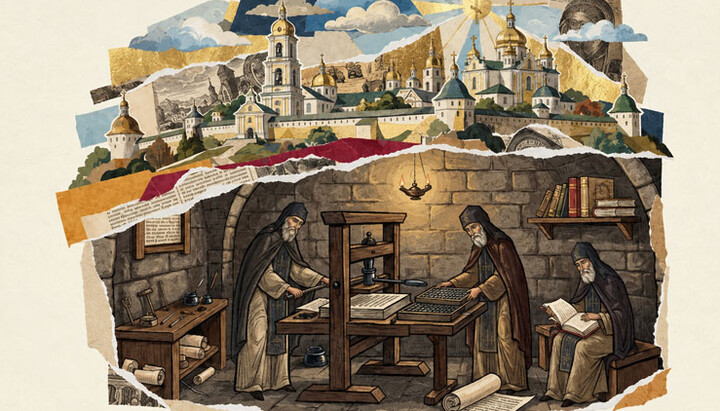
The Pochaiv printing house. Photo: SPZh
In 1790, a new edition of the book «Mirror of Theology» was published in Pochaiv. On the title page, the printing house proudly announced that it had first been printed at the Pochaiv monastery in 1618, and that it was now being issued again at the request of many readers.
The Pochaiv printers clearly wanted to show that their work was ancient and venerable. But if we go back to 1618, the story turns out to be far more tangled.
The wandering press
In 1618 there was no permanent printing house in Pochaiv. A wandering printer, the hieromonk Kirill Tranquillion-Stavrovetsky, stopped here for a time with his portable press. He worked openly. The imprint of the «Mirror of Theology» states that his works were published «in the Pochaiv monastery, on the estate of His Grace Pan Andrzej Firlej, in the year 1618, on the 12th day of March».
The piquant detail is that Firlej was a Calvinist, while the Pochaiv hegumen at that time was suing him over monastery lands. Tranquillion sided with the magnate in this dispute.
The printer did not linger at the monastery. By November 1619 his press was already at work in Rohmanov. He himself called his shelter «the humble tent of my wandering». The fate of his books was not an easy one: around 1625 they were condemned by the Kyiv Council, and in 1627 his works were burned in Moscow. A year earlier Tranquillion had joined the Union.
So the «first Pochaiv edition» is merely an episode in the life of a wandering bookman.
Monks at the type case
A real printing house appeared in Pochaiv more than a hundred years later. By then the monastery already belonged to the Greek Catholic Order of St. Basil the Great (the Basilians). The sources give different years for the monastery's transition to the Union – 1712, 1713 or 1720. The Orthodox say that the monastery was taken away, while the Greek Catholics say that the brethren themselves decided to change jurisdiction.
Around 1730 the Greek Catholic Bishop of Lutsk, Theodosius Rudnitsky-Lyubenetsky, and the local hegumen took up the project. In 1731 the monks concluded two contracts with craftsmen from Sokal for the production of type.
The first impressions were not even books but separate sheets: tables for the proskomedia, pastoral epistles and engravings of the Pochaiv icon. The first large book was the Service Book of 1734–1735. The Pochaiv icon was placed on its title page. The print run exceeded a thousand copies.
The monks themselves worked in the printing house. Up to seven monks served there in obedience, all very young, around twenty years old.
They did not leave the monastery enclosure, and they were headed by a hieromonk – the «prefect». The texts were edited and checked by brothers who studied philosophy and theology, some of whom had even studied in Rome.
The undertaking proved not only pious but also profitable. At various times the printing house brought the monastery up to 40% of its income.
An order from the Old Believers
The most unexpected page of Pochaiv's history is connected with the Old Believers. In February 1781 the printing house prefect Spiridon Kobersky received permission from Bishop Cyprian (Stetsky) of Lutsk to print books for the Old Believers.
From November 1782 the work was carried out under the supervision of Feofilakt Terentyev from Klintsy. Pochaiv engravers cut five blocks for the «Pandects» and four for the «Taktikon». Between 1782 and 1795 at least 30 Old Believer editions were published here.
Uniate monks printing books for Old Believers with the permission of a Uniate bishop. It sounds like an anecdote, but that is how it was. For the printing house, the most important thing was to fulfill the order.
However, the Pochaiv mark was so highly valued that it began to be counterfeited. Some books with the inscription «Pochaiv» on the title page were in fact printed by other printing houses.
Chants for everyone
In 1790 the printing house issued the «Bohohlasnyk» – a collection of 247 spiritual songs. They were sung not during services but at home, on the road, on pilgrimage. The book was loved by both Uniates and Orthodox. It was reprinted right up to the 20th century.
One of the songs in the collection, «When the soul is parted from the body», is an adaptation of a Polish lament. Thus different traditions came together in one collection, and no one was troubled by it.
The Pochaiv printing house also did what others did not dare to do. At the end of the 18th century it was the only one publishing books in the Ukrainian vernacular.
Two hundred blocks and one icon
Pochaiv books were recognizable by their design. The printing house kept more than two hundred blocks for headpieces and about a hundred and fifty blocks for tailpieces. The Crucifixion was carved on more than ten blocks, and the Pochaiv icon on six.
The engraver Yosyf Hochemsky made about 130 engravings, among them the «Siege of Pochaiv» of 1675. Not everything, however, was original. The title page of the 1798 Bible was copied by the engraver Fyodor Strelbitsky from the Kyiv edition of 1758.
How many books came off the Pochaiv press? The counts differ. Some reckon about 300 Cyrillic and about 260 Latin editions over the printing house's entire history, others more than 355 books for the years 1731–1800 alone.
A printing house that outlived its owners
In 1831 the monastery was handed over to the Orthodox, and in 1833 it became a Lavra. The Basilians demanded 12 thousand rubles in compensation for the printing house and the books. The printing house itself continued to operate for almost another century and closed in the early 20th century.
The Uniate monks of Pochaiv in the 18th century hardly imagined that their books would outlive their order. They set Church Slavonic services in type, cut blocks with the Crucifixion and the Pochaiv icon, and printed songs for pilgrims. Their Service Books and the «Bohohlasnyk» were read and sung by people of different confessions.
A book, once it leaves the press, begins to live a life of its own. The Pochaiv press did not choose whose hands it would fall into, and therefore its books still preserve the memory of the vicissitudes of the centuries-long history of this holy place.
Read also
The story of the honey brotherhood
The Mogilev Brotherhood began with members pooling money to brew honey drinks for feast days – and eventually grew to have its own printing press.
Golgotha in the midst of a pogrom
In the autumn of 1938, the Jewish artist Marc Chagall painted the crucified Christ. Synagogues burn and refugees flee around the cross, while the Crucified One Himself is wrapped in a prayer shawl.
Stories of the Early Church. Level of governance: patriarch
How did several episcopal sees rise above the rest, why did the Church’s administrative map come to mirror that of the empire, and is the patriarchate a sacred form of Church governance?
A Chronicle without an author
We are accustomed to calling The Tale of Bygone Years the work of St. Nestor. Yet another monk left his signature on it, while the chronicle itself passed from one generation of scribes to the next.
How a wedding stopped a war
The young princess of Slutsk was married off to keep two powerful noble families from drowning the city in blood. Soon afterward, a Uniate metropolitan complained that Orthodoxy had been reborn in Slutsk.
Man before the forces of nature
A solitary figure on the shore seems insignificant before the immense power of the sea, yet it is he who stands before the Creator.