
A Chronicle without an author
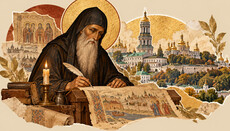
We are accustomed to calling The Tale of Bygone Years the work of St. Nestor. Yet another monk left his signature on it, while the chronicle itself passed from one generation of scribes to the next.
On March 20, 1377, the monk Laurentius laid down his pen. For two months, beginning on January 14, he had been copying a large book “from an old chronicle” for Prince Dmitry Konstantinovich of Suzdal and Nizhny Novgorod. It was painstaking work. When he finished, he left a note on the final page whose meaning was roughly this: a merchant rejoices in a profitable deal, a helmsman in a safe harbor, a traveler in returning home – and a scribe rejoices when he reaches the final line of his work.
That same year, Nizhny Novgorod, where Laurentius had been working, was captured and burned by the Tatars. The book, thank God, survived. Today we know it as the Laurentian Chronicle, and it contains the oldest surviving copy of The Tale of Bygone Years.
That brief note tells us something important: the chronicle was not the work of a solitary genius. Generations of monks labored over it. Each took up the work of his predecessor, added to it, and passed it on.
The mystery of St. Nestor
We all learned in school that The Tale of Bygone Years was written by St. Nestor the Chronicler, a monk of the Kyiv-Pechersk Monastery. The Church venerates his memory, and his name has become synonymous with the early Rus’ chronicle tradition. Yet the title of the Tale in the Laurentian Chronicle gives no author’s name. The early 15th-century Hypatian Codex identifies the author simply as “a black-robed monk of Theodosius’ Pechersk Monastery” – in other words, a monk of the Pechersk Monastery, but without naming him. St. Nestor’s name first appears only in the later Khlebnikov Codex from the mid-16th century. Some scholars even consider it a later insertion.
Does that mean tradition is mistaken? Not at all.
According to tradition and the majority of scholars, it was Nestor who compiled the first version of the Tale around 1113. That version itself, however, has not survived. In fact, The Tale of Bygone Years has not survived as a separate book at all: we know it only as part of later chronicle compilations.
There are also theories that Nestor himself had predecessors. According to one hypothesis, a so-called Primary Compilation had already been produced in the 11th century. Not all scholars accept this theory, but the underlying logic is clear: each generation of chroniclers built on the work of those who came before. In an entry for the year 1114, one of the Tale’s editors notes that he had personally visited Ladoga and questioned local residents. This tells us that a chronicler was not merely a copyist, but also a researcher.
The abbot's signature
If Nestor’s name does not appear in the Tale, whose name does? The answer can be found near its end in the Laurentian Chronicle. There we find an entry from 1116 – the only authorial signature in the entire Tale. In modern language, it reads roughly as follows: “I, Sylvester, abbot of the Monastery of St. Michael, wrote this book in the hope of receiving mercy from God, when Vladimir reigned in Kyiv and I was abbot, in the year 6624 from the creation of the world. Whoever reads this book, remember me in your prayers.”
Sylvester headed St. Michael’s Vydubychi Monastery near Kyiv, the family monastery of Prince Vladimir Monomakh. He later became Bishop of Pereiaslav. But what exactly did he do with the chronicle? Most scholars regard him as either its copyist or the author of the second version of the Tale. Some researchers, however, consider Sylvester the book’s sole author.
Notice the final words of his note. The abbot does not ask for fame. He asks only for the reader’s prayers. Perhaps this is the best explanation for why the chroniclers of ancient Rus’ so rarely signed their work.
Named and nameless chroniclers
It is generally assumed that the chronicles were written by anonymous monks. This is partly true. Of all the chroniclers of the 11th through 14th centuries, only four are known by name: Nestor, Sylvester, Laurentius, and Timothy, a sacristan from Novgorod. The last of these was not even a monk, but a parish cleric who copied liturgical books on commission and served as secretary to the archbishop.
The Laurentian Chronicle, as we have already seen, is not anonymous: Laurentius identified himself, while two other scribes also worked on the manuscript with him. The compilers of the Hypatian Chronicle, on the other hand, are indeed unknown to us by name. Scholars associate one section of it, the Kievan Chronicle, with Moses, abbot of the Vydubychi Monastery, but this remains only a hypothesis.
Curiously, the Hypatian Chronicle takes its name from the Ipatiev Monastery in Kostroma, where it was discovered, although it has nothing to do with Kostroma itself. It preserves material from southern Rus’, Kyiv, and Galicia-Volhynia, while the Laurentian Chronicle focuses primarily on northeastern Rus’. Together, the two complement each other.
Why did monasteries become centers of chronicle writing?
The answer may seem obvious: monasteries had literate people and libraries. That is true, but it is only part of the explanation. Equally important was the fact that chronicles were commissioned and preserved by metropolitans, bishops, princes, and probably abbots. Often a chronicle existed in a single copy and was guarded as a treasure.
A chronicle could also serve as a legal document. In 1432, Prince Yuri Dmitrievich used old chronicles and his father’s will at the Horde to substantiate his claim to the grand princely throne. A chronicle entry could determine who would sit on a throne.
The result of this centuries-long relay of chroniclers is remarkable. Academician Dmitry Likhachev wrote of The Tale of Bygone Years: “Never before or afterward, right up to the 16th century, did Russian historical thought rise to such heights of scholarly inquiry and literary skill.”
The chronicle was created by a whole succession of monks, most of whom remained nameless. Each labored in the hope of God’s mercy and the prayers of future readers. And perhaps the best thing we can do today when opening their works is to fulfill that modest request of those ancient authors.