The help God never asked for
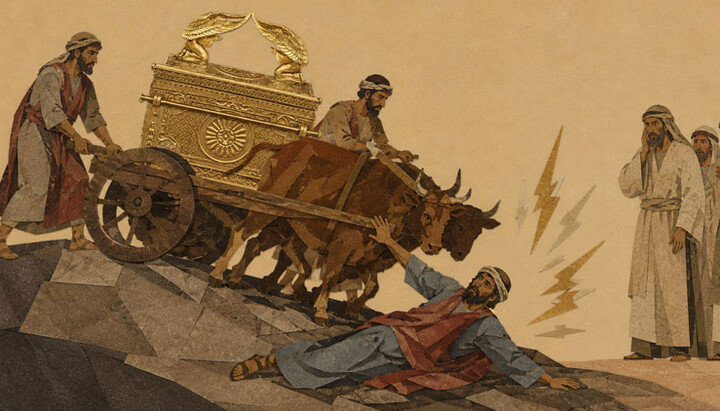
The death of Uzzah. Photo: UJO
A procession of thirty thousand elite warriors makes its way from Kiriath-jearim to Jerusalem. Tambourines and cymbals resound. King David and all Israel rejoice: the Ark of the Covenant is finally being brought to the new capital.
The Ark is a small chest made of acacia wood, two and a half cubits long and one and a half cubits wide and high, overlaid with gold. For Israel, it is the holiest of sacred objects, the place where God manifests His presence among His people. For many years, it has remained in the house of Abinadab. Now his sons, Uzzah and Ahio, are transporting it.
An idea borrowed from the Philistines
The Bible describes the preparations for the journey: "And they set the ark of God upon a new cart" (2 Samuel 6:3). A new cart, strong oxen, reliable drivers. Everything seems carefully planned.
But where did the idea of transporting the sacred Ark this way come from? Several decades earlier, the Ark had been captured by the Philistines. When various calamities struck its captors, their priests advised sending it back. Cows pulling an unmanned cart carried the Ark toward the Israelite town of Beth-shemesh. They lowed as they went but "turned not aside to the right hand or to the left" (1 Samuel 6:12). The Ark arrived safely.
Thus, a precedent had been established for transporting the sacred object. The problem was that the precedent came from pagans.
Israel had its own prescribed procedure, recorded in the Law. When Moses distributed carts to the Levites for transporting the Tabernacle, he gave them to two clans but none to the third. "But unto the sons of Kohath he gave none: because the service of the sanctuary belonging unto them was that they should bear upon their shoulders" (Numbers 7:9).
Special gold-covered poles had been made for carrying the Ark by hand. Removing them from their rings was forbidden. Everyone knew this – or should have known it.
The Incident at Nachon's threshing floor
The procession reaches Nachon's threshing floor, a hard-packed area where grain is threshed. Here the oxen stumble. The cart lurches sharply, and the Ark is about to slide to the ground. Then "Uzzah put forth his hand to the ark of God, and took hold of it; for the oxen shook it" (2 Samuel 6:6).
Who among us would have acted differently? A sacred object is falling – naturally, you reach out to catch it. It is an almost instinctive reaction. Uzzah was not thinking about ritual regulations. He simply did not want the Ark to break or fall into the roadside dust.
What happens next is described in Scripture: "And God smote him there for his error; and there he died by the ark of God" (2 Samuel 6:7).
The Hebrew word rendered here as "error" is exceptionally rare, and translators still debate its meaning. It has been understood as a "mistake," "irreverence," or "rashness." The Book of Chronicles clarifies that God "smote him, because he put his hand to the ark" (1 Chronicles 13:10).
The travelers' festive joy vanishes instantly, and the site of the tragedy receives the name Perez-uzzah – "the breaking forth against Uzzah."
After this, David, Scripture tells us, "was afraid" (2 Samuel 6:9). He does not dare take the Ark any farther and leaves it in the house of Obed-edom the Gittite.
The Law had warned the Kohathite Levites who carried the sacred objects: "They shall not touch any holy thing, lest they die" (Numbers 4:15). Uzzah touched the Ark. But surely he had done nothing wrong!
Who set the chain of mistakes in motion?
Blessed Theodoret of Cyrus asks the same question: Why did Uzzah die? His answer is unexpected. He argues that Uzzah was not punished for acting rashly, since when the cart began to tip, it was only natural to steady it with his hand.
Theodoret sees the real cause in the improper method of transporting the Ark. God had commanded that the Ark be carried on the shoulders of the priests, he explains, but the Israelites transported it on a cart in violation of the Law. They were misled by the fact that the Philistines had sent the Ark back in the same manner without suffering any harm.
God overlooked in the Philistines what He did not overlook in Israel. Why? Theodoret explains that the Philistines did not know the Law and had no priests who could carry the Ark in the prescribed manner.
Those who do not know are held to a different standard. Israel, however, knew the Law and still decided that the pagan method was more convenient.
Uzzah's hand upon the Ark was merely the final link in a chain of transgressions. Israel's willful disobedience had begun long before the procession reached Nachon's threshing floor, when someone decided that transporting the Ark on a cart would be safer.
David realized they were all to blame
The Ark remained in Obed-edom's house for three months, and the Lord blessed his household. During that time, David had much to reflect upon. When he resolved to make a second attempt to bring the Ark to Jerusalem, he openly acknowledged: "The Lord our God made a breach upon us, for that we sought him not after the due order" (1 Chronicles 15:13).
Not "upon him" – Uzzah – but "upon us." The king does not shift the blame onto the dead man. Responsibility rests with everyone who organized the procession, including David himself.
This time the Levites carried the ark “as Moses had commanded according to the word of the Lord, on their shoulders with poles” (1 Chron. 15:15). After every six steps a sacrifice was offered. And David himself, in a linen ephod, “danced before the Lord with all his might” (2 Sam. 6:14). Joy returned to the camp of the worshippers.
Why this was not cruelty
The story of Uzzah still troubles many people. A man tried to help – and died. Where is God's mercy in that?
The answer lies in the difference between human reasoning and divine wisdom. Human reasoning tells us that what matters is not the method but the result. If the Ark arrives intact, then everything was done correctly. Whether it was carried on shoulders or transported on a cart makes no difference, as long as the journey was convenient and quick.
But God's perspective is different. God Himself established how His people were to approach what was holy. These rules were not for God's benefit but for man's. They remind us that sacred things cannot be treated as ordinary objects, loaded onto a cart and steadied by human hands whenever necessary. When we begin handling holy things according to our own judgment, even the best intentions can lead to disaster.
This story is about obedience to God's commandments. Even our good intentions do not override the order He has established. David came to understand this and, three months later, ordered the Ark to be carried as the Law required. And then the very same Ark whose transport had brought death to Uzzah brought blessings to the house of Obed-edom and joy to all Israel.
Read also
Freedom begins when there's nothing left to take
Fear of persecutors takes root in our attachment to possessions. We turn to St. Basil the Great to understand why the prefect's threats held no power over him.
The bride in the window frame
The author of the earliest account of St. Thecla’s life was defrocked. Yet it was his book that preserved the only ancient description of the Apostle Paul’s appearance.
Drinking priest, or the flip side of parish life
In his epistle, the Apostle Jude describes a scene familiar to anyone who has seen a church meal turn into a drinking party.
A lesson from a speechless donkey
The famous seer struck his donkey three times for refusing to go forward. All the while, she was saving his life – and seeing what he could not.
The time when the soul ripens
Modern society has turned youth into a cult and old age into a period of merely “living out one’s days.” The Christian perspective reveals the profound spiritual meaning of our later years.
Faith is not a checker piece in a spectator sport
Arguments about faith on social media increasingly resemble no-holds-barred fights. We turn to a saint who, sixteen centuries ago, knew how to speak to those interested only in turning theology into a combat arena.