
A lesson from a speechless donkey
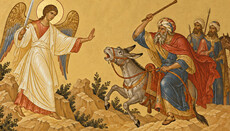
The famous seer struck his donkey three times for refusing to go forward. All the while, she was saving his life – and seeing what he could not.
The road to Moab winds between vineyards. Stone walls run along both sides, with ripening vines beyond them. The passage is narrow: two travelers can barely pass, and there is no room for a cart to turn around. Along this road rides a man named Balaam, seated on a donkey. His reputation reaches far beyond his homeland. The king of Moab himself believes that whoever Balaam blesses is blessed, and whoever he curses is cursed.
And Balaam has not come here by chance. He has been summoned by Balak, king of Moab. A vast people who came out of Egypt have encamped at the borders of his land, and the king is afraid. He needs someone who can curse Israel. And he is prepared to pay handsomely for it.
Incidentally, Balaam is known from more than the Bible. In 1967, archaeologists working at Deir Alla in Jordan discovered an inscription on the plaster walls of an ancient sanctuary mentioning “Balaam son of Beor, a seer of the gods.” The inscription is generally dated to around the ninth or eighth century B.C. Evidently, neighboring peoples remembered the seer as well.
The right words and the wrong road
It all begins piously enough. The elders of Moab come to Balaam “with the rewards of divination in their hand” (Num. 22:7). The prophet does not rush into anything. He asks God. God forbids him to go, and Balaam sends the envoys away.
But the king does not give up. He sends another delegation, more distinguished than the first. Balaam gives them a stern answer: “Though Balak would give me his house full of silver and gold, I cannot go beyond the word of the Lord” (Num. 22:18).
Fine words, aren’t they?
And yet, after saying them, for some reason he asks the envoys to stay the night – just in case the Lord has something more to tell him. But the answer has already been given. Why ask again?
This time, surprisingly, God permits him to go: “Rise up, and go with them” (Num. 22:20). Yet only two verses later we read that “God’s anger was kindled because he went” (Num. 22:22).
How can that be? God Himself gave permission – and then became angry when Balaam went?
Commentators offer different explanations. Some see it as a warning: Balaam was to remember the essential condition and speak only what the Lord commanded. Others believe that Balaam’s words did not match his true intentions.
The Book of Numbers does not explicitly accuse the prophet of greed. But centuries later, the Apostle Peter calls things by their proper name: Balaam “loved the wages of unrighteousness” (2 Pet. 2:15).
Three blows with a stick
What follows is a scene at once almost comic and deeply tragic.
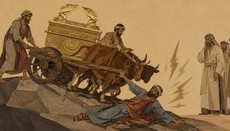
The Angel of the Lord stands in the road with a drawn sword. The donkey sees him. The famous seer does not.
First, the donkey turns off into a field. Balaam beats her to force her back onto the road. Then the Angel stands “in a path of the vineyards, a wall being on this side, and a wall on that side” (Num. 22:24). The donkey presses herself against the wall, crushing her master’s foot against the stone.
Another blow.
The third time, the Angel stands “in a narrow place, where was no way to turn either to the right hand or to the left” (Num. 22:26). There is nowhere to go. So the donkey simply lies down beneath her rider. Balaam, furious, reaches for his stick.
Three times she saw the danger. Three times she was beaten for it. And the man renowned for seeing the unseen saw nothing at all.
The sword in someone else’s hand
Then the Lord opens the donkey’s mouth. She asks her master why he has beaten her three times. And what does Balaam do? Does he recoil in terror? Fall to his knees?
Nothing of the sort.
He argues with his donkey as casually as if he were quarreling with a neighbor at the marketplace. In his rage he shouts: “I would there were a sword in mine hand, for now would I kill thee” (Num. 22:29).
There was indeed a sword nearby. It was simply in someone else’s hand.
Only after this exchange does the Lord open Balaam’s eyes, and he sees the Angel standing before him with a drawn sword. The Angel explains: “Unless she had turned from me, surely now also I had slain thee, and saved her alive” (Num. 22:33).
The prophet was ready to kill the animal that had just saved his life three times.
Why would God need a talking donkey?
We could, of course, treat the story as little more than a curious and amusing biblical episode. But the Holy Fathers saw a serious lesson in it.
Blessed Theodoret of Cyrus explained that God “frightens Balaam by the donkey’s supernatural speech and by the vision of the Angel, so that Balaam might learn how greatly God cares for the people of Israel.”
The Lord did not send the seer another prophet. He did not send him a king. He spoke through the simplest, most speechless creature at hand. And the great wise man had to take a lesson from his own donkey.
Who is trying to stop us?
Sometimes we, too, desperately want to keep moving down the road we have chosen – especially when there is a reward waiting at the end.
We say all the right things about faithfulness to God while already calculating the profit in our heads. And we ask the Lord the same question again and again, hoping that eventually we will hear the answer we want.
Then something begins to get in our way.
Circumstances drive us off the road, pin us against a wall, or simply bring us to the ground. Or someone close to us digs in their heels and refuses to let us take another step. We become angry, ready to “beat” the very person who is holding us back.
But perhaps we should look around first.
What if the person opposing us can see something we cannot?
God knows how to speak through the simplest and most inconspicuous people. The important thing is to recognize it in time – before His sword flashes on the road.