Prosphora notes replace loving embraces
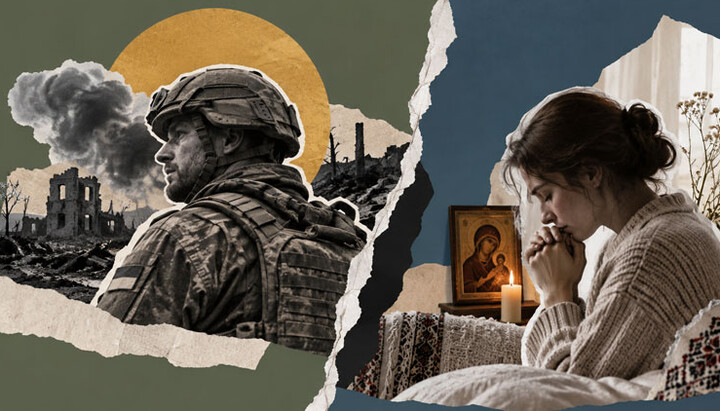
Семья, разлученная войной. Фото: СПЖ
The bride and groom have just drunk from the common cup. The priest joins their hands and leads them three times around the analogion. The joyful hymn "Isaiah, dance for joy" is sung. And then the choir begins a strange troparion: "O holy martyrs, who fought the good fight and are crowned, intercede with the Lord that He have mercy on our souls." At a wedding – suddenly a hymn about martyrs. Why?
Father Alexander Schmemann explained: "The wedding crowns signify the glory and honor of martyrdom." And he added: "For the path to the Kingdom is always martyrdom, that is, the feat of bearing witness to Christ." From the very beginning, the Church tells newlyweds: marriage is not only a celebration. It is also a readiness to sacrifice oneself for the other every day.
In peacetime, these words seem like a beautiful metaphor. But when a husband goes off to the front and his wife is left alone with the children in anxious uncertainty, they become very clear.
Stories of holy spouses
Saints Adrian and Natalia lived together for little more than a year, after which everything in their life was turned upside down. This took place in Nicomedia, at the beginning of the fourth century. Adrian, a young official, saw Christians being tortured and himself confessed Christ. He was thrown into prison.
Natalia had been a Christian even before this. When Adrian unexpectedly came home one day, she decided that her husband had renounced the faith and been released. And she did not let him cross the threshold, saying reproachfully: "Depart from me, you who have forsaken God…" She was afraid of losing her husband, but even more afraid of living to see his apostasy.
Having learned that she was mistaken, Natalia did everything she could to be near her beloved. She cut her hair, put on men's clothing, and, disguised as a youth, made her way into the prison. And when Adrian was executed, she held his hands and feet while they were broken with a hammer. After the execution, she secretly took his hand and kept it with her.
The married life of Timothy and Maura was even shorter. Timothy was a reader in Egypt. Soon after their marriage and wedding, he was arrested for his faith. Timothy immediately called his wife: "Come with me to this valiant struggle." And Maura answered: "I too desire the very same thing that you desire."
They were crucified on crosses set facing each other. For nine days and nine nights they hung face to face and supported each other with spiritual words. The last thing they saw in this life was each other's eyes.
Of course, we do not wish any of today's families to repeat their feat literally. But in these stories there is something familiar to many: separation, fear, the impossibility of embracing the beloved and confessing one's feelings aloud. And, of course, the shared faith that binds every Christian marriage together.
Letters from the camp
The twentieth century also knew countless stories of separated spouses. Priest Pavel Florensky wrote to his wife, Anna Mikhailovna, from the Solovki camp. In one letter he says: "Dear Annulya, the past has not passed away but is preserved and abides forever, yet we forget it and move away from it." And half a year later he confesses: "Amid the torrents of words, I cannot find my own word that I would like to say to you."
This feeling is familiar to those who today write short messages to their beloved at the front.
One wants to say so much, but all that comes out is "How are you?", "Have you eaten?", "Take care of yourself." Yet these words are now dearer than the most eloquent declarations of love.
When Kyiv priest Anatoly Zhurakovsky found himself in prison, the first thing he asked his wife to send him, strange as it may seem, was not food but a cassock. Even in captivity, he wanted to remain, above all, a priest. And once, in the camp town of Kem, the confessor Roman Medved was visited by his wife, Anna Nikolaevna, who came with their daughter. They rented a corner of a barracks for three days in order to be near him, if only for a little while.
The Counsel of Chrysostom
St. John Chrysostom wrote about marriage long before the camps and the trenches. Yet some of his counsels sound as if they were written for families today.
He suggested that a husband say to his wife such words as these: «I prefer your love to everything, and nothing could be so hard for me as ever to be parted from you».
The saint spoke of family life in peacetime. But his counsel applies in the present, wartime as well. The Christian life of spouses goes on even when hundreds of kilometers lie between them.
What can be done today
The Church has simple means of preserving the spiritual unity of families separated by distance. One can submit names for the proskomedia: then, for the health of the husband, the priest will take out a particle from the liturgical prosphora before the Liturgy. Even when far away, a person is spiritually present where he is remembered in prayer. This applies to both the living and the departed. One can pray for loved ones morning and evening, in one's own words or from a prayer book — God hears everything.
One can also agree with one's spouse to pray at the same time. This is a good way to feel that you are always near each other. In the moments when both stand before God, the distance disappears.
The Apostle Paul, speaking of spouses who by agreement part for a time for the sake of prayer, added: «and come together again» (1 Cor. 7:5). He was speaking of voluntary abstinence during a fast. But these words apply now as well. Separation is not for long, it is «for a time».
Of course, it can be very hard to endure a long separation. Estrangement, jealousy, silence, and the temptation to begin a new life with someone else can set in. One should speak openly about this at once with a priest whom you trust. The Church does not offer ready-made recipes, but a spiritual father will help you sort out your particular situation.
Until death unites
In the Western marriage vow there are words that marriage lasts «until death do us part». Fr. Alexander Schmemann observed that Orthodoxy does not speak this way. A Christian marriage lasts endlessly, and death and the passage into eternity, on the contrary, unite spouses forever.
In 1936 in Kyiv, the granddaughter of Hieromartyr Alexander Glagolev, returning from school in the morning, saw her grandfather praying at her grandmother's bedside. He simply stood and prayed.
There are many such tender moments in the life of a believing family. They go unnoticed; they are not written about in the lives of the saints. But it is precisely from them that what the Church calls martyrs' crowns is made: daily faithfulness, prayer for one another, readiness to wait for one's beloved, at times — for a very long time.
The crowns that are placed on the newlyweds in church remain with the spouses forever. And in times of trial it becomes especially clear why they were given to them then.
Read also
Honest atheism vs. spiritual hypocrisy
The 70th anniversary of Albert Camus’s Nobel Prize recalls an uncompromising challenge to Christianity. An honest unbeliever brings theology back to the mystery of the Cross.
The valley of trouble and the gateway of hope
One soldier buried an expensive cloak and some gold beneath his tent. Because of this, all Israel lost a battle. Why did one man’s sin bring disaster upon an entire nation?
From love spells to bishop's throne
Antioch’s most powerful sorcerer sent demons against a devout young Christian woman three times – and failed every time. In the end, a demon himself revealed the truth that led to his conversion.
The Weeping Queen of Blachernae
On the night of the Feast of the Protection, only two people witnessed the miracle in the Church of Blachernae. Everyone else prayed and saw nothing. Yet they, too, received grace.
Deadly spiral of human hatred
The tragedy of Lebanon's civil war lays bare how dehumanization and fear can turn human beings into monsters.
Woe to expectant mothers – or to those of little faith?
God commanded one prophet not to have children, yet told his people in exile to bear sons and daughters. What does this apparent contradiction tell us today?