Archpastor's word for weary city dwellers
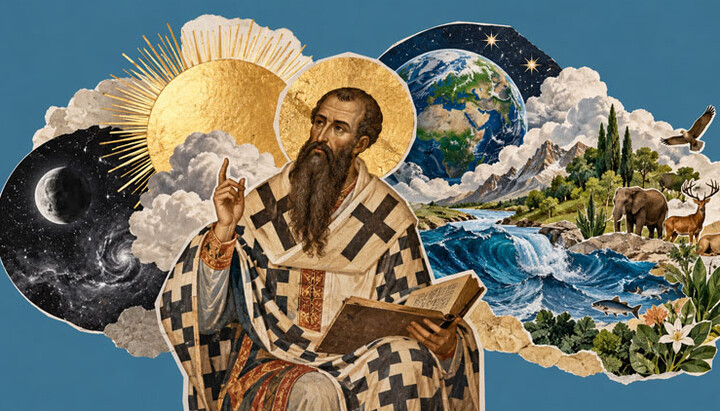
Еседа о тайнах мироздания. Фото: СПЖ
We enter beneath the high vaults of the church at Caesarea. All around stand ordinary townspeople: craftsmen with calloused hands, widows, women coming from their work. Beyond the threshold the marketplace is noisy, the news brings anxiety, and the bustle drains our strength. It is hard for us to keep inner order when the world outside is breaking into pieces. We approach the preacher, look at his gaunt face, and ask the questions that weigh on us most.
– Master, everything around us is falling apart, – we say quietly. – It seems as though existence has lost its harmony and moves at random. Is there any order left in all of this?
Saint Basil the Great turns to us. In his eyes we read the wisdom of a man who knows the price of human sorrow.
– Godlessness, having taken up residence in people, has suggested to them the false thought that everything exists without governance and arrangement, and is set in motion as if by chance, – he suddenly says.
We freeze at these words. The chaos within us recedes. It suddenly becomes clear that disorder dwells not in nature, but in our bewildered mind, which has ceased to notice the brush of the Great Artist.
Worldly Haste
But daily cares continue to weigh on our shoulders. We remember the workshops we have left, the bread we have not yet bought, the hubbub of work. The craftsmen beside us fear losing their day's wages.
– Master, – we lament, – it is hard for us to keep the peace of prayer. We are constantly rushing, and our thoughts fly off to household cares. How can we learn to hear God amid the noise?
The holy archpastor looks at the crowd of hurrying workers and addresses us:
– Therefore put away from your heart every worldly care, and gather yourself wholly into yourself now. For there is little profit if you are here in body, while your heart is occupied with earthly treasure.
We lower our eyes in embarrassment, acknowledging our spiritual weakness. But the preacher is indulgent and does not reproach us.
– Even the most active mind proves insufficient to explain properly the smallest part of the world. We must sincerely confess our weakness, – the saint is convinced.
Thus the Archbishop of Caesarea teaches us to be honest before ourselves and the Creator. Unlike Him, we cannot add to our lives a single year, or an extra hour of time.
The Nature of Darkness
We take a step closer to the saint, because the answer to our next question is very important to us.
– Saint, where does so much evil around us come from? – we ask. – Why does darkness draw near to the very heart, making us literally drown in despondency?
The preacher answers confidently and gently, dispelling our fear of the enemy's power:
– This darkness is not something independent; it is simply the absence of light, – says the Cappadocian saint.
He sees our astonishment and continues to develop this thought:
– Evil, too, is not a living and animate being, but a state of the soul opposed to virtue, and it arises in the careless through falling away from the good. Therefore do not seek evil outside yourself.
– So the gloomy circumstances are powerless in themselves? Does everything depend on God's will? – we ask with hope.
– The first word of God created the nature of light, dispelled the darkness, banished gloom, gladdened the world, and suddenly gave everything an attractive and pleasing appearance, – says Saint Basil.
We understand his teaching. Evil has no nature of its own; it is merely the absence of Good. This means that in order to drive away the darkness, we must open our hearts to the divine light.
Fate and Will
Then we raise another subject that troubles many people:
– Vladyka, what about belief in fate or an ominous sign? Perhaps our actions are written out in advance by the movements of the stars, and we are not answerable for anything?
The archpastor's voice rings with firmness:
– If the beginnings of vicious and virtuous deeds do not depend on us, then lawgivers exist in vain, and judges exist in vain, who reward virtue and punish vice, – Saint Basil the Great replies with reproach.
The holy preacher returns to us full responsibility for our own lives. No astrological forecasts can deprive a person of free will. We ourselves choose our path, and this choice carries eternal weight.
Lessons of Nature
We ask the saint to show us clear examples to strengthen our faith.
– Where should we seek consolation when our spiritual strength runs dry? – we ask.
The holy archpastor points with his hand to the humble plants by the church fence:
– By sand, which is the weakest of all things, the unbearable violence of the sea is restrained, – says the Cappadocian saint. – A single blade of grass, or a single stalk, occupies your mind with contemplation of the art with which it was made. The change of the seasons prompts everything living to manifest anew the power it possesses for the production of grasses, seeds, and trees.
By listing examples from nature, the saint helps us to look at the world differently. Here he points to a blooming rose:
– At first it was without thorns, but afterward thorns were added to the beauty of its color, so that after the enjoyment we might see sorrow, remembering sin.
Then the preacher speaks of the grapevine:
– Looking at these tendrils, we learn to entwine ourselves with our neighbors in the embrace of love and to find rest in it.
It is astonishing how nature becomes for the holy archpastor a book of creation.
The Preacher's Parting Word
The sun is sinking toward the horizon. Evening comes, and we ask the preacher one last question:
– Vladyka, you have told us about the heavens, about the underwater world, about the elements, about plants. But what is the plan for man? Why did the Creator conceal some details from the chronicler?
The Cappadocian saint falls silent. A meek smile appears on his emaciated face. He looks at the people, who have grown quiet after the bustle of the day, and speaks his parting words:
– If He kept silent about what does not concern us, as being useless, was it not so that everything might serve for the edification and perfecting of our souls?
The preacher makes the sign of the cross over the gathered laity and withdraws into the altar.
We will stand a little longer in the coolness of the fading day. We know that the further discourses on man and the world around him were never delivered by the saint during his lifetime because of his swift repose. Later, the missing word would be written by his younger brother, Saint Gregory of Nyssa. Yet in this incompleteness a deep mystery remains. Saint Basil has led us to the threshold of the divine mystery and left open space for our own personal seeking. We leave the church for the streets of the city as different people, with strengthened faith, having overcome despondency and perplexity.
Read also
Brother of tax collector and brother of Lord
The Gospel is silent about the son of Alphaeus, and commentators have argued for centuries over who he was. And the Church commemorates two apostles named James in close proximity.
Prayer commemorations instead of loving embraces
At every Orthodox wedding, the choir sings a hymn to the martyrs. For families separated by war, these words carry a special meaning.
Honest atheism vs. spiritual hypocrisy
The 70th anniversary of Albert Camus’s Nobel Prize recalls an uncompromising challenge to Christianity. An honest unbeliever brings theology back to the mystery of the Cross.
The valley of trouble and the gateway of hope
One soldier buried an expensive cloak and some gold beneath his tent. Because of this, all Israel lost a battle. Why did one man’s sin bring disaster upon an entire nation?
From love spells to bishop's throne
Antioch’s most powerful sorcerer sent demons against a devout young Christian woman three times – and failed every time. In the end, a demon himself revealed the truth that led to his conversion.
The Weeping Queen of Blachernae
On the night of the Feast of the Protection, only two people witnessed the miracle in the Church of Blachernae. Everyone else prayed and saw nothing. Yet they, too, received grace.