Story of two oaths and mother on high mountain
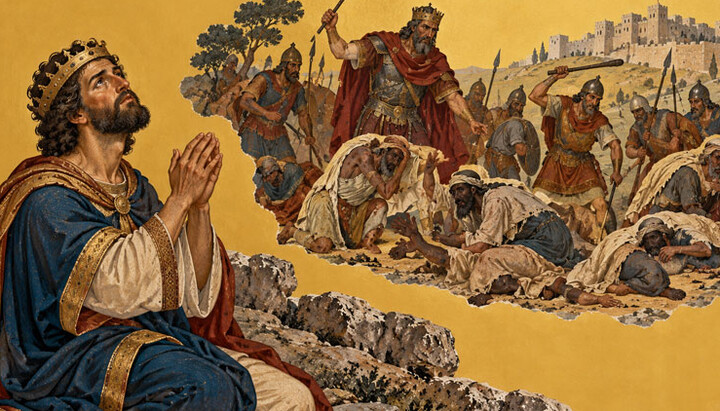
Видение царю Давиду. Фото: СПЖ
Anyone who has ever walked the Palestinian hills in the height of summer heat knows that the soil there scorches and cracks into deep fissures, and the dry beds of stony streams wait for the slightest breath of moisture. Life on these steep slopes always depended on rain from heaven. When the Heavens were shut, calamity followed.
This remarkable story begins with these lines of Holy Scripture: «Now there was a famine in the days of David three years, year after year» (2 Sam. 21:1). The people endured three seasons without a harvest. The first season they met with hope, opening the old storehouses and scraping together the last of the barley grain. The second season brought anxiety: the fields stood empty, and the flocks grazed on scorched grass. By the third season, despair and a destructive hot wind had come.
King David sought the cause of the disaster not in the whims of the local climate. He took the tried and proven path of prayer. The biblical text says that the psalmist «inquired of the Lord» (2 Sam. 21:1). And the Master's answer proved unexpected for the inhabitants of Jerusalem. The cause of the calamity lay in a long-forgotten crime of years past.
The Lord answered: «It is on account of Saul and his bloodthirsty house, because he put the Gibeonites to death» (2 Sam. 21:1). It became clear that the wounded land would not yield a harvest until the age-old injustice was healed. The Creator remembered the covenant that the ruler Saul had chosen to forget. To grasp the depth of this story, we must step back several centuries and return to the times of Joshua the son of Nun.
Moldy Bread at Gilgal
When ancient Israel entered the promised land, the news of the fall of Jericho frightened the local inhabitants. Travelers came to the military camp at Gilgal. Their donkeys stumbled under the weight of worn-out sacks, their wineskins were torn and patched, the sandals on their feet were worn through, and their bread was dry and moldy.
The travelers showed their dry crusts and said that they had set out on the road from a distant country, having barely heard of the glory of God. They claimed that they had left home with warm bread, and that their provisions had spoiled along the way. It was a cunning deception. The Gibeonites lived very close by, only a few hours' walk from Gilgal. Their fortified city stood on a hilltop, protected by deep wells.
The leaders of Israel made a blunder. They sampled the travelers' bread, «but did not inquire of the Lord» (Josh. 9:14). The outward evidence seemed convincing. The leaders made a covenant with the newcomers and swore before God to spare their lives.
Just three days later the truth came out. The Israelites came to the Gibeonite towns and saw that the travelers were in fact their closest neighbors (Josh. 9:16). Murmuring rose in the camp. The people demanded that the deceivers be punished and their rich lands seized. But the elders refused to break their given word. They answered the people: «We have sworn to them by the Lord God of Israel, and so we cannot touch them, lest wrath be upon us because of the oath» (Josh. 9:19-20). They feared adding to the sin already committed a new, grievous sin of breaking an oath.
Thus the newcomers survived, but became woodcutters and water carriers for the altar of God. Obedience turned into a blessing: a pagan people was brought into the service of the Church.
The City Beneath the Standing Sun
Gibeon has gone down in history not merely as a city of deceivers. Great events of sacred history are connected with it. It was by the walls of this city that the well-known miracle took place, when the leader Joshua, son of Nun, cried out to God in the face of his enemies: «Sun, stand thou still upon Gibeon» (Josh. 10:12), after which the luminary truly stood still.
Centuries passed. In this city stood the chief altar, where solemn sacrifices were offered. Later the young King Solomon came to Gibeon. It was here that the Lord appeared to him in a dream by night, granting him wisdom to govern the people (1 Kings 3:4–5).
The Gibeonites faithfully fulfilled their humble obedience. They served at the sanctuary, hewed wood, drew water from the rock-hewn shaft, and held to the sacred covenant. They knew that the name of God is a sure protection for everyone who has put his trust in an oath.
The Blind Zeal of a King
However, in the days of the first king, Saul, the ancient covenant was subjected to a cruel reassessment. Scripture says that «Saul sought to slay them in his zeal to the children of Israel and Judah» (2 Sam. 21:2).
The Gibeonites «were not of the children of Israel, but of the remnant of the Amorites» (2 Sam. 21:2). It seemed to the king that foreigners had no place on the holy land, and that the oath of the time of Joshua, son of Nun, had lost its former force. This was a zeal that places human advantage above the name of God. Blessed Theodoret of Cyrus emphasized that the descendants of those who had sworn were obliged to observe strictly the treaties that had been made and not to break oaths given in the name of the Lord.
The ruler Saul launched a cruel persecution and shed the blood of defenseless inhabitants.
But with God there are no forgotten victims. Years passed, the government changed, and a drought came.
When King David summoned the surviving Gibeonites and asked: «Wherewith shall I make the atonement?» (2 Sam. 21:3), the wronged inhabitants answered: «We will have no silver nor gold of Saul» (2 Sam. 21:4). They did not seek wealth. The Gibeonites asked that seven descendants from the house of the former king be handed over to them, so that they might hang them before the Lord in Gibeah of Saul. David had to make a harsh decision.
A Mother on the High Mountain
Among those handed over to the Gibeonites were two sons of the king's concubine Rizpah – Armoni and Mephibosheth. Together with five grandsons of Saul, they were hanged «in the hill before the Lord» (2 Sam. 21:9). This happened «in the days of harvest, in the first days, in the beginning of barley harvest» (2 Sam. 21:9), when the dry April heat scorched the valleys of Palestine.
Here the biblical narrative reveals to us an image of astonishing maternal love. Rizpah took coarse cloth – sackcloth – and spread it out on the mountain.
Day after day, month after month, this woman sat beneath the scorching sun. She suffered neither the birds of the air to rest on the dead by day, nor the beasts of the field by night. Her feat continued throughout the dry season, until at last «the water dropped upon them out of heaven» (2 Sam. 21:10).
Rizpah's act is worthy of respect. Instead of loud curses, the faithful mother protected her dead sons.
When King David was told of what Rizpah had done, the ruler's heart trembled.
David went to Jabesh-gilead for the bones of Saul and Jonathan, which the people of that city had once secretly carried away. The king gathered the bones of the fallen ruler and the bones of the young men who had been hanged. He brought them to the land of Benjamin and laid them "in the sepulchre of Kish his father" (2 Sam. 21:14).
Reconciliation After Long Years of Waiting
The text of the Book of Kings concludes with a brief line: "And after that God was entreated for the land" (2 Sam. 21:14).
It is important to notice this sequence. Final reconciliation did not come immediately after the stern demand of the Gibeonites was fulfilled. God looked upon the parched land only after the debts of justice had been paid, an honorable burial had been performed, and mercy had been shown to the slain house.
Blessed Theodoret of Cyrus, reflecting on this event, wrote that the Master does not distinguish between peoples, but righteously defends the wronged, even if they are foreigners.
God's law teaches us not to violate agreements made under oath. Treachery can never be justified, and a word given before God retains its power through the ages.
This biblical story leaves us with a deep reflection. In a world where promises go unfulfilled under the pressure of circumstances, Holy Scripture reminds us of the inviolability of the spoken word. God's mercy returns to the scorched land not when we try to conceal old sins, but when we find the courage to fulfill an ancient covenant and show love where only dry earth remains.
Read also
Collapse of Babel's tower of globalism
October 24 is United Nations Day. An analysis of the crisis of secular institutions and the ideology of globalism through the prism of biblical Babylon and Pentecost.
Archpastor's word for weary city dwellers
When exhaustion weighs us down, we turn to ancient sermons to ask profound questions about human destiny and the nature of existence.
Brother of tax collector and brother of Lord
The Gospel is silent about the son of Alphaeus, and commentators have argued for centuries over who he was. And the Church commemorates two apostles named James in close proximity.
Prayer commemorations instead of loving embraces
At every Orthodox wedding, the choir sings a hymn to the martyrs. For families separated by war, these words carry a special meaning.
Honest atheism vs. spiritual hypocrisy
The 70th anniversary of Albert Camus’s Nobel Prize recalls an uncompromising challenge to Christianity. An honest unbeliever brings theology back to the mystery of the Cross.
The valley of trouble and the gateway of hope
One soldier buried an expensive cloak and some gold beneath his tent. Because of this, all Israel lost a battle. Why did one man’s sin bring disaster upon an entire nation?