
"The Ladder" as neurobiology of the spirit
After fifteen hundred years, the book by the abbot of Sinai remains the most accurate textbook on "hacking" human consciousness.
In our church tradition, there are not so many works by ancient authors that have become classics of patristic heritage and on which thousands of generations of Christians have been raised for hundreds of years. One such book is "The Ladder" by the Sinai abbot John. Reading it is not easy for a modern person, like any other book written almost fifteen hundred years ago. As a relatively modern analogue, I would recommend the book by Jean-Claude Larchet "Healing from Spiritual Diseases."
Saint John Climacus is perhaps one of the most enigmatic authors of that time. This man is an undoubted genius. Long before psychoanalysis, he studied the step-by-step mechanisms of consciousness capture, uncovered algorithms of personality deconstruction and reconstruction, and wrote a profound scientific work on how to stop being a "bot" controlled by external triggers and internal automatisms. This work deserves a Nobel Peace Prize, but it wasn't awarded back then.
Lawyer from the desert
But who is this genius who was able to write such a work? According to the official version, he was the abbot of Mount Sinai, who entered a monastery at the age of 16 and immediately devoted himself to obedience and monastic ascetic practices. Yet such a youth, at best, could have written a good manual on how to properly care for camels or how to find hidden sources of water in the desert.
The official life of St. John, written by the monk Daniel of Raitha, is a classic hagiographic canon, whose purpose is to create an icon, not a biography. We have many such "fairy-tale" lives: medieval hagiographers wrote them according to standard templates.
What mattered was not the real biography, which was often not properly known or remembered, but a polished glossy picture of ideal holiness.
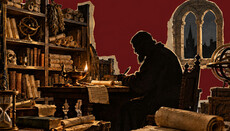
"The Ladder" is written in incredibly complex, high-class Greek. This is not the language of a simple monk who went to a monastery in adolescence. This is the language of rhetoric and jurisprudence. To master words, metaphors, and logical constructions in this way, John must have not only received the best education of that time but also spent many years immersed in that intellectual sphere. An interesting fact: he bore the nickname “Scholasticus.” In the 6th century, this did not mean a “schoolboy,” but rather a “lawyer” or “a person with a legal education.”
Psychology of manipulation
The official version of the life says that John was pure in thoughts and lived in a cave in prayer. But read his chapters on vanity, anger, and falsehood. He describes the subtlest mechanisms of how people manipulate each other, how worldly flattery works, and how selfish the human mind is. Such depth of psychological analysis cannot be obtained by sitting in a cave from age 16. To dissect passions in this way, one would need to have observed them in "high society" for years at minimum.
"The Ladder" is not an inspiration that fell from heaven but the result of colossal analytical work and the deepest experience of the soul.
John appears here as a sociologist of the desert. He classifies monks as a biologist classifies species.
Algorithm for "hacking" consciousness
In the sixth century, a work was written that tells, in modern terms, how to "reprogram" neural connections. Look at the strict sequence in which he systematized the process of "hacking" our consciousness:
- SUGGESTION. Simply a "pop-up window." For example, a thought flashed: "Shouldn't I eat some cake?" At this stage there is no sin, it's just an incoming data packet.
- COUPLING. You begin to examine this window: "The cake looks delicious..."
- ASSENT. You click "OK." The will joins with the thought.
- CAPTIVITY. A state when you can no longer think about anything else. The processor resource (mind) is completely occupied with processing "cake."
- PASSION. The virus is written into autostart. Now you want cake automatically, without even thinking.
These are the stages through which any thoughts go. The only question is the speed of their passage. Anger passes through them swiftly, other thoughts move more slowly.
Cache clearing and kintsugi scars
Using the example of vanity, St. John Climacus showed that our Ego is a self-learning algorithm. The more we clean it, the more sophisticated forms it takes. The solution for vanity is only one – complete ignoring of evaluative judgments from others.
And how wonderfully Saint John described the passion of resentment! These are like logs of old grievances that are constantly loaded into working memory. This consumes all the "processor" resource of the soul, preventing current processes (love, joy) from working. Saint John proposes a hard "Reset." Until you clear the cache (forgive), the system will lag and produce errors in all other areas of life.
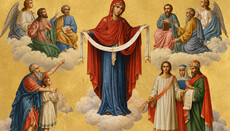
On the icon that we see in churches on the Sunday of Saint John Climacus, monks are depicted climbing to heaven on a ladder, and then falling down.
You can reach almost to the very end, but this doesn't guarantee that you won't fall again.
This image evoked in me completely different feelings than the icon's author intended.
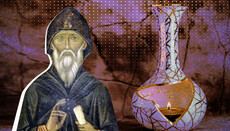
I remembered the Japanese art of "kintsugi." A broken cup or pitcher is glued together, and the cracks themselves are coated with golden lacquer. Scars are not hidden: they become the most precious decoration of the vase. A self-satisfied Pharisee is like a brand-new plastic cup from IKEA – it's whole, but has no soul. A repentant publican is an antique vase assembled piece by piece.
Remember how a bone heals: at the fracture site, a bone callus forms that is stronger than the bone itself. A person who has never fallen is often unbearably cruel and dry. He is "whole" but dead. Our cracks are traces of sins. And the gold in them is not the sin itself, but the sweat and blood of fighting against it. We try to look "whole" before God, while God Himself practices kintsugi, gathering our broken pieces to create something eternal out of them.