
Exhibition on ecclesial Russian fascism touring across Ukraine
Experts believe the exhibition about “Rashism” in the Church is aimed at the UOC, since the authorities portray it as “Moscow's.”
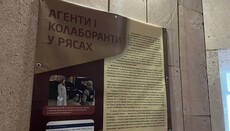
The Ukrainian Institute of National Memory (UINP) has organized a traveling exhibition titled “Ecclesial Rashism” (a blending of Russia and fascism – Ed.), which is being shown one after another in various cities across Ukraine. The display is devoted to the role of the Russian Church in supporting Russia’s war against Ukraine. It also defames the UOC.
The exhibition was first presented in Kyiv in November 2025. The organizers set it up outdoors in a small park near the “Kontraktova Ploshcha” metro station, next to the monument to Hryhorii Skovoroda. The stands featured materials describing how Russian clergy justified military aggression by echoing the theses of state propaganda.
On December 12, 2025, the exhibition moved to Kremenets, where it opened on Maidan Voli. The opening was accompanied by a roundtable on the contemporary challenges of Ukrainian Orthodoxy, organized jointly with the Kremenets–Pochaiv State Historical and Architectural Reserve.
On January 14, 2026, the exhibition began operating in Vinnytsia. It was placed in the historic building of the Artinov Tower.
Vinnytsia mayor Serhii Hula said that “the exhibition shows how church structures of the Russian Federation for decades have formed instruments of influence for the destruction of Ukrainian identity, the rewriting of history, and the substitution of spiritual reference points.”
Experts note that the exhibition has a propagandistic character and, in the end, is directed against the UOC, since the authorities are trying to present it as a “Moscow church.” In particular, the exhibition contains outright fakes. For example, it claims that UOC priest Mykhailo Pavlushchenko allegedly helped the Russian army on the second day of the invasion – a claim the police refuted the very same day. The exhibition also presents fakes alleging that Russian servicemen and weapons were hidden in UOC churches, and that clergy cooperated with occupation administrations. Separate stands are devoted to stories about interactions between the ROC leadership and Soviet special services – the KGB and the NKVD.
UINP head Oleksandr Alferov stated that the ROC was allegedly created in 1943 by Stalin’s order after the Soviet authorities themselves had banned it.
A representative of the State Service for Ethnopolitics, Viacheslav Horshkov, called the ROC’s activity “the crime of using what is holy for a criminal purpose.” The organizers emphasize that the exhibition demonstrates the deep historical roots of "Rashism" – from tsarism to the USSR – and the role of the ROC as an important mechanism in this chain.
The exhibition also includes information about the destruction of Orthodox churches and the persecution of clergy in occupied territories. According to the data presented, 67 clergy of various confessions in Ukraine have been killed at the hands of Russian occupiers.
Earlier, the UOJ wrote that, according to Alferov, the “cultured Germans” of Hitler’s era cannot be compared with “uncultured Russians.”