Double standards: How the U.S. interferes in the life of the Orthodox Church
What lies behind U.S. officials’ concern for the rights of Orthodox Christians?
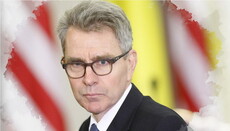
On March 5, former U.S. Ambassador to Ukraine and current Ambassador to Greece Geoffrey Pyatt made a striking statement at a conference in Athens devoted to disinformation and news manipulation, claiming that Russia was seeking to undermine the authority of Patriarch Bartholomew: ”We’ve seen evidence of this kind of manipulation of information in Greece. We’ve seen Russian efforts in the Church, the efforts to undermine the role of the Ecumenical Patriarch.”
He stressed in particular that the main purpose of the Athens event was “to raise awareness so that Greece’s democratic institutions, Greece’s free press – all of which are quite strong – can be vigilant and able to respond.”
It is not difficult to guess what kind of “response” is expected – one that is correct from the U.S. point of view. And there is only one criterion for what is “correct”: the U.S. government supports those who serve the interests of the American state.
It is presumably on this basis that Geoffrey Pyatt regards any criticism of Patriarch Bartholomew as an attempt to “undermine his role,” while the State Department’s full-fledged support for the Phanar is presented merely as a defense of “religious rights and freedoms.”
But things are not quite so simple.
The State Department and the Tomos
The U.S. government has never concealed the fact that the “church issue” has been, and will remain, an important element of its policy in Ukraine. The Tomos and everything surrounding it therefore received strong backing from the State Department. Here are just a few recent examples.
Among the first to congratulate Ukrainians on receiving the Tomos were not representatives of neighboring countries such as Poland or Lithuania, but officials at the U.S. Embassy in Kyiv. On December 16, the day after the “Unification Council,” they wrote on Twitter: “We support the right of all Ukrainians to worship as they choose. Tolerance and restraint are key to a peaceful transition period, so that people with different religious affiliations can live and prosper together.”
On December 17, State Department Deputy Spokesperson Robert Palladino said: “The establishment of this Church was a historic event for Ukraine. The United States continues to strongly support Ukraine and believes that religious freedom must not be impeded by outside interference. Religious freedom extends to all Ukrainians, including those who choose to join or not to join the new Orthodox Church.”
On January 10, that is four days after receiving the Tomos, U.S. Secretary of State Michael Pompeo wrote: “The January 6 announcement of autocephaly for an independent Orthodox Church of Ukraine marks a historic achievement as Ukraine seeks to chart its own future. On this momentous occasion, the United States reiterates its strong support for a sovereign, independent Ukraine.”
“The creation of this Church was a historic event for Ukraine. The United States continues to strongly support Ukraine and believes that religious freedom must not be impeded by outside interference.”
Robert Palladino, Deputy Spokesperson for the U.S. State Department
On February 8, U.S. Ambassador for International Religious Freedom Samuel Brownback said that Washington was “pleased to see” the actions of Constantinople Patriarch Bartholomew on creating a new church structure in Ukraine and believe that they should be implemented.
For his part, the head of the Kyiv Patriarchate Filaret Denysenko awarded former CIA Deputy Director Jack Devine with the Order of St. Andrew the First-Called, and “Metropolitan” Epifaniy Dumenko thanked the United States for its support.
The U.S. position on church affairs in Ukraine prompted a number of Ukrainian and foreign experts to conclude that the State Department not only supported the granting of the Tomos to the OCU but, in a sense, also oversaw the process. Ukrainian political analyst Andriy Vydyshenko, for example, believes that U.S. politicians have the ability to exert pressure on the Phanar by using the Greek Orthodox Archdiocese of America as an instrument of political influence.
There is nothing particularly surprising about this, since the United States and the Phanar have maintained close and productive cooperation for a very long time.
The State Department and the Phanar
On October 27, 2018, former US Vice President Joseph Biden, who had repeatedly emphasized the importance of establishing the OCU, was among the guests at the ceremony where Archpriest Alexander Karloutsos received the Patriarch Athenagoras Human Rights Award for his service to the Church and the Greek-American community.
Incidentally, the same event, organized by the Patriarchate of Constantinople at the Hilton Hotel, was attended by Patriarch Bartholomew’s representative, Metropolitan Emmanuel of France – the same hierarch who later presided over the schismatic “Unification Council.”
So, during the award ceremony, Fr. Alexander Karloutsos, addressing Joseph Biden, said: “Our political ties to the Oval Office began when then-Archbishop Athenagoras was called in November 1948 to lead the Holy See of St. Andrew as an element of the Truman Doctrine and the Marshall Plan, to prevent the First Throne of Orthodoxy from falling into the communist hands of Stalin’s Soviet Union. That is why President Truman personally decided to send his trusted friend to Constantinople aboard his presidential aircraft, then known as the Sacred Cow.”
Father Alexander is no ordinary figure. He serves as executive adviser to the Faith: An Endowment for Orthodoxy and Hellenism foundation, whose purpose is to finance institutions of the Greek Orthodox Archdiocese of America. Many analysts regard the foundation as one of the instruments of American influence in Greece. So he knows what he is talking about.
“President Truman personally decided to send his trusted friend to Constantinople aboard his presidential aircraft, then known as the Sacred Cow.”
Fr. Alexander Karloutsos
Indeed, much has been written about the election of Patriarch Athenagoras and the role played by the United States in the process. One of the most detailed examinations of the circumstances surrounding the event can be found in the article by priest Pavel Ermilov, “The Incorporation of the Patriarchate of Constantinople into U.S. Foreign Policy in the Early Years of the Cold War.”
Athenagoras emerged as a candidate after Patriarch Maximos refused to cooperate with U.S. intelligence agencies – cooperation that was extremely important to Washington in its confrontation with the Soviet Union. Behind the lofty rhetoric about promoting universal values and combating the “communist menace” stood the ordinary political interests of the American state. And as a U.S. citizen, Patriarch Athenagoras was particularly well suited to defend those interests.
For example, in one of his first interviews with the Evening Independent, the newly elected Patriarch of Constantinople said: “I will always promote America and American interests, live American ideals and preach them. I will never forget this great country.”
The Patriarch of Constantinople’s openly stated position and direct support for American interests caused unease even among members of the U.S. political establishment. U.S. Consul General in Istanbul Robert Macatee wrote to the State Department:
“During my first official visit to Ecumenical Patriarch Athenagoras on April 1 [1953], the Patriarch devoted much of his time to expressing his love and admiration for the United States and all that our country symbolizes. He went so far as to say that he regarded the promotion of American ideals as the cornerstone of his work as Patriarch. His expressions of admiration for the United States were at times so excessive that I found them almost embarrassing. I could not escape the feeling that if, as a Turkish citizen, he expressed these views just as openly before non-Americans, he would immediately be branded as something of a professional lobbyist for American interests; his influence in Turkey and among Orthodox Christians would decline accordingly, and some would regard his statements as little more than American propaganda. As I understand it, his initiatives had previously been met with skepticism in certain circles for precisely this reason, something of which I believe the Department should be aware. In this connection, I would be inclined to recommend that we do everything possible to encourage greater subtlety in the Patriarch’s expression of his understandable pro-American sentiments, and that our future relations with him be handled delicately enough to avoid associating him too closely with us.”
The State Department and Mount Athos
The Phanar did not merely associate itself with U.S. foreign-policy interests; it also cooperated with Washington on matters that were purely ecclesiastical. And it did not simply cooperate – it received directives and acted on them.
In 1957, for example, Patriarch Alexy of the Russian Orthodox Church asked Patriarch Athenagoras to allow ten young monks to join the Russian St. Panteleimon Monastery on Mount Athos. Priest Pavel Yermilov describes what happened next:
“Patriarch Athenagoras immediately hands Patriarch Alexy’s letter to the American consul in Istanbul. The consul takes the letter and sends it to the State Department. The correspondence has survived; the documents exist and can be examined. He sends the letter directly to the State Department asking how he should respond. Just imagine: U.S. Secretary of State Dulles himself cables Istanbul to say that a favorable response to the letter would not be consistent with Western interests in the region.”
“I will always promote America and American interests, live American ideals and preach them. I will never forget this great country.”
Patriarch Athenagoras of Constantinople
One might say that all this happened long ago and has nothing to do with either our own time or our country.
Yet many Orthodox Christians were deeply troubled by the fact that one of Mount Athos’s most respected abbots, Ephraim, was expected to attend Epifaniy’s “enthronement.” Believers asked what could lie behind what they saw as such a betrayal of Orthodoxy. An answer was offered in the article “How the Elect Are Tempted, or Why Athonite Abbots Were Going to Epifaniy.”
As it turned out, on April 14, 2018, Sam Brownback, the aforementioned U.S. Ambassador-at-Large for International Religious Freedom, held talks with Patriarch Bartholomew. Brownback also flew to Kyiv on September 11, at the height of negotiations over bringing the schismatic groups together into a single religious structure.
Then, on April 17, Geoffrey Pyatt visited Vatopedi Monastery on Mount Athos – the same diplomat who later complained that Russia was seeking to discredit the role of the Patriarch of Constantinople. Pyatt wrote on Twitter: “Honored to meet Metropolitan Hierotheos of Nafpaktos at Vatopedi. We had an important discussion about Orthodoxy worldwide and U.S. support for the Ecumenical Patriarchate.”
On October 12, 2018, Archimandrite Ephraim was invited to Washington, where he visited the White House and the State Department. There he discussed support for the Patriarchate of Constantinople with Eugene Fishel, head of a division within the State Department’s Bureau of Intelligence and Research; Wess Mitchell, Assistant Secretary of State for European and Eurasian Affairs; Deputy Assistant Secretary George Kent; and Sam Brownback, who played one of the central roles in the operation to establish the OCU. Only after these “friendly” meetings did Abbot Ephraim travel to Ukraine...
American-style concern for Orthodoxy
As we can see, the American state is more than actively involved in Ukraine’s religious life. This makes Geoffrey Pyatt’s accusations that Russia is attempting to undermine the role of the Patriarch of Constantinople all the more striking. The fact that Pyatt himself discusses the establishment of the OCU in Ukraine with the primate of the Church of Greece apparently does not trouble him in the least. Nor, apparently, does the constant contact between Mount Athos’s civil authorities and the abbots of Athonite monasteries.
Yet as soon as the civil governor of Mount Athos, Konstantinos Dimtsas, prepared for a visit to St. Petersburg, the same U.S. official began instructing the Greek media on how the visit should be covered and how Orthodoxy in general should be discussed. And this despite the fact that neither he nor any other representative of the U.S. government has any need for Orthodoxy as the faith of millions of people.
Yet for some reason they do need a “united Orthodox Church of Ukraine.” Why? U.S. citizen and UGCC “bishop” Borys Hudziak offered an answer: “With one Church, it will be easier to conduct theological, spiritual and ecumenical dialogue.”
Apparently, the U.S. State Department decided, first, that the OCU should serve as a powerful instrument for weakening the role of the Moscow Patriarchate in world Orthodoxy and, second, that all Ukrainians should be merged into a single religious body: not only would this make it clearer whom one is dealing with, but it would also make it easier to achieve “ecumenical unity.” With whom? We know with whom.
So when we hear the U.S. government suddenly expressing concern that Orthodox Christians somewhere are being mistreated, we should not rush to conclusions. Most likely, its representatives are concerned not with making Orthodoxy more secure or ensuring that Orthodox Christians enjoy the same rights as everyone else in the civilized world, but with protecting their own allies – allies whom they would abandon without hesitation or remorse if the interests of the American state required it.
Orthodoxy, religious freedom and human rights have nothing to do with it.