Prince Volodymyr and his legacy
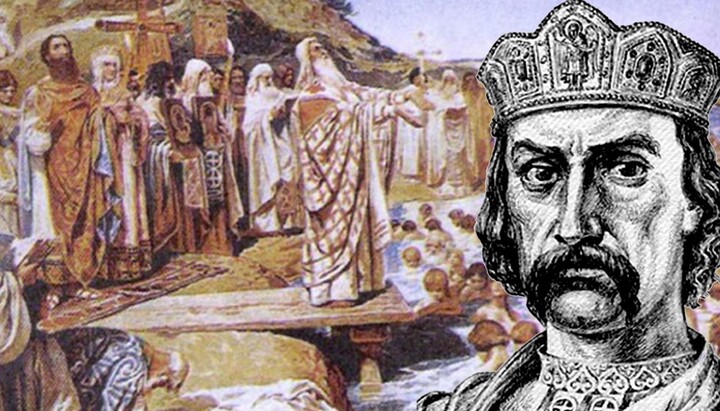
Prince Volodymyr the Great. Photo: 24tv.ua
Grand Prince Volodymyr was not a deeply spiritual or devout man by nature. His life included mistakes, blatant transgressions, and even crimes. Yet the time came when he baptized Rus’, giving the people the apostolic faith that united them into a single nation. One might ask why he is venerated under the name Volodymyr – the name by which he is known as a pagan and for most of his life an enemy of Christianity – rather than his Christian name Basil.
This is a paradox. It is with this name – Volodymyr – that the prince entered history, much like the holy right-believing princes Borys and Hlib (baptized as Roman and David), Princess Olha (baptized as Helen), and others. Conversely, Prince Sviatoslav Davydovych of Lutsk is venerated by the Church as the Venerable Nicholas Sviatosha because, at age 26, having lost his princely domain, he embraced monasticism and labored more in the monastery than he had as a ruler. He is remembered by the people precisely as Nicholas Sviatosha, and a district of Kyiv – Sviatoshyn – bears his name.
Why are some princes (and not only princes) venerated by the Church under their baptismal names, while others are remembered by their secular names? Because they are commemorated in the way in which they most labored for the good of their people. And since Saint Volodymyr contributed greatly to the establishment of the Orthodox Church, he is remembered first and foremost as a great prince – hence, under his princely name he entered the history of our land.
Prince Volodymyr labored more as a ruler, while his Christian name is sanctified by his personal, not public, ascetic life of prayer.
From the Tale of Bygone Years (Primary Chronicle), we know that the pagan prince at one point revised his worldview. His heart and mind were moved by the martyrdom of the Scandinavian Christian warriors – his finest companions – Theodore and his son John, who rebuked paganism and refused to be sacrificed to an idol. Theodore and John were distantly related to the prince, as they were all descendants of Rurik.
Prince Volodymyr was deeply shaken by the behavior of these first Orthodox martyrs on our soil, for whom remaining with Christ was more precious than life itself. He became intrigued by this unusual and seemingly “impractical” faith whose adherents remained loyal to their Teacher even unto death, while also exhibiting exemplary qualities as citizens of their state. Volodymyr began sending emissaries to various countries. We know of his wise decisions. He rejected Judaism due to the lack of a Jewish state: “Do you want us to become scattered across the earth like you?” This refusal shows his concern for the integrity of his own state.
In choosing a faith, the prince demonstrated wisdom: he sought a good religion for his people as much as for himself and chose Christianity, because in this faith his people would be of one mind – and thus could grow and develop harmoniously as a nation.
As a statesman, Prince Volodymyr is known for ordering that children be taught to read and that food be distributed to the poor and needy. After embracing Christianity, he dismissed his wives and concubines and entered into only two lawful marriages: first with the Greek princess Anna, and after her death – with the unnamed “stepmother of Yaroslav,” as the chronicle records.
As a Christian prince, though he still applied coercion in his beneficial state policies, he did so with less fervor: it was not easy to wean the people from paganism, and force was sometimes necessary – which he employed to help his people embrace Christianity.
Of course, Prince Volodymyr had known of Christianity before: Prince Askold of Kyiv was Christian, as was Volodymyr’s grandmother, Princess Olha; Prince Ihor of Chernihiv was also Christian. According to the chronicle, there were Christians among the retinue of Prince Ihor, Olha’s husband.
Through the labors of his forebears, the prayers and efforts of Christians, and his own wise policy, the prince preserved and strengthened the Christianity that had existed on the lands of Kyiv before him, rather than replacing it with another faith.
Perhaps it is through the prayers of Prince Volodymyr’s princely predecessors that our people today have once again found themselves ready to confess their faith and to bear witness in the face of adversity. And this witness has become so powerful that people have begun to perceive a Christianity previously unnoticed among their own – a faith that sanctifies human life, helps one turn away from sin, amend one’s ways, and build a proper hierarchy of values with God at the center – a right relationship with God, the world, and other people.
The wisdom of Prince Volodymyr as a ruler, and of his people, helped our nation acquire the inner foundation that preserved both the people and the state in their integrity. As heirs of Prince Volodymyr and his people, mindful of the bright pages of our history, let us strive to imitate our ancestors in goodness, so that we may remain worthy successors who do not squander their precious legacy.
Read also
A shepherd boy with a letter from Christ to French king
In the summer of 1212, thousands of pilgrims carrying staffs waited for the sea to part before them. Later chroniclers added ships, slave traders, and a pope's lament to their story.
Facade of bones and facade of light
Antoni Gaudí spent forty-three years building a church in Barcelona, knowing that this construction was for the ages.
Trial of a dead pope
Once in Rome, the body of a deceased pope was seated on the throne and put on trial. The accusation relied on a church canon that had once saved his see.
Monastery built in defiance of king
When Orthodox believers in Minsk were left with just one church, townspeople decided to build another – and even a royal decree did not stop them.
Young Mother and Sleeping Christ
Michelangelo carved a Virgin Mary who looks younger than her Son – and signed his name in marble for the only time in his life. Neither of these peculiarities was accidental.
Orthodox books from a Uniate printing press
In the 18th century, Uniate monks at Pochaiv printed books used in prayer by Orthodox Christians and Old Believers alike.