Expert: Up to half of all monasteries on Mount Athos are opposed to OCU
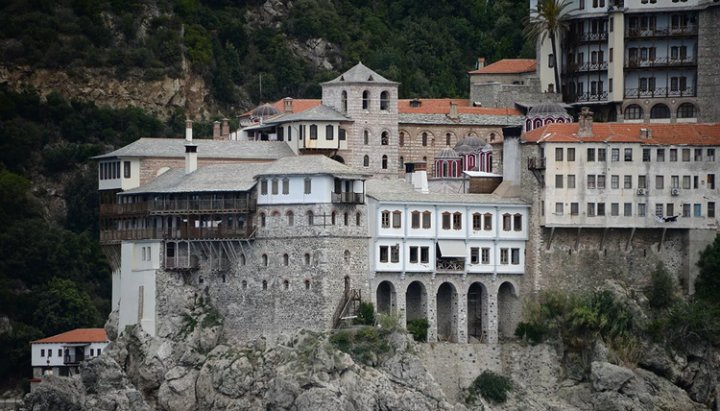
The expert named the Athonite monasteries opposed to supporting Ukrainian schismatics. Photo: RIA Novosti
Up to half of all monasteries on the Holy Mount Athos do not support of Ukrainian schismatics and criticize the activities of the Patriarch of Constantinople. The historian and one of the founders of the publishing house "Svyataya Gora" Athanasios Zoitakis said this in a comment to RIA Novosti.
The expert admitted that there is no unified position on the "Ukrainian issue" on Athos and the schism that has arisen in the Orthodox world, and "there is a division on the peninsula."
“Those monasteries on Mount Athos that are quite skeptical about the recognition of Ukrainian autocephaly are the same monasteries that were just as skeptical about the Cretan Council in 2016 and about the ecumenical course of Patriarch Bartholomew in general,” Zoitakis said. “These are primarily monasteries founded by the disciples of Elder Ephraim of Arizona (1928-2019): Philotheou, Caracal, Xiropotamou and Constamonit. They are the most radical in this regard."
In particular, he recalled, the Constamonit monastery was the only one of 20 Athonite monasteries that did not participate in the meeting of the head of Phanar on Mount Athos in October 2019 and did not even send a representative to the meeting.
In addition, the opponents of the current Patriarch of Constantinople, according to the expert, include the monastery of St. Paul, whose abbot "is very critical of the modernist steps of Bartholomew", as well as Dochiariou, the Serbian Chilandariou and the Bulgarian Zografou, "because they follow the positions of their Churches", Russian Panteleimon Monastery and Grigoriat, in which "there is also a very, at least, a very skeptical attitude towards Ukrainian schismatics."
Also, Zoitakis said, in addition to monasteries, there are many sketes and cells on Athos – small monastic communities, and their position is also very heterogeneous and often sharply critical in relation to the course of the head of Phanar. In particular, he recalled the statement made by a number of Athonite cells in March 2019, who condemned Patriarch Bartholomew for recognizing Ukrainian autocephaly.
The expert believes that the ROC in relation to Athos had better adhere to the same principles as in relation to the Alexandrian, Greek and Cypriot Churches, viz. "to be in communion with those brotherhoods that do not recognize schismatics and consistently oppose the non-canonical steps of the Patriarch of Constantinople."
Let us recall that after the creation of the OCU, the Russian Orthodox Church ceased Eucharistic communion with the Patriarchate of Constantinople, including with Athos subordinate to it. An exception was made only in relation to the Russian Panteleimon Monastery.
Earlier, the UOJ wrote that in 2019, protest inscriptions against Patriarch Bartholomew appeared on Athos.
Read also
Activist targeting UOC lawyers wears clothing with Nazi symbols
Davyd Pshenychnyi, a radical who opposes the UOC, was photographed wearing clothing by Svastone, a brand that describes itself as pagan.
TRC mobilizes 24-year-old UOC hieromonk on his way to study in Athens
Hieromonk Viktor (Denysov), a student at a university in Athens, said he was taken off his flight and brought to a TRC and is now serving with the 8th Special Operations Regiment.
Shevchuk thanks Catholic cardinal for visit to Russia
The UGCC head called Catholic Cardinal Matteo Zuppi’s visit to Ukrainian prisoners held in Russia an extremely important step.
‘Won’t find a girl better than you’: UGCC clergy dance on church porch
In Ternopil, UGCC clergy danced to a wedding song on the steps of a church and tossed candy into the crowd.
Metropolitan Onuphry consecrates Church of Sts. Cosmas and Damian in Kyiv
On the feast day of the “She Who Is Quick to Hear” Icon of the Mother of God, the UOC Primate consecrated a Kyiv church dedicated to the Holy Unmercenaries Cosmas and Damian.
‘This is not how freedom is done’: Met. Theodosiy on secret Phanar report
The Cherkasy hierarch said the Constantinople cleric’s report on the 2018 “council” shows that the fate of “autocephaly” was determined not by the canons but by the authorities and security services.