German expert: Raids of UOC temples presented to the West as "transitions"
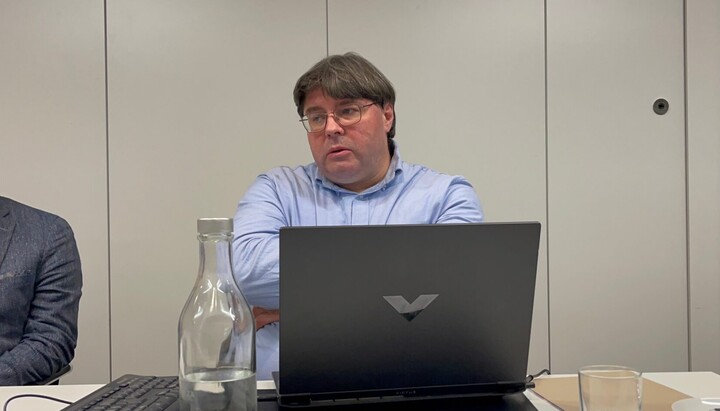
Nikolai Mitrokhin. Photo: Baznica.Info
At a theological conference in Berlin dedicated to state-confessional relations in Ukraine, religious commentator Nikolai Mitrokhin analyzed the situation regarding the "transitions" of communities from the UOC to the OCU, as reported by the Latvian resource Baznica.Info.
According to him, there are no independent professional studies of the religious space in Ukraine, which leads to many examples of manipulation to distort the results of voting.
"Ukraine is a multi-confessional and multinational state. Accordingly, no Orthodox Church can claim the position of 'the church of the Ukrainian people', including because the support of it by the ruling authorities does not necessarily mean its support and recognition among believers," emphasized the sociologist.
He mentioned that cases of majority community members transitioning from one church to another do exist, but they are an absolute minority and are not contested within the UOC.
However, the majority of "transitions" either signify schisms in former communities, often accompanied by disputes over church ownership, or involve active pressure from external forces on communities (primarily local authorities and activists of socio-political organizations previously not involved in active faith practice and community membership), or involve the direct seizure of churches and parish property from the "wrong" church in favor of the "national" one through administrative or blatantly illegal methods, often involving direct violence.
He clarified that this property is not always subsequently used for religious purposes. The expert stressed that supporters of the OCU describe such situations as "transitions" in all cases, thereby completely discrediting this term.
Mitrokhin asserts that many (if not the majority) of the "transitioned" communities remain and conduct regular services, as the overwhelming majority of the clergy refuse to participate in these "transitions".
He also placed responsibility for religious conflicts on the state authorities, which, during Poroshenko's presidency, began to grossly interfere in the affairs of denominations.
The conflict began with direct state intervention in the sphere of religious relations and is primarily sustained through political accusations and state pressure practices. Xenophobic statements by church figures and the involvement of priests and church activists are of secondary importance. According to Nikolai Mitrokhin, state interference in this sphere could become a topic of discussion between EU representatives and the Ukrainian government.
Earlier, the UOJ wrote that violations by the Ukrainian authorities against the UOC were reported at the Berlin Consultation.
Read also
TRC releases UOC priest from Vilniansk after two days in detention
Archpriest Viacheslav Honcharenko was released from the Zaporizhzhia TRC following two days of efforts by his lawyers and family.
Karas urges to “de-occupy” UOC churches after Trump’s remarks on Zelensky
Radical activist Yevhen Karas said that following Trump’s call for Zelensky to step down, nothing stands in the way of seizing all UOC churches.
Lutsk cathedral holds memorial service for victims of Russian attack
A memorial service was held at the Cathedral of All Saints of Volyn for those killed in the Russian attack on October 14.
UOC’s Holy Protection Monastery in Kharkiv celebrates 300th anniversary
Metropolitan Onufriy of Kharkiv and Bohodukhiv led a Divine Liturgy and cross procession to mark the monastery’s 300th anniversary.
For EU integration, Zelensky approves LGBT rights protection strategy
Zelensky signed a decree approving a National Human Rights Strategy that identifies LGBTQI+ people as a group at heightened risk of rights violations.
Lavra lawyer details attack on him at court hearing
Lawyer Valerii Kushnir has filed a police complaint over threats and physical assault during a hearing at the Northern Commercial Court of Appeal.