Greek theologian on OCU: Tomos is not magic that turns laymen into bishops
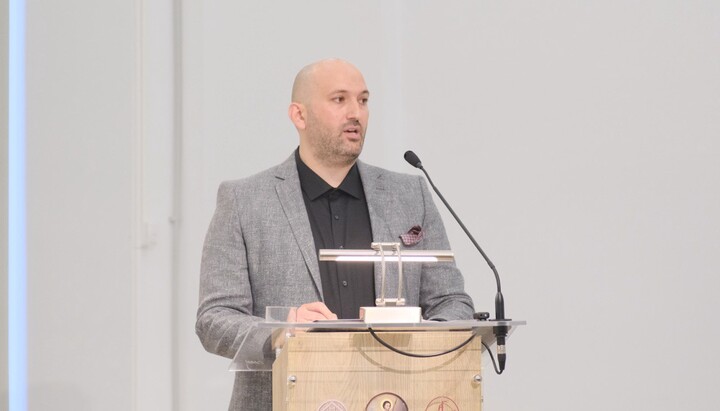
Theologian Vasilis Touloumtzis. Photo: UOJ
At a theological conference held in Piraeus, Greece, theologian Vasilis Touloumtzis delivered a sharply critical address regarding Constantinople’s decision to grant autocephaly to the Orthodox Church of Ukraine (OCU), reports a UOJ correspondent. His presentation was titled: “The Ecclesiastical Evaluation of Non-Reordination According to the Seventh Ecumenical Council and the Ukrainian Crisis.”
According to the Greek theologian, the group that received the tomos of autocephaly from the Ecumenical Patriarch in January 2019 consisted of three categories: former canonical bishops who broke away from the UOC, members of schismatic structures, and self-proclaimed “bishops” who very likely lack sacramental grace.
“Though these three cases have distinct ecclesiological characteristics, all were accepted through one and the same procedure, in precisely the same way. Every one of them was recognized as a bishop of the Church,” Touloumtzis noted.
Autocephaly does not confer priesthood
The theologian emphasized the fundamental difference between reinstating someone in the priesthood and granting autocephaly:
“It is impossible for an administrative act like autocephaly to magically bestow the priesthood upon individuals who never received it and perhaps never belonged to the Body of the Church,” he stated.
According to Touloumtzis, this creates an unprecedented paradox – “where a group that possesses a tomos of autocephaly is not, in fact, a Church.”
He explained: “For a Church to become autocephalous, it must first of all be a Church to begin with. The Church comes into being and functions wherever there are valid sacraments, sanctifying grace, and the priesthood.”
A direct misuse of the Seventh Ecumenical Council
The theologian accused OCU supporters – among both theologians and hierarchs in the Greek world – of distorting the rulings of the Seventh Ecumenical Council to justify uncanonical decisions.
“Studies that attempted to theologically justify the reception of Ukrainian schismatics were essentially exercises in intellectual acrobatics aimed at lending theological cover to an ecclesiologically unsound decision of the Ecumenical Patriarchate,” he stated.
Touloumtzis emphasized that the Seventh Ecumenical Council addressed the issue of accepting bishops who had originally received valid ordination within the Church before falling into the heresy of iconoclasm. In the case of the Ukrainian schismatics, the situation is fundamentally different.
Toward the ecclesiology of branches
In his view, the approach used in the Ukrainian situation leads toward the “branch theory” of ecclesiology – a view characteristic of post–Vatican II Catholicism, which recognizes the presence of valid sacraments across all historical churches.
“Since non-reordination assumes the prior existence of valid priesthood – and in this case, the approach has no limitations – it effectively implies that heretics and schismatics, in principle, do not exist,” the theologian explained.
Conclusion
“The practice employed for receiving and recognizing the Ukrainian schismatics has no connection whatsoever to the Seventh Ecumenical Council and is not compatible with Orthodox ecclesiology, which does not acknowledge valid sacraments or priesthood outside the Church,” Touloumtzis concluded.
The theologian stressed that the Ukrainian church crisis, as an ecclesiological issue, will remain unresolved so long as Orthodox ecclesiology is sidelined and solutions are sought within geopolitical power centers – which, he added, “neither ordain nor restore but only command.”
Earlier, the UOJ reported that at the same conference in Piraeus, Metropolitan Seraphim declared that the reinstatement of Filaret and Maletich by the Ecumenical Patriarchate was invalid.
Read also
Kyiv conscription officers abduct UOC priest
TRC officers reportedly abducted Maksym Kostiuchenko, a cleric of a UOC church in the Ukrainian capital.
Court grants DESS lawsuit to dissolve UOC’s Rovenky Eparchy
The appeals court partially granted the DESS lawsuit seeking to dissolve the Rovenky Eparchy but rejected the request to seize its property, citing a gap in Ukrainian legislation.
Met. Meletiy consecrates house of worship for UOC community in Dankivtsi
Members of the persecuted UOC Intercession parish in Dankivtsi have converted a house into a place for communal prayer and worship services.
OCU eparchy sells church center site to developer for housing
The OCU’s Volyn Eparchy sold land intended for a spiritual center to a private developer planning to build townhouses and residential buildings.
SBU names UOC priest’s wife a suspect in Cherkasy region
The SBU accused Matushka Kateryna Prykotenko of “spreading enemy propaganda” through correspondence with parishioners.
UGCC cleric calls Russian Orthodox literature dangerous for clergy
While examining the causes of divisions within the UGCC, Yustyn Boiko concluded that Russian Orthodox literature had influenced Greek Catholic clergy.