Romanian Church responds to Ukraine's call to recognize OCU
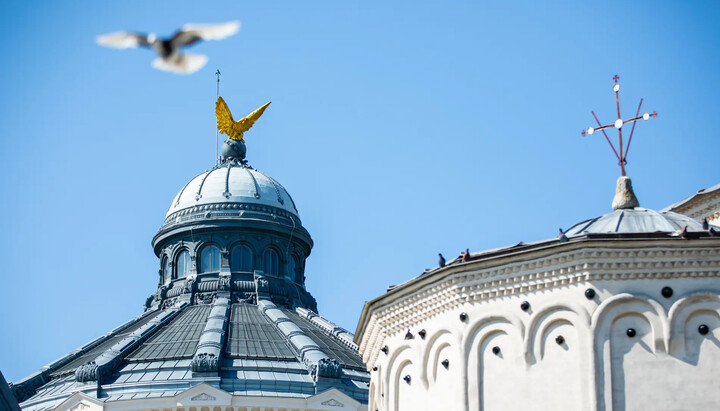
The Conference Hall of the Romanian Patriarchate. Photo: Basilica
The Romanian Patriarchate responded to the call of Ukrainian Ambassador Ihor Prokopchuk to recognize the OCU, which he voiced shortly after Dumenko's structure attempted to seize the Holy Spirit Cathedral in Chernivtsi. The Romanian Church explained its position in the Romanian publication Stiripesurse.
As the publication writes, "The Romanian Patriarchate emphasized the hostile attitude of the Ukrainian state towards the Romanian believers in Ukraine , by failing to respect the rights regarding the practice of faith, in total contradiction with the attitude of the Romanian state towards the Ukrainian parishioners in Romania."
The Patriarchate stressed that regarding the church situation in Ukraine, the point of view of the Romanian Orthodox Church remains that formulated by the Holy Synod in its working session held on February 21, 2019, namely: "For almost 30 years, the problem of the schism in Ukraine has not been resolved, nor has there been an appeal for pan-Orthodox mediation, as was done in the case of the schism in Bulgaria."
The Patriarchate also highlighted that the Synod's decision included a call for convening a pan-Orthodox council if the establishment of the OCU does not resolve the Ukrainian issue.
The Romanian Church emphasized: "Following consultations with Romanian Orthodox clergy and laity in Ukraine, the majority of them firmly reject, even with fear, their possible transfer to the jurisdiction of the Orthodox Church of Ukraine."
The Romanian Orthodox Church notes that recognizing the OCU "will automatically lead to increased pressure (on Romanian believers of the UOC. – Ed.) from the Ukrainian authorities to force them to come under the jurisdiction of Metropolitan Epifaniy."
The Patriarchate also criticized the Ukrainian authorities for refusing to register the religious association (administration) of the Romanian Orthodox Church in Ukraine.
Moreover, the promises of the Ukrainian authorities to guarantee the celebration of services in Romanian seem to lack credibility, especially in the context in which the same authorities boast of the celebration of the first service in Ukrainian in a church in Chernivtsi that was taken over abusively, on the frontispiece of which is written in Romanian, in Cyrillic characters: "One in three hypostases - God". This situation raises serious questions about the sincerity and good faith of their actions", the Romanian Orthodox Church also explained.
According to UOJ, in the coming days, a meeting of the Synod of the Romanian Church will take place, where tough decisions regarding the OCU are expected.
Recall, in 2019, the Romanian Church asked Patriarch Bartholomew to clarify the issue of non-canonical hierarchs and priests who belonged to the Kyiv Patriarchate.
Read also
Upper Lavra court hearing postponed
The next court hearing in the Upper Lavra case has been scheduled for November 3.
UOC priest blesses ambulances at Kamianske medical center
A UOC priest in Kamianske blessed ambulances for a medical facility and wished its doctors God's help in their work.
Dumenko to German ambassador: Law targeting UOC also applies to other groups
Epifaniy Dumenko sought to defend Ukraine’s law restricting religious organizations during a meeting with the German ambassador.
Activists bused to court hearings in UOC cases, media say
A minibus has been spotted transporting protesters to and from courthouses where UOC cases are being heard.
Firefighters save historic UOC church from fire in Zakarpattia
A fire broke out at a UOC church in the Tiachiv district, damaging the altar and church furnishings.
Volyn Eparchy faithful collect six tons of aid for Sviatohirsk Lavra
Believers in Volyn collected food and warm clothing for people displaced by the war who have found shelter at Sviatohirsk Lavra.