President of Estonia rejects anti-church bill for the second time
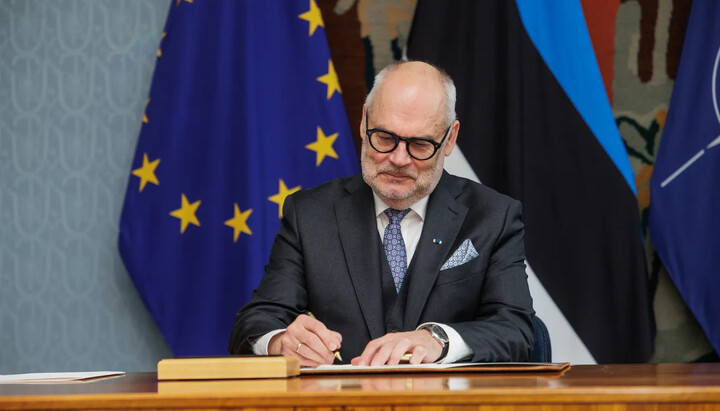
President of Estonia Alar Karis. Photo: Postimees
On July 3, 2025, the official website of the Riigikogu published a message stating that the President of Estonia once again refused to approve the so-called law on churches and parishes, which provides for the possibility of terminating the connections of religious organizations with foreign structures.
President of Estonia Alar Karis declined to promulgate the amendments to the Churches and Congregations Act adopted by the parliament in April, considering it to be contrary to the Constitution. Taking into account his remarks, the Riigikogu prepared a new version and adopted it in the third reading on June 18. However, the president also refused to proclaim this updated version.
"The Riigikogu has indeed amended the text of the Churches and Congregations Act somewhat, but not sufficiently. It still conflicts with three articles of the Constitution and disproportionately restricts freedom of association and freedom of religion," noted the president.
According to the president, the definitions of "threats" and "foreign ties" remain too vague and may affect congregations that do not pose a real danger. "The concept of ‘threat’ is defined so broadly in the law that, according to its wording, it is enough if violence was justified decades or even longer ago. Thus, the law also encompasses religious organizations whose restriction would not align with the intended goals of the legislation," he added.
Alar Karis also drew attention to the desire not only to regulate administrative relations but also to address issues of doctrine and religious practice: "The explanatory memorandum to the law explicitly states that beyond regulating administrative relationships, there is also an intention to regulate church teachings and religious rites," he emphasized.
In addition to the Church law, President Karis also refused to approve the so-called super database law. He pointed out that the system was planned to include information about religious beliefs. According to him, when dealing with such sensitive information, clear guarantees for the protection of citizens' rights are necessary.
Thus, both laws were returned to the parliament for further revision.
The Estonian Orthodox Church (EOC) highlighted that the law adopted by the parliament, despite amendments, still violates the Constitution, restricts freedom of religion, and interferes in the internal life of religious organizations. The EOC emphasized that the law is primarily directed against their Church, as it provides for the severance of ties with the Moscow Patriarchate, and proposals to come under the jurisdiction of Constantinople are voiced against the backdrop of legislative pressure, which excludes the possibility of free and canonical dialogue.
Earlier, the UOJ wrote that the Estonian Church expressed hope that the head of State would make a balanced decision in defense of freedom of religion.
Read also
UOC marks Synaxis of Poltava Saints
Metropolitan Philip celebrated the Divine Liturgy at the Horbanivka Monastery in Poltava on the feast of the Synaxis of the Saints of Poltava.
Rector of UOC church in Kramatorsk sent for second military medical exam
Lawyers have secured a second military medical examination for Archpriest Oleg Kruchinin, who was unlawfully detained by TRC officers.
Jews, Muslims, Catholics, and OCU pray together at St. Sophia Cathedral
Representatives of Jewish, Muslim, Catholic, and OCU communities held an ecumenical prayer service for Ukraine in Kyiv.
Horbanivka Theootokos Icon honored at Poltava Eparchy monastery
Metropolitan Philip of Poltava and Myrhorod led a festal service at the Horbanivka Convent.
Greek hierarch: Clergy should use social media to bring people to Church
The Church of Greece hierarch stressed that while the internet and YouTube can be useful, they cannot replace in-person participation in church life.
Odesa prosecutors appeal UOC church ruling to Supreme Court
The Odesa Regional Prosecutor's Office has appealed to the Supreme Court, seeking to transfer a UOC church to state ownership.