“The road paved with good intentions…”: Reflections on the Church of Cyprus
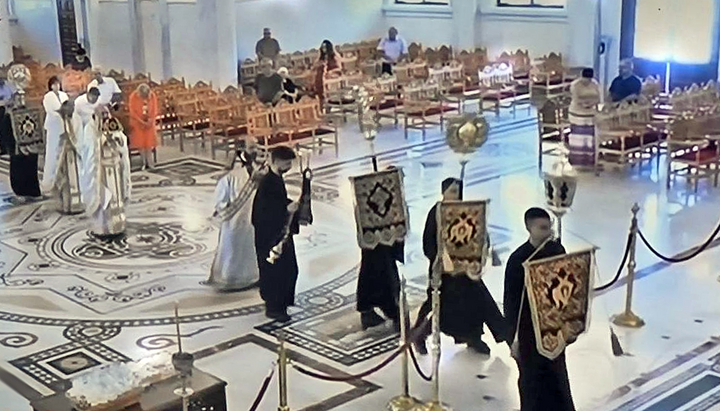
Empty cathedral in Nicosia during the service of Archbishop Georgios. Photo: UOJ
A sorrowful image of an empty church
Looking at the photos circulating across religious corners of the internet, I am filled with mixed feelings of sorrow and hope. In such moments, the ancient adage comes sharply to mind: “The road to hell is paved with good intentions.”
Does not the sight of the majestic Cathedral of the Church of Cyprus – the Church of the Holy Apostle Barnabas in Nicosia – nearly empty on the feast of the Holy Fathers of the Fourth Ecumenical Council (July 13, 2025) stir grief? The Divine Liturgy was celebrated by none other than Archbishop Georgios of Cyprus – and yet the church stood almost entirely deserted.
Why do we see such a disheartening emptiness during the Great Entrance?
Have the people of Cyprus stopped attending church altogether? Hardly – churches in Cyprus are typically filled with faithful.
So what is really happening?
The voice of the People of God
Let Archbishop Georgios, who was serving the Liturgy, reflect on what this tragic image of an empty church might signify. Perhaps it does not reflect a lack of ecclesial consciousness among the faithful, but rather the awakening of their true ecclesial awareness?
Could it be that the very presence of Archbishop Georgios in the Church of the Apostle Barnabas drove the faithful to attend services elsewhere?
Might the absence of believers be a clear form of protest – a sign of disapproval of Archbishop Georgios’ actions?
Is it possible that the people’s healthy church consciousness has risen up against the Archbishop’s unacceptable actions toward Metropolitan Tychikos of Paphos and against the very stance he has taken within the Church?
Might the people, through their absence from the Liturgy, have been proclaiming loudly to the Archbishop:
“Enough, Your Beatitude! You have no right to act arbitrarily! No right to trample on church order, on the Charter of our Church, on the principles of a lawful state! You have no right to disgrace our Apostolic Church in the eyes of the entire Orthodox world! Stop provoking us! Stop leading us into temptation!”
Is there hope that the Archbishop heard this message? I doubt it – but I hope so and pray for it. Otherwise, he will be left to repeat: “The road to hell is paved with good intentions.” But by then, it will already be too late.
A message to the hierarchs of Cyprus
The empty church during Archbishop Georgios’ Liturgy should serve as a warning to the other hierarchs of Cyprus – especially to those who, perhaps out of fear or pressure, and most certainly out of self-interest, participated in the scandalizing of the faithful and the humiliation of the Church of Cyprus before the entire Orthodox world through the unjust and immoral removal of Metropolitan Tychikos of Paphos.
Your Graces! The legally and morally unacceptable “mock trial” of Metropolitan Tychikos – followed by prohibitions on serving, a ban on holding a memorial for his mother, restrictions on his sustenance, threats, and insults – has yielded the opposite result of what was intended: it has elevated Tychikos in the eyes of the people and undermined the credibility of the Archbishop and his supporters.
But even those who now remain silent are not absolved of responsibility. Do not forget the Roman legal maxim: “Qui tacet consentire videtur” – “He who is silent is taken to agree.” Though not part of modern law, it remains a powerful accusation in the eyes of history – which will judge guilty silence with merciless severity.
Thoughts on dignity
To you, hierarchs of Cyprus, I dedicate the words of Professor Aristotelis Manesis:
“In times like these, the main thing is not to protect oneself from persecution, but from humiliation. To preserve one’s dignity – as a human being, as a citizen, as a scholar. And thereby to defend the authority of the university chair you have the honor to hold – a chair that, being a bastion of political liberty, naturally endures political storms, for it stands at the height of its mission...”
(Arist. Manesis, Lecture on Constitutional Law, January 18, 1968)
Final warning
I fear that the judgment of history may be preceded by the protest of outraged believers – a protest aimed squarely at your own responsibility for what is happening in the Church of Cyprus. And then, together with the Archbishop, you will be forced to seek the answer to this question: “Where did our good intentions lead us?” – and recall the saying: “The road to hell is paved with good intentions.”
Read also
Concubine or daughter? On words that cannot be used about the Church
An archon of the Church of Constantinople likened the UOC to Moscow’s “concubine.” But for St. Epiphanius of Cyprus, “concubines” are heresies.
Shameful chronicle of one week: how the OCU was born
Exarchs under escort, a call from the operations room, and 36 votes for Epifaniy: what a member of the Phanar delegation revealed about the 2018 "Council".
Can UOC eparchies be dissolved before court ruling on Metropolia?
DESS is launching separate proceedings against UOC eparchies, monasteries, and institutions while the case involving the Kyiv Metropolia is still pending.
Two murders, one silence
Zelensky condemned the killing of a Catholic priest in Poland the very same day. A month earlier, a UOC monk was murdered at the Sviatohirsk Lavra – and the president has remained silent ever since.
A bow to Phanar? Why did UOC academy congratulate Constantinople’s exarch?
A delegation from the Kyiv Theological Academy congratulated the Phanar’s exarch, who has remained silent about the persecution of the UOC. Who authorized this gesture, and why did even OCU supporters fail to appreciate it?
“De-Moscowize” for unity: Shevchuk’s recipe for bringing Ukrainians together
The head of the UGCC assures that internal division threatens the country's existence, while simultaneously calling to fight against the "wrong" ones. Is this cognitive dissonance or something more?