
A word as a crime: What the court found Metropolitan Theodosiy guilty of
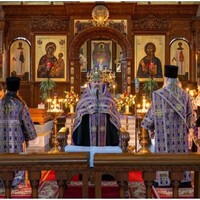

The court delivered its verdict on Metropolitan Theodosiy of Cherkasy: guilty. Of what? We examine the judgment.
On February 6, 2026, the Prydniprovskyi District Court of the city of Cherkasy issued a ruling in the case of Metropolitan Theodosiy (Snihiriov), Metropolitan of Cherkasy and Kaniv. Bad news: the court found him guilty. Good news: the punishment is small – just 8,500 hryvnias, rather than three years in prison, which could have been imposed. There is one more piece of news: the decision is groundless, as will be shown below.
The basis for the verdict
The hierarch was convicted under Article 161 of the Criminal Code of Ukraine: “Violation of equality of citizens depending on their race, nationality, religious beliefs, disability and other grounds.”
Under this article, a crime is defined as: “Deliberate actions inciting national, racial or religious enmity and hatred, humiliation of national honour and dignity, or the insult of citizens' feelings in respect to their religious convictions, and also any direct or indirect restriction of rights, or granting direct or indirect privileges to citizens based on race, colour, political, religious and other convictions, sex, disability, ethnic and social origin, property status, place of residence, linguistic or other characteristics.”
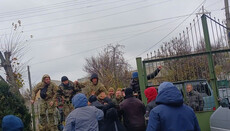
The basis for the guilty verdict was a video of Metropolitan Theodosiy’s pastoral address to the monastic community of the Nativity-of-the-Theotokos women’s monastery, posted on the eparchy’s social media on January 8, 2024. That monastery was seized by supporters of the OCU on November 20, 2023. During the seizure, priests and parishioners were beaten and suffered serious injuries.
In this homily – which is reproduced in full in the text of the verdict – the court claims that Metropolitan Theodosiy “made intentional, public statements aimed at inciting religious enmity and hatred…” and so on, in the language of the article. But first, the court did not examine any evidence at all that the Metropolitan’s intent was directed toward inciting enmity and hatred. And second – what exact words were supposedly aimed at such incitement?
The “criminal” words
The key word because of which the hierarch was found guilty was “Judas.” In the extended form, the phrase sounded like this: “Seven priests served in the monastery under the leadership of an archbishop. One turned out to be a Judas. And all the others serve as they did, and the sisters remain as they were.” The reference, apparently, was to Yosyp Zasanskyi, who appeared as the injured party in the criminal case against Metropolitan Theodosiy. He was so offended by the word “Judas” that he “lost his emotional balance,” experienced “moral suffering,” stopped sleeping peacefully, and so on. He assessed his suffering at 100,000 hryvnias and demanded that this amount be recovered from Metropolitan Theodosiy. The court refused – but more on that later.

How can the word “Judas” ignite religious hatred? In whom, and against whom? After all, first, Metropolitan Theodosiy’s homily was addressed to the monastic community and parishioners of the UOC. Second, it was spoken in the context of concrete circumstances that were grievous for the community – namely, the loss of monastery buildings and property as a result of obvious violence, and the expulsion of the nuns. The homily contained pastoral consolation amid sorrowful circumstances.
And third, the Metropolitan did not name the specific priest to whom the “criminal” word was allegedly addressed. Why, then, did the court decide that the word was said about Yosyp Zasanskyi?
It is hard to believe, but the verdict states that Zasanskyi simply “took it as being addressed to him.” In other words, the basis for the criminal prosecution of Metropolitan Theodosiy was the subjective perception of his words by a person who was not even present when they were spoken.
Paradoxes of the judgment
The text of the verdict contains several statements that contradict one another.
For example, regarding the SBU expert who conducted the analysis of Metropolitan Theodosiy’s homily, the verdict says: “She has no theological education. She did not evaluate the text from the point of view of theology. She evaluated it exclusively within the framework of forensic linguistics.” But the Metropolitan’s speech was precisely a religious sermon addressed to religious people. It carried theological meaning. Can a secular linguist with no theological education interpret church speech while ignoring the genre of a homily and the tradition of the Church’s moral evaluation?
Next point.
The expert conclusions state: “There are no linguistic signs of a call to action against a person or a group of persons.” That is, Metropolitan Theodosiy did not call for any unlawful actions, did not name specific individuals, did not restrict anyone’s rights – yet the court still saw in this “the presence of incitement of religious enmity and hatred.”
No calls to incite were found. No facts were found that hatred was actually stirred up in anyone. Moreover, no harm whatsoever was found from the homily. The person because of whom the criminal case began, Yosyp Zasanskyi, claimed that Metropolitan Theodosiy’s words caused him suffering worth 100,000 hryvnias. But here is what the court established: “The plaintiff (Zasanskyi – Ed.) in no way substantiated and did not confirm with any evidence that the negative emotions and mental suffering of the plaintiff <…> reached the level of suffering that constitutes moral damage subject to compensation by monetary means.”
So if there was no “level of suffering constituting moral damage,” then on what basis did the court hand down a verdict for “inciting enmity”? Or do we now have categories of “paid” and “unpaid” incitement – the Metropolitan incited, but at a level that is free of charge?
The context the court ignored
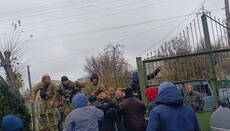
This is another paradox of the court’s decision. The court recorded witness testimony about the violent seizure of the Nativity-of-the-Theotokos Monastery – and with particular brutality. For example, one witness told the court: “We saw people gathering outside in military uniform <…> They climbed over the fence and began smashing the church windows with stones. <…> The parishioners offered no resistance. The people in uniform, of whom there were no fewer than 40, forced people and nuns off the church grounds. After that, someone helped him (a UOC believer – Ed.) reach an ambulance, and he was taken to the Third City Hospital, where he underwent surgery because he had two fractures in his leg, and two plates and two bolts were installed.”
Another witness statement: “They beat the faithful, the nuns, the priests. They knocked him (a UOC believer – Ed.) to the ground, tore his clothes, smashed his phone. Then an ambulance arrived, and he was hospitalized. He had a head injury, an injury to the rib cartilage, and broken teeth, which he is still treating.”
It was precisely in this context of a brutal monastery seizure that Metropolitan Theodosiy’s homily was delivered – spoken to console the nuns and the faithful, not to “incite” anything. Yet none of this was taken into account in the verdict. On the contrary,
the court concluded that the “transfer of the church in honor of the Nativity of the Most Holy Theotokos of the UOC <…> to the OCU <…> was not carried out by violent means, but in a manner provided by law.” How does this square at all with the witness testimonies that clearly spoke of violence?
Moreover, there is video of the seizure online, where all of this can be seen with one’s own eyes.
Why is the verdict dangerous?
First, it sets a precedent.
Now courts may issue similar verdicts by analogy. To seize a UOC church, vandalize it, beat the faithful – that is not “incitement.” But to speak about it, to call things by their proper names – that is Article 161 of the Criminal Code of Ukraine.
Second, the basis for criminal prosecution can now be someone’s subjective perception of another person’s words. It does not matter that the words were spoken without naming anyone. If someone took them personally – there is already a guilty verdict.
Third, in effect, it becomes forbidden to give anyone a religious assessment. A linguist-expert may construe it as an insult. In other words, the court has deprived believers of the right to think in categories of “faithfulness” and “betrayal.” The court has also effectively prohibited making arguments that a particular confession is non-canonical. In essence, this is a ban on expressing a religious position.
And finally: with this decision, the Cherkasy court proved that the freedom of faith which our authorities proclaim at every international venue is a fiction. The verdict against Metropolitan Theodosiy shows that today one cannot speak the language of church tradition without risking criminal prosecution.