
“Canonical mathematics” from Constantinople, or where OCU bishops came from
Why there is no foundation for dialogue with the OCU – and why Constantinople’s “canonical mathematics” yields no results.
In recent times, the leadership of the OCU has been declaring its readiness for dialogue. This dialogue, they say, should begin without preconditions and end with reconciliation and the healing of the divisions that currently exist among Ukrainian Orthodox confessions. We will not weigh the sincerity of such declarations. Let us speak instead about a problem which, in this context, cannot be bypassed. Without resolving it, no “healing” and no “reconciliation” are possible, because it lies at the very core of ecclesial existence. It is the question of episcopal ordinations – the “validity” of the episcopate. Validity here means fitness, authenticity, lawfulness, the capacity to fulfill the tasks entrusted.
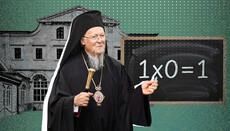
In this respect, the story recounted by historian and theologian Serhii Shumylo is particularly telling – a story about the logic used by representatives of the Patriarchate of Constantinople when addressing the issue of episcopal “ordinations” in the UAOC. Shumylo said that in 2018 he sent to Constantinople an entire investigation into the first episcopal “ordinations” in the UAOC in 1990. Those involved included Archbishop Ioann Bodnarchuk, who had been defrocked by the Russian Church, and one Vikentii Chekalin. The investigation convincingly showed that Chekalin was not a bishop, but an impostor, a fraudster, and a pedophile. Yet Constantinople was not in the least troubled by the participation of such a person in the UAOC’s “ordination.” According to Shumylo, the then secretary of the Synod of the Patriarchate of Constantinople – now Metropolitan Gregory of Ankara – said that Chekalin was simply “a zero,” and that “grace” passed to the UAOC’s “bishops” solely through Bodnarchuk.
“Chekalin is a zero, that is, he is not a bishop at all – he is a random person who ended up there due to certain circumstances. He is a zero. And in mathematics, whether you multiply by zero, divide by zero, add zero, subtract zero – it creates nothing, it gives nothing as a result,” the secretary of the Synod of the Church of Constantinople explained, laying out his understanding of mathematics.
Canons, ecclesiology, and validity
Even if we were to count defrocked Bodnarchuk as “one,” the laws of mathematics refute the Patriarchate of Constantinople’s “canonical mathematics.” When you multiply or divide any number by zero, the result is only zero. And in the case of the Church’s canons, we see the same outcome.
In Orthodox tradition, the question of the canonical nature of ordinations is not a formality and not a juridical convention. Ordination cannot be reduced to a mechanical transfer of some условная “grace,” as though it were a substance flowing from one physical body to another. Nor does “canonical mathematics” work here – the notion that if Chekalin is a “zero,” then his participation in the “ordination” neither adds nor subtracts anything. We will not even touch the question that a bishop must be ordained by at least two bishops.
It is through episcopal ordination that apostolic succession is realized – and therefore the Eucharistic unity of the Church. This is why the Church’s canons are so strict regarding prayerful – and especially liturgical – communion with heretics, schismatics, and in general persons who do not belong to the Church. For example, the 10th Apostolic Canon says: “If anyone prays with one who has been excommunicated from church communion, even in a house, let him also be excommunicated.” The 11th and 45th Apostolic Canons say the same, as do a number of canons of the Ecumenical Councils.
Why such severity? And why, in principle, could Bodnarchuk – with Chekalin’s participation – not ordain a valid bishop? Because contempt for the canons, which strictly forbid prayerful communion with those cut off from the Church, itself testifies that such a person serves not God and not the Church, but other ends – and therefore is incapable of bearing the Good News to people and celebrating the Mysteries. Apostolic succession is not a mechanical transmission of grace. It presupposes fidelity to apostolic teaching in its wholeness. He who at the very moment of a hierarchal ordination performs actions aimed at destroying church unity and contradicting the Creed (“I believe in One, Holy, Catholic, and Apostolic Church”) – such a one cannot become a true bishop.
The voices of the Local Churches: doubts that lingered
Many Local Churches have said that one cannot simply close one’s eyes to original contempt for the canons and “ordain” bishops while under ecclesiastical anathema. The most detailed statement on this subject was made by the late Archbishop Anastasios of Albania. For example, in a letter to Patriarch Bartholomew dated January 14, 2019, he wrote: “It is recognized pan-Orthodox as a basic ecclesiological principle that the ordinations of heretics and schismatics, and especially of those deposed and excommunicated, as ‘sacraments’ performed outside the Church, are invalid. This basic principle is inseparably linked with Orthodox teaching on the Holy Spirit and constitutes the unshakable foundation of the apostolic succession of Orthodox bishops.”
The Romanian Orthodox Church, in decisions of its Holy Synod from 2019, explicitly recorded that the question of “uncanonical hierarchs and priests in Ukraine” remained unresolved. The Romanian hierarchs indicated that without a clear answer to the problem of succession and ordinations, it is impossible to speak of full ecclesial recognition of the OCU.
The Patriarch of the Bulgarian Church, Daniil, back in 2019 – when he was still Metropolitan of Vidin – sent a message to Orthodox hierarchs in which he stated, among other things: “In the ongoing course of expressing of opinions by various Orthodox hierarchs and theologians, including the exchange of letters of some Primates with Patriarch Bartholomew, very serious concerns have been raised. One of which that has been identified is the gravely problematical uncanonical status of the 'hierarchy' of the ecclesiastical structure to which the Tomos was granted.”
After becoming patriarch, he did not change his opinion. In one recent interview, Patriarch Daniil said that there are “significant canonical obstacles” to recognizing the OCU.
Even the Church of Cyprus, which later conditionally recognized the OCU, stated in February 2019: “The two-thousand-year experience of the Cyprus Church and the entire Orthodox Church as a whole gives us reason to doubt the possibility of legally backdating those ordinations that were committed by banned, excommunicated and anathematized bishops. The ban, excommunication and anathema of individuals who initiated the Ukrainian crisis were recognized by all Orthodox. The right of appeal, when submitted, must have certain limitations on the timing of its filing [on these rights] and its consideration.”
To this day, in the Church of Cyprus there is public discussion about the impossibility of recognizing the OCU’s “ordinations,” and many Cypriot hierarchs refuse to commemorate Serhii (Epifaniy) Dumenko.
Oikonomia or arbitrary will
That much-discussed oikonomia to which representatives of the Patriarchate of Constantinople like to appeal truly has existed in the history of the Church. History knows various forms of receiving schismatics. But first, the very fact of applying oikonomia already testifies to the presence of a canonical problem. Second, the application of oikonomia has always had the good of the whole Church as its aim – in this case, the unity of the Church. Third, the application of oikonomia presupposed its reception by the fullness of the Church. In other words, applying oikonomia requires pan-ecclesial consent. Otherwise, oikonomia brings only harm.
In the case of Constantinople’s reception of Ukrainian schismatics “in their existing rank,” it was clear from the outset that this would not lead to church unity, but to an even greater division – and a deeper one than before. And, of course, there was no consent of all, or even of a majority, of the Local Churches for such oikonomia. It was a unilateral decision of the Patriarchate of Constantinople.
The subsequent behavior of the Ukrainian schismatics whom Constantinople recognized and from whom it formed the OCU has plainly demonstrated their invalidity. Instead of preaching the Gospel and teaching their followers God’s commandments, the OCU’s “hierarchs” encourage seizures of UOC churches, violence against UOC faithful, legislative bans on the UOC, and so on. “You will know them by their fruits” (Matt. 7:16).
Dialogue without a foundation
No matter how much is said about the need for dialogue between the UOC and the OCU, everything runs into an obvious problem. If there are no doubts about the grace-bearing nature of the UOC hierarchy (even within the OCU), then the OCU’s “hierarchy” is recognized by only four Local Churches – and even then not in full. Let us imagine that the UOC suddenly decided to forget the uncanonical nature of the OCU’s ordinations and unite with it. Would the positions of the Albanian, Bulgarian, Romanian, and all the other Churches that do not recognize the OCU change? Clearly not, because that position is determined by Orthodox ecclesiology, not by the UOC’s opinion. And that means that in the end we would obtain doubts about the canonicity of this already “united” Ukrainian church structure.
The assertion that the question of ordinations is a matter of the past does not withstand criticism. It remains on the agenda and will surface with every attempt to resolve the Ukrainian church crisis.
The only realistic and theologically correct way to overcome this crisis is a conciliar, pan-Orthodox discussion and decision. Without this, any calls for dialogue are nothing more than a farce and a performance for the public.