Catholic bishop refutes another fake claim about the Shroud of Turin
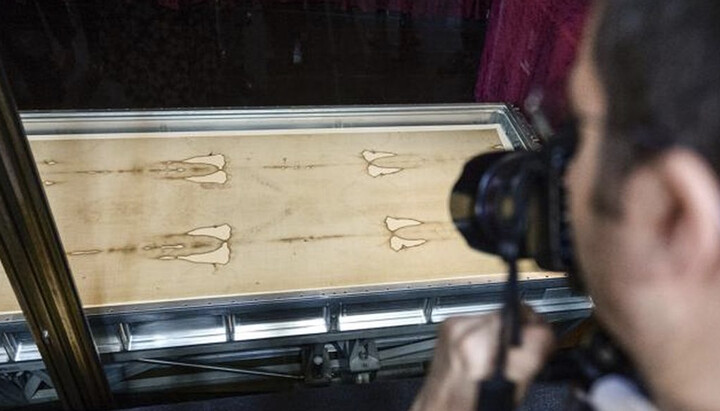
The Shroud of Turin. Photo: diocesi.torino.it
Cardinal Roberto Repole, custodian of the Shroud of Turin, responded to a recent wave of publications questioning the authenticity and origin of the Shroud. The controversy was sparked by a theory proposed by Brazilian digital graphics expert Cicero Moraes, who suggested that the image on the Shroud could have resulted from contact with an artificial object rather than a human body.
The Italian prelate urged the public and media to approach such claims with critical scrutiny, pointing out that similar ideas were already scientifically debunked over a century ago.
“Such theories were already rejected in the early 20th century,” the archbishop noted. “It is unfortunate that they are now resurfacing in the media without proper verification or analysis.”
“We must be cautious with what is published so frivolously,” the cardinal added.
Cardinal Repole stated that his work is guided by the International Center of Studies on the Shroud of Turin, based in Turin. The Center has published a technical memorandum critically analyzing Moraes’ article titled “Image Formation on the Holy Shroud – A Digital 3D Approach.”
In the document, experts assert that the software and modeling parameters used by Moraes lack physical justification and do not correspond to actual conditions under which the image could have formed.
The researchers emphasize that while digital models can be helpful for reflection, they cannot replace the physical and chemical studies performed on the original cloth.
They also recalled that as early as 1902, Paul Vignon and Yves Delage had demonstrated that the image on the Shroud represents a perpendicular projection – something not characteristic of a contact transfer.
Furthermore, scientists urge the public not to forget that the 1978 investigations by the Shroud of Turin Research Project (STURP) ruled out the possibility that the image could have resulted from pressure, heat, or contact with a shaped object.
The Shroud of Turin is a linen cloth bearing the front and back imprint of a man’s body, showing signs of a violent death consistent with the Gospel accounts of the Passion of Jesus Christ. Despite many attempts to explain the image's origin, science has yet to provide a definitive answer.
Earlier, the UOJ reported that scientists had released new data regarding the Shroud of Turin.
Read also
Medieval сhurch сrumbles as Culture Ministry сites missing agreement
The 14th–15th-century St. Nicholas Church in Chesnyky, Ivano-Frankivsk Region, is falling into disrepair.
Poland сondemns Lviv Regional Council's decision to declare 2007 year of UPA
Polish Prime Minister Donald Tusk says the Lviv Regional Council's decision to dedicate 2027 to the UPA and Roman Shukhevych is harmful to Ukraine.
OCU seeks court recognition of ownership of seized Cherkasy cathedral
The Cherkasy Regional Commercial Court will hear an OCU lawsuit seeking ownership of St. Michael's Cathedral, which was seized from UOC believers.
Lithuanian bishop: Ukraine is no model for believers' rights
Vicar of Vilnius Diocese voices concern over attempts to import Ukraine's religious conflict into Lithuania.
Hundreds of believers honor St. Alexis of Carpatho-Russia in Khust Eparchy
At the St. Nicholas Monastery in the village of Iza-Karputlash, Metropolitan Mark of Khust led a festive liturgy, concelebrated by six metropolitans, five archbishops and three bishops.
Court upholds UOC parish appeal in Voloshky over OCU switch dispute
The Northern Commercial Court of Appeal has upheld the appeal of the St. Nicholas parish of the UOC in the village of Voloshky, Volyn region, in a dispute over a transfer to the OCU.