Elon Musk's Neuralink unveils plans to merge human brain with AI
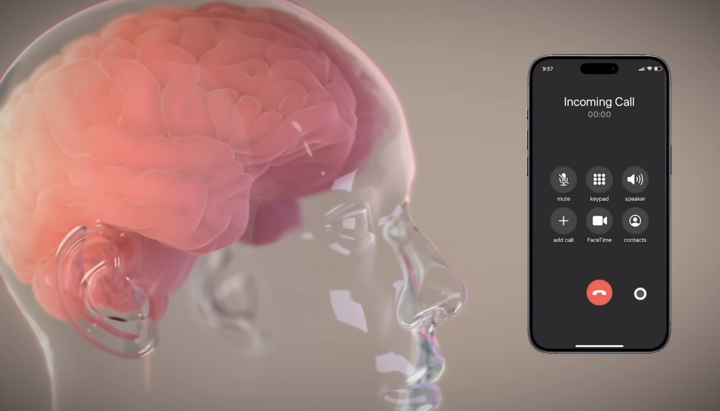
Neuralink promises to merge brain with AI. Photo: Neuralink
The American company Neuralink, founded by entrepreneur Elon Musk, has unveiled long-term plans to create a direct interface between the human brain and AI systems. This was revealed in a presentation by Neuralink President DJ Seo at the Korea Advanced Institute of Science and Technology in Seoul.
In the near future, in accordance with FDA approval for the use of experimental devices, a clinical trial with an implant for translating thoughts into text will be conducted in the USA.
According to the stated plans, the ultimate goal of Neuralink is to create an integral brain-machine interface that will allow not only reading neural activity but also stimulating any areas of the brain. According to the developers, this will pave the way for a "symbiosis of humans and artificial intelligence".
The company draws an analogy with the structure of the human brain: the left and right hemispheres are connected by a structure of 100-200 million nerve fibers, yet a person perceives their consciousness as a unified whole. Similarly, Neuralink claims, high-speed communication between the brain and external computing systems will blur the boundaries between biological and artificial intelligence.
"It will become very blurred where your brain ends and another begins," stated DJ Seo, describing the planned merging of human consciousness with AI.
In the coming months, a speech restoration program for people with severe speech impairments is planned to launch, and in 2026, a project for vision restoration through direct stimulation of the visual cortex of the brain starts.
However, the long-term plans go far beyond medicine. The company predicts that within 3-4 years, the first healthy person will decide to implant the Neuralink device, as the "balance of benefits and risks will tip in favor of the advantages",
Developers claim that their system already demonstrates "superhuman capabilities". Patients report seeing the movement of a cursor on the screen before they are aware of their intention to move it, as the signal from the brain to the computer is transmitted ten times faster than nerve impulses in the body.
In the long term, there are plans to expand human capabilities: vision in the ultraviolet and infrared spectra, control of multiple robotic limbs, direct access to information without using devices.
The company is also working on creating an "optimal state button" that would allow maintaining peak mental and emotional activity.
The company claims that a person would be able to gain direct access to the knowledge and computational capabilities of AI, while artificial intelligence would gain access to human intuition and creativity.
Earlier, the UOJ wrote that Elon Musk promised that with his help, the blind would begin to see.
Read also
Met. Meletiy consecrates house of worship for UOC community in Dankivtsi
Members of the persecuted UOC Intercession parish in Dankivtsi have converted a house into a place for communal prayer and worship services.
OCU eparchy sells church center site to developer for housing
The OCU’s Volyn Eparchy sold land intended for a spiritual center to a private developer planning to build townhouses and residential buildings.
SBU names UOC priest’s wife a suspect in Cherkasy region
The SBU accused Matushka Kateryna Prykotenko of “spreading enemy propaganda” through correspondence with parishioners.
UGCC cleric calls Russian Orthodox literature dangerous for clergy
While examining the causes of divisions within the UGCC, Yustyn Boiko concluded that Russian Orthodox literature had influenced Greek Catholic clergy.
UOC will play major role in achieving peace, says Vadym Novynskyi
UOC Protodeacon Vadym Novynskyi believes the Church will help bring about reconciliation within Ukrainian society after the war ends.
Catholic media outraged by forcible conscription of Uniate cleric
The Vatican’s Apostolic Nunciature has demanded the return of a forcibly mobilized Greek Catholic cleric.