Polygamy and close-kin marriages: Why did Old Testament patriarchs practice them?
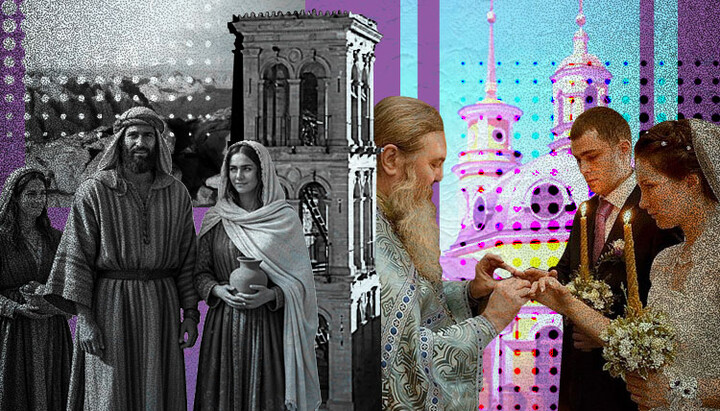
Christian rules of marital life gradually replaced the ancient patriarchal customs. Photo: UOJ
Marriage was instituted by God even in paradise, but after the fall, its institution was greatly shaken. This was true not only among pagans but also among the chosen people. For example, among the ancient Hebrews, marriages between close blood relatives and polygamy (having multiple wives) were allowed up to a certain point.
From the Bible, we know that such marriages were even among the holy patriarchs: Abraham, Jacob, King David, and King Solomon.
In the light of the New Testament, we explain this with Christ's words about the «hardness of people's hearts» (Matt. 19:8), because the original divine plan intended for monogamous marriage: «and the two shall become one flesh» (Gen. 2:24) – precisely two, not three or more.
The Bible also mentions numerous problems that polygamy leads to. Later, the Law of Moses regulated marital relations and restricted the arbitrariness that existed in this field.
Close-kin marriages in historical context
At the beginning of biblical history, humanity consisted of one family – Adam and Eve. Their descendants, to fulfill God's command «be fruitful and multiply» (Gen. 1:28), entered into marriages with close relatives. For example, Cain, the son of Adam, married a woman who was apparently his sister (Gen. 4:17). After the Flood, Noah’s family found themselves in a similar situation: his sons and their wives became the forebears of new generations (Gen. 9:18–19). Such marriages were not considered immoral, as in the absence of other people, they were the only way to continue the lineage.
This practice was maintained even in the patriarchal era. Abraham married his half-sister Sarah (Gen. 20:12), and Isaac took Rebekah, his cousin, as his wife (Gen. 24:15). Jacob married his cousins – Leah and Rachel (Gen. 29:16–30).
These unions not only corresponded to the customs of that time but were also necessary to preserve the faith and purity of the lineage in a pagan environment.
The Bible does not condemn these marriages for several reasons. First, before the Law of Moses, there was no direct divine prohibition on such unions. Second, in ancient Near Eastern cultures – Egypt, Mesopotamia – marriages within the family were common to strengthen clan ties and preserve property. In this context, the patriarchs' marriages did not stand out.
Polygamy and its consequences
Polygamous marriages were also common. Abraham had his wife Sarah and concubine Hagar (Gen. 16:3–4), and Jacob, after marrying two sisters, Leah and Rachel, also had children from their maidservants (Gen. 30:4–13).
The Holy Fathers, for example St. John Chrysostom, understood the polygamy of those times as a temporary phenomenon permitted by God out of condescension to human weakness after the Fall, with the purpose of preserving and multiplying the lineage, as well as fostering the gradual spiritual growth of humanity.
At the same time, the Bible does not hide the problems associated with polygamy: rivalry between Sarah and Hagar, jealousy between Leah and Rachel, enmity between their children – all this led to severe family conflicts.
Levirate marriage
Even with the advent of the Law, some of its provisions differed significantly from modern concepts. One of them was levirate marriage: when a husband died childless, his brother (or another close relative) was to take his wife to "raise up seed" for the deceased. The first child born in such a marriage was considered the descendant of the deceased (Deut. 25:5-6). This custom was due to the necessity of continuing the family line and preserving the land allotment within one tribe.
From the Old to the New Testament
Marital practices of the patriarchal era were determined by historical realities.
With the adoption of the Sinai legislation (Lev. 18:6–18), strict prohibitions on close-kin relations were introduced.
Marriages with people from other nations also began to be prohibited in order to protect the faith of the chosen people from pagan influence. The history of Israel shows that unions with pagan women often led to apostasy (1 Kings 11:1-8).
The Law of Moses became an important stage in the regulation of marital relations. Although its norms were still far from New Testament ideals, it prepared the ground for them.
Christian rules of marital life, based on fidelity, love, and strict monogamy, gradually replaced ancient patriarchal customs. The understanding of marriage began to be perceived as a spiritual union of two equal persons, reflecting the sacrificial love of Christ and the Church.
Read also
Facade of bones and facade of light
Antoni Gaudí spent forty-three years building a church in Barcelona, knowing that this construction was for the ages.
Trial of a dead pope
Once in Rome, the body of a deceased pope was seated on the throne and put on trial. The accusation relied on a church canon that had once saved his see.
Monastery built in defiance of king
When Orthodox believers in Minsk were left with just one church, townspeople decided to build another – and even a royal decree did not stop them.
Young Mother and Sleeping Christ
Michelangelo carved a Virgin Mary who looks younger than her Son – and signed his name in marble for the only time in his life. Neither of these peculiarities was accidental.
Orthodox books from a Uniate printing press
In the 18th century, Uniate monks at Pochaiv printed books used in prayer by Orthodox Christians and Old Believers alike.
The story of the honey brotherhood
The Mogilev Brotherhood began with members pooling money to brew honey drinks for feast days – and eventually grew to have its own printing press.