Why the OCU refuses to recognize its "honorary patriarch's" testament
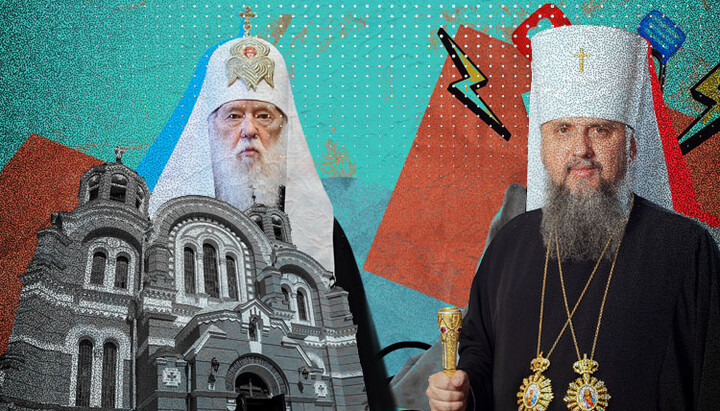
After Filaret’s death, has Dumenko set his sights on St. Volodymyr’s Cathedral and other property of the UOC-KP? Photo: UOJ
Before our eyes, a battle is unfolding for Filaret Denysenko’s legacy – both material and ecclesiastical-political. In this case, the two are closely intertwined. Back in 2019, Filaret repeatedly declared that he was the head of the UOC-KP and had nothing to do with the OCU. Dumenko and Zorya, by contrast, insisted he was merely the “honorary patriarch” of the OCU. Now, as OCU-linked media spread rumors about Filaret’s frail condition (he is nearly 97 years old), debates have erupted online about who will inherit the Kyiv Patriarchate’s assets after his death.
If the OCU succeeds in ignoring all of Filaret’s statements, they will inherit not only the material assets – St. Volodymyr’s Cathedral in Kyiv and the mansion on Pushkinska Street – but also the very idea of a “national Ukrainian church,” which Filaret himself had forged. If not, victory may go to the few remaining allies of Filaret within the UOC-KP, ensuring the continuation of that body’s existence.
The sequence of events
On October 19, 2025, a document titled “Spiritual Testament of Patriarch of Kyiv and All Rus’-Ukraine Filaret” appeared, signed personally by Filaret Denysenko.
In it, the head of the UOC-KP categorically stated that he has no relation whatsoever to the structure headed by Serhii (Epifaniy) Dumenko: “I am not the honorary Patriarch of the Orthodox Church of Ukraine, as its representatives and leadership claim,” wrote Denysenko.
He also forbade the OCU from conducting his funeral services: “I bequeath that the funeral rites and burial be performed at St. Volodymyr’s Patriarchal Cathedral in Kyiv by the clergy and hierarchs of the UOC-KP, not by the OCU.”
The next day, October 20, OCU spokesman Ivan (Yevstratii) Zoria – once Filaret’s long-time aide – declared the “testament” a forgery. “This is not the Patriarch’s will but a piece of paper on which they managed to get his signature,” he said, adding that “neither the style nor the expressions correspond to the Patriarch’s manner of speech.”
In other words, Zoria made it clear that the OCU would not honor the testament and would therefore attempt to take charge of the “honorary patriarch’s” funeral – with all that this entails.
On October 23, 2025, Zoria continued this narrative on his platform Ukraina Pravoslavna. The key messages were the same: Filaret is old, his condition is “quite difficult,” and he allegedly saw the text of the will for the first time only when signing it.
That same day, Filaret’s supporters on the Telegram channel For the Ukrainian Church responded from the UOC-KP, accusing Zoria and his associates of planning to seize St. Volodymyr’s Cathedral in Kyiv: “Under the guise of taking part in the funeral of Patriarch Filaret, they want to stage a raider seizure of the St. Volodymyr Patriarchal Cathedral in Kyiv. They will enter the church to shed their crocodile tears over the Patriarch’s coffin – but then they will not leave.”
At the same time, Dumenko issued a congratulatory message to Filaret on the 30th anniversary of his “patriarchate,” implying that he still regarded him as part of the OCU and calling him to “humble himself before the will of God.”
A familiar scenario
Attempts by OCU representatives to portray Filaret as a senile, irrational man unable to control his actions are nothing new.
In July 2019, right after Filaret broke with Dumenko and revived the UOC-KP, Ivan (Yevstratii) Zorya claimed that mysterious medications prescribed to Filaret had “seriously affected his health.”
On Facebook, he went even further, accusing the “honorary patriarch” of aiding Kremlin propagandists: “Illness has changed him beyond recognition… But I can’t even imagine our Patriarch to give an interview to Kremlin propagandists knowing what they need it for – to further destroy Ukraine. The disease made him a real ally of Moscow in its fight against the Tomos.”
In response, Filaret filed a defamation lawsuit against Zoria in the Shevchenkivskyi District Court of Kyiv.
Two years later, in February 2021, a similar incident occurred. “Archbishop” Andrii Marutsak of the UOC-KP accused Zoria of spreading falsehoods about Patriarch Filaret’s health, reminding him of his own past praise for Filaret: “Many of those who once lauded Bishop Filaret before their episcopal consecration, who received the grace of ordination from his hands, have now found themselves among his persecutors and opponents.”
Now we are witnessing the third round of this confrontation. Every time Filaret poses a threat to the OCU leadership’s comfort, they try to present him as a confused old man detached from reality and manipulated by his entourage.
In late August 2025, the OCU suddenly expressed “concern” for the health of “honorary patriarch” Filaret Denysenko. An announcement appeared on the official website of Dumenko’s structure, stating that Filaret’s health had “visibly deteriorated” and calling for the faithful across Ukraine to pray for him. Yet just a day later, Filaret personally led the Dormition service, publicly disproving the OCU narrative.
Thus, by autumn 2025, Dumenko had clearly gone on the offensive against Filaret. On one hand, the OCU strives to depict him as a dying, incapacitated man; on the other, they insist he remains a member of the OCU – dismissing all his anti-OCU statements as the product of senility.
What’s at stake?
"The bone of contention" is considerable. First and foremost stands St. Volodymyr’s Cathedral in the center of Kyiv – built, incidentally, through the efforts of Russian Emperor Alexander II. Another front is Filaret’s residence at 36 Chykalenko Street (formerly Pushkinska), which he has occupied since 1966. Under favorable circumstances, several dozen churches of the UOC-KP could also fall into the OCU’s hands.
But property is not the only legacy of Filaret Denysenko. Since his break with the canonical Church in 1992, Filaret has personified the idea of a “Ukrainian national church.” To his credit, he built it practically from scratch.
In 1992, only two bishops – both under canonical suspension – supported him. By 2018, the UOC-KP counted dozens of dioceses and thousands of parishes. As a self-proclaimed “state national religious organization,” it had surpassed both the Ukrainian Greek-Catholics and the Autocephalists.
It is precisely this ecclesiastical-political legacy that the OCU now seeks to appropriate. Some may argue that Dumenko already succeeded, that the UOC-KP has been relegated to the margins. But time changes everything. New faces will eventually appear in the leadership of the Ecumenical Patriarchate, in Ukraine’s government, and in international politics.
One day, someone may need to loudly distance themselves from the OCU – a structure repeatedly discredited by deceit, coercion, and other unchristian deeds. And at that moment, the UOC-KP may once again stake a claim to the title of “national church.”
Only, all of these power struggles have nothing to do with the faith of Christ, His Church, or the salvation of souls.
Read also
The Council of Crete: a decade of unity in name only
Constantinople marked the anniversary of the Council of Crete with a theological conference in France. They spoke about the unity of Orthodoxy, although over the past years there has noticeably been less of it.
Yelensky’s plan: Why is DESS demanding what the UOC has already done?
DESS is demanding that the UOC take steps it has already taken, while offering no assurance that further demands will not follow. What is behind Yelensky’s ultimatum?
Why OCU hierarchy lacks canonical ordination: what Local Churches say
The OCU head refuses to address invalidity of his ordinations. But almost all Local Churches speak of it – even those that recognized the OCU.
Why nation-first advocates do not call for peace
Ukraine’s population is declining by nearly one million people a year, and experts are warning of the nation’s demographic extinction. Yet the leaders of the Orthodox Church of Ukraine (OCU) and the Ukrainian Greek Catholic Church (UGCC) continue to call for war and mobilization.
The deception that decided the fate of the Tomos
In 2008, the "Filaret problem" derailed Yushchenko's plan. In 2018, Poroshenko solved it in just one hour – with a police escort for the Greeks and verbal promises to Filaret.
Lawyers in the crosshairs: How UOC is being stripped of its right to defense
Activists harass UOC lawyers outside courthouses, call them “traitors” on air, and promise them a “warm welcome” at hearings. The Church’s right to a legal defense is at stake.