
"Underpants or cross": Why condemn UGCC ban while outlawing UOC?
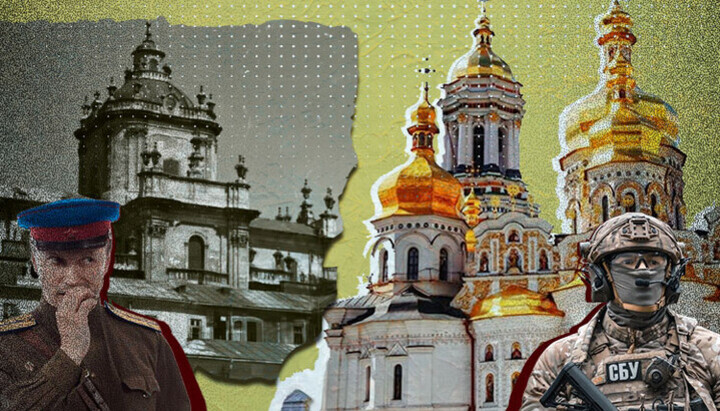
If Stalin’s suppression of the Greek Catholics was an act of repression, what does that make the current drive to ban the UOC? We compare 1945 with the present day.
On November 27, Lviv hosted a conference titled “The 1946 Lviv Pseudo-Council: Reflections Through the Lens of History and Contemporary Challenges,” marking the 80th anniversary of the liquidation of the Ukrainian Greek Catholic Church (UGCC). Among the speakers was Viacheslav Horshkov, head of the Religious Affairs Department at the State Service of Ukraine for Ethnopolitics and Freedom of Conscience (DESS).
According to him, the council became “an instrument for implementing the Soviet regime’s repressive policies.” “The state must protect … every individual’s freedom from coercion, manipulation, and the political exploitation of their faith,” the DESS official emphasized.
So, according to the official, the banning of the UGCC in 1946 was a very bad thing. What DESS is doing to the UOC today, however, is apparently a very good thing. Why? Because, speaking about Law 3894 (commonly referred to as the law banning the UOC), Horshkov stated that “the issue of religious freedom must be considered in the context of national security.”

But let us delve a little deeper into history and compare the two situations: the Soviet liquidation of the Greek Catholic Church in 1946 and the Ukrainian authorities’ efforts to dismantle the UOC today.
What did the Soviets want in 1945?
Initially, the Soviet authorities took a relatively accommodating approach toward the UGCC. In December 1944, a UGCC delegation visiting Moscow was promised the same rights as other religious denominations. There was only one condition: help bring an end to the armed resistance of the Organization of Ukrainian Nationalists and the Ukrainian Insurgent Army (OUN-UPA). The UGCC refused, limiting itself to general statements condemning violence.
It is important to remember that, through its priests, the UGCC was involved in the activities of virtually all armed nationalist formations, including those incorporated into Nazi Germany’s military formations.
During the recruitment campaign for the SS Galicia Division, UGCC parishes served as centers of recruitment propaganda. Later, with the blessing of Metropolitan Andrey Sheptytsky, UGCC chaplains joined the regiments of the Waffen Grenadier Division. In February 1944, SS Galicia police regiments operating as part of the Beyersdorf combat group participated in the destruction of the Polish village of Huta Pieniacka.
The UGCC’s cooperation with the Nazis was no secret. In a 1941 pastoral letter, Sheptytsky welcomed “the victorious German army as a liberator.” That same year, he sent letters of greeting to Hitler.
Another important point is that the UGCC is part of the Roman Catholic Church, which maintained a secret dialogue with the Nazis. In his 2022 book The Pope at War, Pulitzer Prize-winning Brown University historian David Kertzer described a series of secret meetings between Pius XII and Hitler’s personal envoy, Prince Philipp of Hesse – a Nazi Party member and an SA stormtrooper. The meetings began shortly after the pope’s election and continued for two years. At one of these meetings, Pius told the prince:
"No one here is anti-German. We love Germany. We are pleased if Germany is great and powerful.”
He added that he had no objection to any form of government as long as Catholics were allowed to live according to their faith.
In other words, the Greek Catholic leadership was effectively on the side of the Soviet Union’s enemies – both Nazi Germany and the nationalist underground. UGCC chaplains served throughout the OUN-UPA formations, where they enjoyed considerable authority and influence. Had the UGCC called on OUN combat units to end their armed struggle in 1945–1946, such an appeal would have had far-reaching consequences. But the UGCC made no such appeal and was outlawed by the Soviet authorities. As early as March 1945, Stalin approved a plan for its liquidation.
What about the UOC?
In 1941, Greek Catholics welcomed the Nazis as liberators. On February 24, 2022, in the very first hours of the invasion, Metropolitan Onuphry described the war as a repetition of Cain’s sin, for which there could be no justification before either God or man. On February 28, the UOC Holy Synod condemned the war and declared its support for Ukraine’s sovereignty and territorial integrity.
Large numbers of UOC parishioners are fighting on the front lines, and many have lost their lives. At a meeting in Zaporizhzhia, DESS head Viktor Yelensky acknowledged that “tens of thousands and hundreds of thousands” of UOC faithful were losing their lives in the war. At the same meeting, he spoke of 25 UOC clergymen killed and 420 churches destroyed.
Nevertheless, DESS maintains that the banning of the UGCC in 1946 was a manifestation of the “Soviet regime’s repressive policies,” whereas the current drive to ban the UOC must be viewed “in the context of national security.”
But here is the question: why could the Soviet authorities not view the Greek Catholics “in the context of national security” when their faithful and priests formed the backbone of armed units fighting the Soviet regime? After all, a full-scale armed conflict was raging in the forests of Galicia at the time. The underground movement also included former soldiers of the SS Galicia Division – historians estimate that up to 2,000 men joined the UPA following the defeat at Brody. The UPA itself had considerable combat experience.
According to Soviet figures, between 1944 and 1953, the underground movement killed more than 30,000 people, over two-thirds of whom were civilians, predominantly peasants. These armed formations posed a genuine threat to the national security of the Soviet Union. But how exactly does the UOC threaten Ukraine’s security today?
Transposing 1945 into the present day
Imagine local saboteurs operating behind Ukrainian lines, blowing up bridges, attacking military recruitment centers, and killing government officials. Now imagine that the UOC has real influence over these people: they are its parishioners, their families attend its churches, and their priests know them by name.
Government representatives approach the UOC leadership and say: call on your faithful to lay down their arms, and we will register your parishes, leave the Lavras alone, and return all the seized churches. But the Church makes no commitments, responding only with vague statements. This is precisely what the negotiations between the Soviet authorities and the UGCC looked like in December 1944.
Yet nothing of the sort is happening today. The UOC has no armed formations operating behind Ukrainian lines. Its faithful are serving in large numbers, weapons in hand, in the ranks of the Ukrainian military, not against it. The state has made no demand that the Church call on anyone to lay down their arms – nor can it, because there is no one to make such an appeal to. Far from threatening national security, the UOC’s parishioners constitute an important part of the forces safeguarding it.
There is an old, somewhat risqué joke about a Jewish man who decides to visit a public bathhouse. To blend in, he puts a cross around his neck. Once inside, he undresses and joins the other bathers. They exchange puzzled glances, looking first at his cross and then at the unmistakable evidence of his circumcision. Finally, one of them says: “Sir, either take off your cross or put on your underwear!”
Today’s DESS is a perfect illustration of that joke. If the Soviet ban on the UGCC constituted political repression, then the current drive to ban the UOC constitutes the same kind of repression. And if the Ukrainian Orthodox Church is being banned on national security grounds, then, by DESS’s own logic, the Soviet authorities were entirely justified in liquidating the Greek Catholic Church.
It is time for DESS to make up its mind – either take off the cross or put on the underwear. What its leadership is preaching today amounts to blatant double standards and hypocrisy.