What Filioque omission at celebrations of Nicaea Council anniversary means
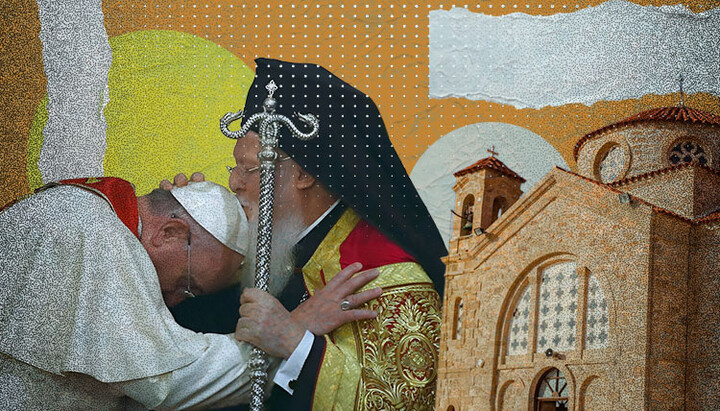
The omission of Filioque in the services at the Phanar with the participation of the Pope does not imply concessions from Rome to Orthodoxy. Photo: UOJ
Greek theologian and presbyter Anastasios Gotsopoulos, in his new article on the website of the Greek branch of the UOJ, analyzes what it means for the pontiff to recite the Creed at the Phanar without adding the Filioque.
The public's attention was particularly stirred by the fact that Pope Leo XIV, during his meeting with the Ecumenical Patriarch in Nicaea of Bithynia as part of the celebration of the 1700th anniversary of the First Ecumenical Council, as well as at the Phanar during the Patriarchate's Patronal Feast (November 27–30, 2025), recited the Creed ("I believe") without the addition of Filioque (and from the Son). Moreover, this "concession" by the Pope was received with special enthusiasm by journalists and certain Orthodox theologians, and was described, among other things, as “a very significant event that offers new prospects and hopes on the path toward the union of the Churches”!
We will attempt to consider this papal step in its true dimensions.
Historical background
Let us recall that the Filioque was initially introduced only in Spain at the Council of Toledo III (589 AD), while from the beginning of the 9th century the Franks attempted to impose it throughout the West into the Creed. However, it was not accepted either by the Eastern Churches or by Rome. Indeed, Pope Leo III came into conflict with the Franks at the Council of Aachen (809–810 AD) and reacted strongly against the alteration of the Creed. In response to the Frankish insistence on adding the Filioque, he inscribed on two silver tablets, in Greek and in Latin, the Creed without the Filioque and displayed them in the Basilica of St. Peter in Rome.
Later as well, Pope John VIII, in a letter to Patriarch Photios, accepted the condemnation of the Filioque by the Council of Constantinople (the Eighth Ecumenical Council, 879–880 AD) as a heretical teaching and regarded its insertion into the Creed as uncanonical because it contradicted the decisions of the Third and Fourth Ecumenical Councils. This alone demonstrates the inaccuracy of the claim made by papal writers and pro-papal Orthodox that the East supposedly tolerated the Filioque for centuries without considering it a deviation from ecclesiastical tradition. It is absolutely clear that as soon as the Franks attempted to alter the Creed in the West, both Rome and the East reacted strongly at the highest level (Popes of Rome – Leo III and John VIII – as well as the Patriarch of Constantinople – St. Photios – and the Eighth Ecumenical Council).
It is quite evident that immediately after the attempt to distort the Creed in the West by the Franks, both Rome and the East resolutely opposed it at the highest level (Roman popes – Leo III, John VIII, – the Patriarch of Constantinople – Saint Photius the Great – and the Eighth Ecumenical Council).
Unfortunately, the dominance of the Franks in Rome overturned the patristic tradition, and in 1014, Pope Benedict VIII introduced the Filioque into the Creed, as unequivocally acknowledged by the current Pope Leo XIV in his encyclical "In Unitate Fidei" (23.11.2025): "The assertion 'proceeding from the Father and the Son (Filioque)' is absent in the text of the Constantinopolitan Creed; it was introduced into the Latin Creed only by Benedict VIII in 1014."
The immediate reaction of the Eastern Patriarchs to Pope Benedict VIII's arbitrary addition was the removal of his name from the diptychs of the Church of Constantinople and the cessation of church communion with Rome even before the schism of 1054.
Subsequently, Rome, having separated from the Church of Christ, proclaimed the Filioque as a dogma of faith at the Fourth Lateran Council (1215) and officially affirmed its addition to the Creed. The Filioque is also mentioned at the Councils of Lyon (1271) and Ferrara-Florence (1438–1439), where all who dare to deny that the Holy Spirit proceeds eternally from the Father and the Son are condemned and censured!
Consequently, from then until today the Filioque has constituted an essential teaching for Rome, incorporated into its dogmatic doctrine and obligatorily accepted by all the faithful. Moreover, the Filioque was imposed also on the Uniates, who preserve an outward resemblance to the Orthodox but are in essence Roman Catholics.
Contemporary practice
However, after the Second Vatican Council (1962–1965), as part of Rome's inclusion in the Ecumenical movement and its rapprochement with "divided Christians," Rome recognized the "sensitivity" of the Eastern Churches to this issue, without in any way retreating from its dogmatic teaching.
Initially, Rome allowed the Uniates to recite the "I believe" without the addition of the Filioque, and with the beginning of the Theological Dialogue (1980), the same practice is applied whenever joint liturgical meetings with the Orthodox are held. Moreover, even in Roman Catholic parishes in Greece, the Filioque is no longer recited in the Creed. However, it should be noted: this does not mean a change in Rome's dogmatic teaching. The heretical dogma of the procession of the Holy Spirit "from the Father and the Son (Filioque)" remains unshakable for Catholics!
The document titled “The Greek and Latin Traditions Regarding the Procession of the Holy Spirit”, issued on 13 September 1995 by the Pontifical Council for Promoting Christian Unity, makes this clear. In it, an attempt is made to reinterpret the Filioque within the perspective of “unity in diversity” between the two traditions, and Rome’s position regarding the omission of the Filioque in the recitation of the Creed is clarified.
This document, in particular, states that "when the Creed is recited in Greek (or at ecumenical meetings), the Catholic Church avoids adding the Filioque to the Greek text," and
it makes clear that "this is not a denial of the Latin dogmatic tradition, which includes the Filioque," with the clarification that "the decision to use or not use the Filioque in ecumenical prayers does not change the dogmatic position of the Catholic Church."
The document concludes that "when the Creed is recited at joint services of Catholics and the Orthodox, the form without the Filioque is is entirely permissible and legitimate".
In the same vein, the declaration "Dominus Jesus" (6.08.2000) presents the Creed without the Filioque, out of respect for the "sensitivity" of Eastern Christians.
However, it should be noted that Pope Leo XIV himself, who omitted the Filioque in the presence of the Ecumenical Patriarch, on November 29 in Constantinople, after the reception and prayer service at the Phanar, went to the "Volkswagen Arena" to celebrate the Latin Mass, and there in his presence, the choir quite ordinarily sang the "I believe" with the Filioque in Latin: "Et in Spiritum Sanctum, Dominum et vivificantem, qui ex Patre Filioque procedit."
Conclusions
From the above, it becomes clear that
the omission of the Filioque in Nicaea and at the Phanar is not something new, and certainly does not signify any special development in the relations between Orthodoxy and Papism, and above all it does not mark a rejection of heresy or a return to the patristic tradition.
This is merely the consolidation of an established practice and, above all, a deception of our uncatechized people.
Without any doubt, the papal "concession" falls within the ecumenical framework of the Second Vatican Council, which some Orthodox leaderships have accepted and on the basis of which they conduct and build their relations with the rest of the Christian world.
During the three-day papal visit, the same “ritual” was observed once again that we have seen in previous papal visits to the Phanar (2006, 2014), with the uncanonical concelebrations and incomplete concelebrated liturgies. We also heard many times, including from Orthodox lips, the phrase “full communion.” I wonder, when did the Fathers of the Church or Orthodox hierarchs, before the Second Vatican Council, ever use the term “full communion” in relations with the non-Orthodox?
For those not particularly familiar with ecumenical terminology, it should be noted that the terminology of “partial” and “full communion” forms the foundation upon which the new ecclesiology of the Second Vatican Council was built (Dogmatic Constitution Lumen Gentium) and the Decree Unitatis Redintegratio on Ecumenism! For anyone with even a basic knowledge of church history and Orthodox ecclesiology, the teaching expressed through this terminology is entirely alien. Yet it has now become entrenched in ecumenical meetings and is used opportunely or inopportunely even by Orthodox, many of whom largely share the Vatican ecclesiology.
Triple benefit for Rome
In conclusion, regarding the present issue, Pope Leo XIV’s “Apostolic Journey” to Nicaea–Constantinople had a triple benefit for the High Visitor:
- By reciting the Creed without the Filioque, naïve Orthodox, skillfully guided by the “professionals of Ecumenism”, were thrilled by the supposedly positive results of inter-Christian dialogue, which allegedly persuaded the Pope to omit the Filioque! What is concealed, however, is that the Pope did not deviate in the slightest from the dogmatic teaching on the Filioque, which remains fully in force.
- Another brick was laid in consolidating the ecumenical terminology of “partial and full communion” among the Orthodox faithful.
- Most importantly, the roadmap for the “union of the Churches” was maintained in full force, as it has been methodically and systematically designed and implemented by the Vatican and its co-travelers.
Under these conditions, can we as Orthodox believers really be enthusiastic and joyful?
Read also
Yelensky’s plan: Why is DESS demanding what the UOC has already done?
DESS is demanding that the UOC take steps it has already taken, while offering no assurance that further demands will not follow. What is behind Yelensky’s ultimatum?
Why OCU hierarchy lacks canonical ordination: what Local Churches say
The OCU head refuses to address invalidity of his ordinations. But almost all Local Churches speak of it – even those that recognized the OCU.
Why nation-first advocates do not call for peace
Ukraine’s population is declining by nearly one million people a year, and experts are warning of the nation’s demographic extinction. Yet the leaders of the Orthodox Church of Ukraine (OCU) and the Ukrainian Greek Catholic Church (UGCC) continue to call for war and mobilization.
The deception that decided the fate of the Tomos
In 2008, the "Filaret problem" derailed Yushchenko's plan. In 2018, Poroshenko solved it in just one hour – with a police escort for the Greeks and verbal promises to Filaret.
Lawyers in the crosshairs: How UOC is being stripped of its right to defense
Activists harass UOC lawyers outside courthouses, call them “traitors” on air, and promise them a “warm welcome” at hearings. The Church’s right to a legal defense is at stake.
How to respond to persecution: Lessons from St. Silouan the Athonite
The Church can and should be defended, but without malice. Why love for persecutors is not weakness but the only way to preserve the Spirit of Christ in the midst of the struggle.