Future of OCU may lie in union with UGCC, says Dumenko's former cleric
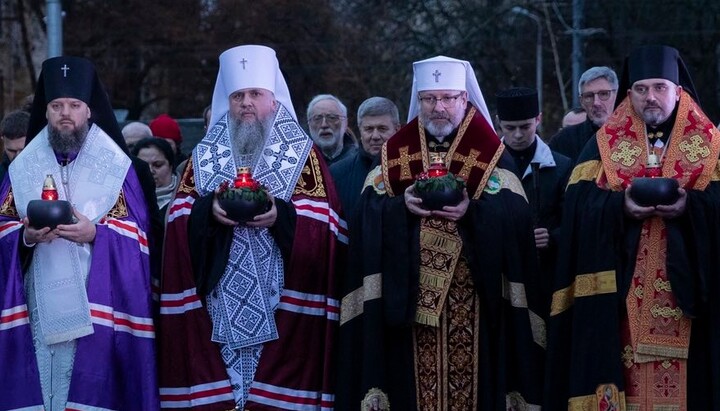
Joint service of the UGCC and the OCU. Photo: Holodomor Museum
Former OCU priest Yaroslav Yasenets believes that Epifaniy Dumenko’s structure may eventually be headed toward a union with the Ukrainian Greek Catholic Church (UGCC).
He said this in an interview with UOJ in America (UOJ-USA).
“I think that it is quite possible because the Greek Catholics, the Uniates benefit the most from this struggle of two branches of Orthodox Church: at some point the Church of Onufrios will be weakened and the church of Epifanios will not grow. It is quite possible that under some future president and government they will reach such an agreement,” the former OCU cleric emphasized.
"There already were even situations when Catholic priests were participating in the liturgy with the church of Epifanios, though once or twice only. And we see that they are much more favored to communicate with Archbishop Sviatoslav, the head of the Greek Catholic Church, and with Catholic bishops than Metropolitan Onufrios," he noted.
“And considering the current moves of Pope Leo and Patriarch Bartholomew, I think it is possible that Uniates will go worldwide,” Yaroslav Yasenets added.
He believes that such a union could be formed on the foundation of the UGCC: "There's this prevailing narrative that in many ways the OCU as a project is really meant to open the way for the union with Rome and that in the end the OCU would either unite with the Union or be overpowered by it."
“The Uniates might say 'now look at us: we are strong, we have a lot of people, we have a lot of priests, we are connected to the civilized world (as they would like to to call it 'this liberal world') so why cannot we become the national church. I believe that the state at some point can say 'all right, we see you as a useful instrument and now we will build the national church on the on the ground of your hierarchy,” the priest said.
The former OCU cleric noted that the Uniates already present themselves as the “true Church” with an "uncorrupted line of ordinations" dating back to the Baptism of Rus’. In their logic, the union was a return to the Church that existed before the Great Schism of the 11th century.
“It is quite possible that it is their plan because I spent a lot of time in Lviv, studied in their university. I still communicate with many Greek Catholics personally and I see the way of their preaching, of their sermon. They are saying uh that we are Orthodox but we are just in the union with Rome. Why cannot we be in the union with Rome? It is right because all the the Christians must be together,” Fr. Yaroslav said.
Earlier, the UOJ reported that, according to Yasenets, the organizers of seizures of UOC churches receive large sums of money.
Read also
Volyn Eparchy faithful collect six tons of aid for Sviatohirsk Lavra
Believers in Volyn collected food and warm clothing for people displaced by the war who have found shelter at Sviatohirsk Lavra.
Trump: "Paris is going to be a Muslim city very soon"
Donald Trump blamed uncontrolled immigration for street protests in France, warning that Paris would soon become a Muslim city.
Dumenko: Jerusalem Church is wrong to refuse communion with us
Dumenko claimed that the OCU, like the Apostle Paul, is standing up against the errors of the Jerusalem Church and other Local Churches.
Ukrainian parliament registers bill to establish Bible Day
Lawmakers have proposed establishing Bible Day to strengthen moral values and preserve the country’s spiritual heritage.
Dumenko: Pochaiv will be ours, and Sviatohirsk Lavra is no Lavra
The OCU head called Pochaiv Lavra the Russian Orthodox Church’s “last stronghold,” predicted that circumstances would eventually allow its transfer, and rejected Sviatohirsk Monastery’s status as a lavra.
Metropolitan Victor offers condolences to families of shelling victims
The ruling hierarch of the Khmelnytskyi Eparchy expressed condolences to the families of those killed in the Russian attack on Khmelnytskyi on October 19.