On the heresy of hating "foreign" enemies
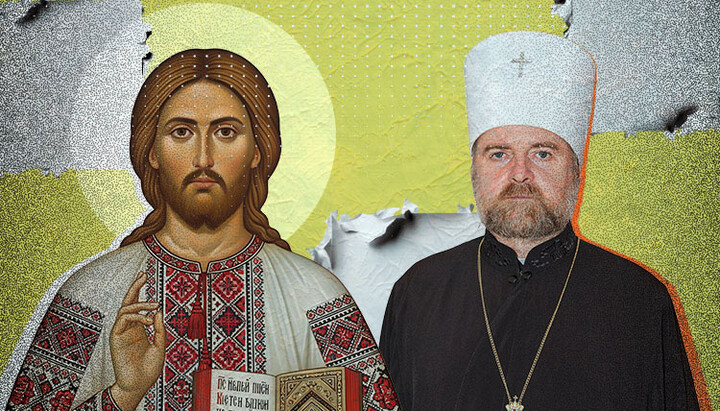
OCU reps "adapt" the words of Christ according to their "theology". Photo: UOJ
“Metropolitan” Ioann Yaremenko of the OCU made a bold statement that Christ’s words about loving one’s enemies can have only an ‘internal’ meaning for Ukrainians and do not apply to Russians.
According to the “hierarch”, the commandment “love your enemies” applies specifically to hostility among yourselves, that is, to your own people, Ukrainians, with whom you have quarreled but whom you love. In this way, you will find a way to resolve problems, overcome enmity, and once again become brother Ukrainians.”
According to him, this commandment does not apply to an enemy who has come with weapons. Such an enemy, therefore, should not be loved but killed. Otherwise, the enemy would “go beyond the borders of Ukraine – to Europe, to the whole world.” According to Yaremenko’s teaching, such killing would not be a sin, and the OCU is doing everything to convince people that they are doing the right thing.
“If someone, while killing an enemy, feels pangs of conscience, our task is to calm that person and explain that this is not a sin but, on the contrary, a sacred duty. People came to me with such questions back in 2014. I remember the first such question was asked by a sniper. I explained and clarified it to him, because a person is tormented by conscience – after all, he is killing,” Yaremenko says.
This viewpoint is not held by him alone. Almost identical words were spoken by the “Metropolitan” of Lutsk, Mykhailo Zinkevych: “So, we love those who love us. We will try to love others; if they have time to repent and we don't shoot them, then maybe we will be able to forgive them.”
Thus, the system of the OCU “hierarchs” is clear: Christ’s commandment of love applies only to “one’s own” enemies, while “foreign” ones must be killed. Moreover, such killing is not even considered a sin.
But is this really what the Savior taught?
Did Christ call for loving only “one’s own”?
No, He said exactly the opposite. Moreover, the Savior started from the very position promoted by Yaremenko, emphasizing that one must act differently: “You have heard that it was said, ‘You shall love your neighbor and hate your enemy.’ But I say to you: love your enemies, bless those who curse you, do good to those who hate you, and pray for those who insult you and persecute you” (Matt. 5:43–44).
Christ specifically stresses that one must not love only “one’s own”, as Yaremenko urges in our case: “And if you greet only your brothers and sisters, what more are you doing than others? Even the Gentiles, do they not do the same?” (Matt. 5: 47).
And the Savior certainly never says that enemies should be killed. When He was seized in Gethsemane, He said, “All who take the sword will perish by the sword,” and ordered Peter to put away the sword with which he had managed to cut off the ear of the high priest’s servant.
Of course, one might say that the realities of modern Ukraine are very different from those of Judea in Christ’s time. But this is only at first glance. Back then, the Jews lived under Roman oppression, which to some extent can be compared to Russian occupation. And the Zealots, who killed the occupiers for the sake of their nation’s freedom, acted strictly according to the instructions of today’s OCU: the killing of an occupier is “not a sin, but a sacred duty”. But did Christ support them?
He humbly endured mockery and torture, although He could easily have destroyed all His tormentors. We see this clearly in the words He said to Peter: “Do you think that I cannot appeal to My Father, and He will at once send Me more than twelve legions of angels?”
Christ did not need the help of angels. Ordinary logic suggests: if Jesus could raise the dead, then if He wished, He could certainly have killed the living. The example with the fig tree leaves no doubt about this.
But not only did He not destroy those who caused Him suffering, the Savior asked the Father to forgive them, emphasizing that they do not understand what they are doing.
The only way to conquer an enemy that Christianity offers is not by killing, but by turning them into a friend. “Love all people, even your enemies, not because they are your brothers, but so that they may become brothers; burn with the fire of brotherly love toward one who has already become a brother, and toward your enemy, so that through love he may become a brother,” wrote St. Augustine.
The Pharisee Saul was among the most active and ruthless persecutors of Christians. But the Savior transformed his heart and turned him into the chief apostle, who, together with Peter, became a founder of the Church.
Yes, the current war is a terrible time for Christians, because even those defending their land are forced to break the commandment “You shall not kill.” And today, it is incredibly difficult to call a person a brother and friend when they stand against you with weapons in their hands. It is much easier to return to the Old Testament practice of “an eye for an eye, a tooth for a tooth.” Yet even in this, one can at least avoid letting hatred into one’s heart and avoid twisting Christ’s words to fit one’s ideology. In any war, no matter how just it is, killing remains killing, and sin remains sin.
Moreover, if one examines Yaremenko’s “theology”, it turns out that he himself does not even follow it.
Who is your enemy?
Ioann Yaremenko says that Christ’s commandment to love can be applied only to “one’s own” enemies among Ukrainians. Does he himself follow his own words?
The most high-profile and bloody seizures in Ukraine took place in Cherkasy, where Yaremenko is the ruling “hierarch” of the OCU. Initially, it was the Nativity of the Theotokos Monastery, where a group of OCU militants brutally beat priests and parishioners. As a result, several people ended up in the hospital with broken legs, a fractured jaw, and concussions. A year later, St. Michael’s Cathedral was seized. The massacre there was even more shocking. Cherkasy Metropolitan of the UOC, Theodosiy (Snigirev), suffered a concussion from a blow to the head with a club; an elderly monk had his head smashed, and parishioners were also shot inside the cathedral with traumatic weapons.
The attackers robbed the cathedral’s treasury and stole the eparchy’s funds. Yaremenko himself appropriated liturgical items belonging to Metropolitan Theodosiy: a staff, panagias, vestments, a dikirion, a trikirion, and more. He also established a residence for himself in the metropolitan’s office in the seized eparchial administration.
The rhetoric of both Yaremenko and his colleagues toward the clergy and faithful of the UOC is extremely harsh. He calls them enemies, even though there are no objective reasons for this: the bishops, priests, and parishioners of the UOC are citizens of Ukraine, overwhelmingly holding a patriotic stance.
In other words, everything indicates that for Yaremenko, the clergy and faithful of the UOC are not among “his people” – those who can be loved rather than killed. We suppose that if, during the seizure in Cherkasy, one of the OCU militants had inflicted a fatal injury on them, the ‘metropolitan’ would not have called it a sin.
We write this not to condemn Yaremenko but to make those who consider him their spiritual shepherd reflect. Does his teaching really correspond to what Christ taught?
Yes, in times of war, the thesis that one should love only one’s own, while foreigners deserve only destruction, seems quite logical and natural. As if Christ merely gave a general direction, and we just improve it a little, adapting it to our circumstances. But there are problems here.
First, every “improvement” of the Savior’s commandment inevitably narrows the circle of those to be loved. Today it excludes Russians, tomorrow – ‘Moscow priests’, and the day after? Those who do not share your political views? Those who become outsiders in corporate disputes? Where is the boundary drawn? In the OCU today, they are even feuding with former colleagues from the UOC-KP, and those respond in kind. Who among the “worthy of love” will remain in the end?
Second, the Savior never said that one should love only enemies from one’s “own” group – ethnic, political, or religious. Moreover, He constantly interacted with and helped “outsiders”: Roman occupiers, tax collectors who served them, Samaritans, etc. It is also worth remembering that those who handed Him over to death were His “own” people, the Jews.
Any Ukrainian patriot reading this far might want to ask the author: so, are you really suggesting we should love Russians? After everything they have done?
We answer with a story from the recent past. At the end of World War II, prisoners of war – hungry, emaciated, and frostbitten Germans – were being transported through cities of the USSR. Many women gave them bread or other food. And yet, it could very well have been that these same Germans had killed the husband, brother, father, or even child of the benefactor. Moreover, the atrocities of the Nazis, who consciously tried to destroy entire nations during that war, surpass all imagination.
Perhaps for those women, it was not love but compassion for the enemy. Yet even that, in this situation, required almost superhuman effort. Because to love your enemy in war is very difficult, almost impossible.
So what is the solution?
Very simple: read the Gospel and do not listen to “shepherds” who “adapt” it.
Want the light? Drop the stone
Today, a great number of Ukrainians die every day. Many depart for Eternity believing that hatred of the enemy is fully compatible with Christianity, and that killing is “not a sin, but on the contrary, – a sacred duty”.
But what is the outcome? After death, these people find themselves carrying a burden that, both in private judgment and on the Last Judgment, will be like a stone tied to the feet of a swimmer. And once this stone is attached, it cannot be discarded: “By what standard I find you, by that I will judge you.”
Yes, today this stone may seem useful, helping one stay at the bottom while gathering what seems valuable. But someday you will have to rise. The war will end sooner or later. The hatred we let into our hearts may remain there forever as that same unliftable stone.
Christ did not give us commandments “with exceptions”. He did not say: “Love your enemies, except when it’s difficult.” He Himself set the example on Golgotha, forgiving those who crucified Him. And if we call ourselves His disciples, we must at least strive for this ideal, however unattainable it may seem.
The choice of every Christian is both simple and terrifying: either to follow the words of the Savior, or to listen to those who “adapt” His words. Either drop the stone in time and rise to the light, or remain at the bottom.
Read also
Yelensky’s plan: Why is DESS demanding what the UOC has already done?
DESS is demanding that the UOC take steps it has already taken, while offering no assurance that further demands will not follow. What is behind Yelensky’s ultimatum?
Why OCU hierarchy lacks canonical ordination: what Local Churches say
The OCU head refuses to address invalidity of his ordinations. But almost all Local Churches speak of it – even those that recognized the OCU.
Why nation-first advocates do not call for peace
Ukraine’s population is declining by nearly one million people a year, and experts are warning of the nation’s demographic extinction. Yet the leaders of the Orthodox Church of Ukraine (OCU) and the Ukrainian Greek Catholic Church (UGCC) continue to call for war and mobilization.
The deception that decided the fate of the Tomos
In 2008, the "Filaret problem" derailed Yushchenko's plan. In 2018, Poroshenko solved it in just one hour – with a police escort for the Greeks and verbal promises to Filaret.
Lawyers in the crosshairs: How UOC is being stripped of its right to defense
Activists harass UOC lawyers outside courthouses, call them “traitors” on air, and promise them a “warm welcome” at hearings. The Church’s right to a legal defense is at stake.
How to respond to persecution: Lessons from St. Silouan the Athonite
The Church can and should be defended, but without malice. Why love for persecutors is not weakness but the only way to preserve the Spirit of Christ in the midst of the struggle.