Scrooge syndrome: Why "A Christmas Carol" is a book about us
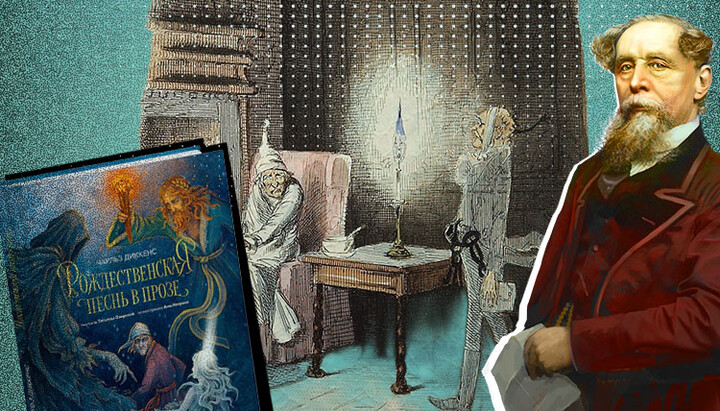
The theology of "A Christmas Carol". Photo: UOJ
“Marley was dead. There is no doubt whatever about that.” That is how the most famous Christmas story in the world begins. But if we set aside the Hollywood adaptations with singing marionettes and actually read Charles Dickens’s text, it becomes unsettling. Because this book is not about a funny miser in a nightcap.
It is about a man who died while still alive. And about us – who so often resemble him.
A fortress of gold coins
We have grown accustomed to despising Ebenezer Scrooge. His name has become a byword for a miser and a misanthrope. But let us be honest: Scrooge was not born a monster. Dickens gives us subtle, barely noticeable hints about his past – a lonely boy forgotten at school during the holidays; a young man who feared poverty more than fire.
Scrooge is not a caricature. He is a person who, one day, decided the world was too cruel, and the only way to survive was to build a fortress.
A fortress of gold coins, promissory notes, and icy indifference. He told himself, “No one will ever hurt me again if I never love anyone.”
Do we not recognize ourselves in that?
When we have been burned by betrayal and bolt the soul shut. When we bury ourselves in work so we do not have to feel the emptiness at home. When we pass by someone else’s misfortune muttering, “They brought it on themselves,” simply because we do not want to spend emotional strength. In moments like these, we put on Ebenezer Scrooge’s invisible top hat.
An inner permafrost
Dickens brilliantly describes the physiology of this condition. He writes that Scrooge’s inner cold was so strong it had literally “frozen his old features.”
He had no need of heating or warm clothing. External cold – rain, snow, hail – was powerless against him, because Scrooge carried his winter with him.
“Rain, hail, and snow could boast of the advantage over him in only one respect – they often came down handsomely, and Scrooge never did.”
Look at his home: dark rooms (because darkness is cheaper than light), a feebly smoldering fire, oatmeal for supper. This is hell.
Theologians say hell is not frying pans and devils. Hell is a state of absolute loneliness – a room locked from the inside. Scrooge is already living in hell; he is simply used to it. It seems to him like freedom and independence.
And in this state he becomes an ideologue. Remember his dreadful words when charity collectors ask for money for the poor. Scrooge asks, “Are there no prisons? … And the Union workhouses?” And then he adds a line that makes the blood run cold: “If they would rather die … they had better do it, and decrease the surplus population.”
Here Dickens puts into his hero’s mouth the fashionable theory of the time – and, alas, of ours as well – the idea of “surplus population,” associated with the thinking of Thomas Malthus.
It is a very contemporary cynicism. We, too, often think: why help “failures”? Let the strongest survive. The economy must be economical.
Scrooge is not evil. He is simply an “effective manager” who has subtracted humanity from the equation.
Therapy by ghosts
To melt that ice, something more is needed than a sermon. A shock is needed.
The appearance of Jacob Marley’s ghost is the first warning. Marley drags a chain of cashboxes and ledgers. “I made it link by link, and yard by yard,” he says. It is a terrifying truth: our passions become our shackles in eternity.
But the real treatment begins with the journey. The Spirits put Scrooge through three sessions of shock therapy.
First – memory. The Spirit of Christmas Past does not scold the old man. It simply shows him the boy who loved reading about Ali Baba and Robinson Crusoe. It shows him the sister he loved. It shows him the fiancée who left because the “golden idol” had pushed love out.
And the ice gives its first crack. Scrooge weeps. Tears are thawing. As long as a person can weep over lost purity, he is not hopeless.
Then – sight. The Spirit of Christmas Present leads him into the home of clerk Bob Cratchit. Poverty, mended clothes, a goose that barely feeds everyone – and yet there is something there that Scrooge does not have: warmth. There is Tiny Tim – a disabled child who will die if the “surplus population” receives no help.
Here the turning point comes. It is not fear of hell that changes Scrooge. It is pity. “Spirit,” the old man asks, clutching the ghost’s robe, “tell me if Tiny Tim will live.”
In that moment his stone heart becomes flesh. Love for a child proves stronger than love for money.
And finally – death. The Spirit of the Future shows him the most dreadful thing. Not death itself (everyone dies), but oblivion. Scrooge sees servants robbing his corpse, stripping even the bed curtains. He hears colleagues at the Exchange discussing his funeral only for the sake of a free meal.
“He died? And who cared? … What has he done with his money?”
A life lived only for oneself ends in total erasure. No one will come to the grave. No one will sigh. A person simply vanishes – like a dirty stain wiped away.
A penitential turkey
The ending of A Christmas Carol is one of the best depictions of repentance (metanoia) in world literature. The Greek word metanoia means a “change of mind,” a 180-degree turn.
Scrooge wakes up alive. He has been given a chance. And what does he do? He does not go to a monastery to atone. He does not sit down to write a philosophical treatise.
He does something very simple, very earthly, and very holy.
He buys the biggest turkey in the shop and sends it to the Cratchits.
Dickens shows active repentance. Scrooge begins to spend – spend money, spend time, spend emotion. He goes to his nephew whom he drove away yesterday. He laughs so loudly he startles passersby.
“He became as good a friend, as good a master, and as good a man, as the good old city knew.”
This is the essence of Christianity that Dickens grasped with his heart.
Holiness is not sterility, not sitting in a corner. Holiness is openness. It is when you finally unboard the very window that has been nailed shut for years and let into the house the frosty air, the noise of the street, and other people.
Scrooge is saved not because he stopped loving money, but because he began loving people. He becomes “a second father” to Tiny Tim. He fills his emptiness with another human being.
As long as you are alive
All of us are Scrooges sometimes. We are all afraid. We are all cold.
But A Christmas Carol gives us a great hope.
It does not matter how many years you were “stone.” It does not matter how many chains you forged. It does not matter how frozen your features have become.
As long as you are alive – as long as you can wake up on a Christmas morning – nothing is lost.
You can get up. You can open the window. And you can, at last, buy that notorious turkey for someone who needs it more than you do.
Read also
Facade of bones and facade of light
Antoni Gaudí spent forty-three years building a church in Barcelona, knowing that this construction was for the ages.
Trial of a dead pope
Once in Rome, the body of a deceased pope was seated on the throne and put on trial. The accusation relied on a church canon that had once saved his see.
Monastery built in defiance of king
When Orthodox believers in Minsk were left with just one church, townspeople decided to build another – and even a royal decree did not stop them.
Young Mother and Sleeping Christ
Michelangelo carved a Virgin Mary who looks younger than her Son – and signed his name in marble for the only time in his life. Neither of these peculiarities was accidental.
Orthodox books from a Uniate printing press
In the 18th century, Uniate monks at Pochaiv printed books used in prayer by Orthodox Christians and Old Believers alike.
The story of the honey brotherhood
The Mogilev Brotherhood began with members pooling money to brew honey drinks for feast days – and eventually grew to have its own printing press.