Why is Church of Cyprus silent about Phanar’s decision in Tychikos case?
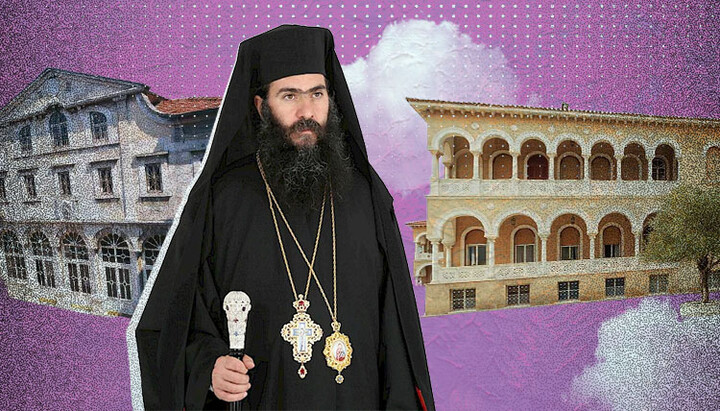
Will the Metropolitan of Paphos be restored to his see? Photo: UOJ
More than two months have passed since Metropolitan Tychikos of Paphos visited Constantinople, yet the official decision of the Ecumenical Patriarchate (not a press release) still has not been published. Meanwhile, more and more indications suggest that this document contains wording that is uncomfortable for the leadership of the Church of Cyprus.
The letter that isn’t there
On October 17, 2025, Metropolitan Tychikos arrived in Constantinople to take part in a session of the Synod of the Patriarchate of Constantinople. That trip became the culmination of a months-long ecclesiastical conflict in Cyprus, as a result of which the hierarch was, in effect, removed from governing the Metropolis of Paphos.
It is now early January 2026. Under church canons and established procedure, the Synod of the Patriarchate of Constantinople was to have sent an official written decision to the Holy Synod of the Church of Cyprus. But there is no such document in the public domain.
At the same time, the priest and physician who accompanied the hierarch to Constantinople, Fr. Evangelos Papanikolaou, said in an interview on Cypriot television that the letter was in fact sent in early December – roughly between the 6th and the 12th. Moreover, according to the information available, it is already in Cyprus. Yet for some reason the Holy Synod of the Church of Cyprus is in no hurry to make it public.
So why is the Cypriot church leadership keeping silent? The answer may lie in the content of the document itself.
Procedural violations
According to Fr. Evangelos, who cites familiar bishops in Constantinople, the Ecumenical Patriarchate’s letter contains fairly stern language about how Metropolitan Tychikos’ case was handled in Cyprus.
The key phrase reads as follows: “Whether due to excessive zeal, or due to ignorance, or due to omissions in your Statute, the decision taken in Cyprus, as it appears to the Patriarchate, suffers from numerous procedural errors and omissions.”
In essence, this is a factual acknowledgment that the trial of the Paphos archpastor was conducted with gross violations of church canons and basic procedural norms. This, incidentally, was also indicated in the press release issued immediately after the Synod of the Patriarchate of Constantinople on the Phanar.
Let us recall that during the proceedings initiated by the Synod of the Church of Cyprus, Metropolitan Tychikos was deprived of elementary rights – the right to a defense, a face-to-face confrontation with witnesses for the prosecution, the ability to review all case materials, and so on. And it is precisely this fact that Constantinople recorded.
It is especially telling that in his subsequent statements Archbishop Georgios of Cyprus began using a different wording from that used by the Synod on the Phanar. He started speaking of “minor shortcomings.” The difference between “procedural violations” and “minor shortcomings” is enormous. The former calls the legality of the entire judicial process into question. The latter is merely an admission of small defects.
Is it possible to restore Tychikos?
The wording about “procedural violations” is not merely rhetoric. It is a legally meaningful assessment that opens very specific possibilities.
If the judicial process was conducted with serious procedural violations, its results cannot be considered lawful. And that means the decision to remove Metropolitan Tychikos from governing the Metropolis of Paphos not only can, but must be reconsidered.
Fr. Evangelos says this directly: “When the Patriarch, in an official document, writes that there were ‘omissions’ in this man’s case, do you understand what that means? It means there are other paths to a solution.”
Church law, like any legal system, recognizes the principle that a decision adopted in violation of procedure is subject to annulment. If a person was tried without basic guarantees of the right to a defense, then such a court cannot be considered just.
Moreover, even the most basic human-rights principles – so often invoked in Europe – require procedural safeguards to be observed. And therefore,
the decision of the Patriarchate of Constantinople opens a path toward the hierarch’s rehabilitation and his return to the Paphos see. The only question is whether the Holy Synod of the Church of Cyprus will be willing to acknowledge its mistakes.
So far, everything points to the opposite. Synod meetings are repeatedly postponed. The document from Constantinople is not made public. And Archbishop Georgios speaks about upcoming amendments to the church Statute, as though trying in advance to build a new system that would prevent “awkward” situations from arising again.
A blow to an ancient tradition
The point is that the Church of Cyprus has always taken pride in preserving the ancient apostolic tradition of lay participation in the election of bishops. This practice goes back to the first centuries of Christianity, when bishops were chosen by the people of God – the entire community of believers. In Cyprus, this tradition survived in the form of a popular vote: laypeople select several candidates, after which the Holy Synod reviews them and confirms one.
This system has long inspired admiration among church people in other countries. More than that, it has been seen as a model worth adopting. But now Archbishop Georgios is proposing, in effect, to abolish lay participation in elections. And that raises an entirely reasonable question: why? Why destroy something that has worked for centuries? What is wrong with this ancient tradition?
The formal pretext was low turnout in the most recent elections – about 13–15 percent of eligible voters. But is that a reason to abolish the possibility of popular participation itself? After all, it is clear that low turnout is not a problem of the electoral system. It is a problem in the relationship between the church hierarchy and the flock. It is a signal that people are disappointed, that they do not feel a connection with the church leadership. And the right response to that is not to cancel elections but to ask instead: why are people failing to come to vote?
On the other hand, there are reasonable ways to address the turnout issue. One could form an electoral body from the most active members of parish communities – priests’ wives, church wardens, people who genuinely serve in the churches, engage in church charity, and participate in parish life. That would be an honest trade-off between a nationwide vote and the complete exclusion of laypeople.
But the Archbishop is proposing something entirely different – in effect, to transfer the full power of electing bishops exclusively to the Synod. But why?
Control over the Synod
A careful analysis of the situation shows that behind the attempt to change the electoral system stands a very concrete goal – to establish the Archbishop’s complete control over the composition of the Holy Synod.
If laypeople do not participate in elections, then bishops are appointed by the Synod – over which the Archbishop himself has enormous influence. That means the future composition of the church leadership will be formed not by the people, not by the communities, but by a narrow circle of senior hierarchs.
And then the logic is simple:
whoever controls the Synod controls the question of succession – who will become the next Archbishop of Cyprus.
Fr. Evangelos says bluntly: “One gets the impression he is trying to control the Synod in order to prevent a certain person from becoming his successor.”
Who is this “certain person”? In church circles it is no secret that for many years one of the most likely candidates for the archiepiscopal throne has been Metropolitan Athanasios of Limassol – a spiritual leader who enjoys immense respect and love not only in Cyprus but throughout the Orthodox world. It is not hard to guess whom the people would vote for.
But if the system of popular elections is abolished, the Archbishop will have the opportunity, over the remaining years of his ministry, to shape the Synod out of hierarchs loyal to him. And that means the question of his successor will be decided not by the church people, not by an ancient tradition, but behind closed doors, within a narrow circle of senior hierarchs.
That is the real reason for the church crisis in Cyprus. The issue is not the “heresy of the non-commemorators” (which Metropolitan Tychikos was accused of), nor “morbid zeal” (which he is now accused of), nor mythical canonical violations. The issue is a struggle for power – for control over the future of the Church of Cyprus.
The envelope
Against the background of all these church-political intrigues, the account of Metropolitan Tychikos himself sounds especially piercing – a man who has become a hostage to this struggle.
Fr. Evangelos, who accompanied the hierarch as his physician and spiritual guide, shares details that reveal the true character of the archpastor of Paphos. He told one story that says more than any words.
When the hierarch was in Greece receiving treatment, certain pious Christians gave him an envelope with a donation for medical expenses. That same day he went to the doctor. At the clinic the hierarch saw a man around forty years old, completely destroyed by cancer.
Metropolitan Tychikos said to his companions: “Go take that envelope they gave us, and give it to this man.” There turned out to be fifteen hundred euros in the envelope. The hierarch gave it all to a man he had never met in his life. Without hesitation. Simply because he saw someone else’s plight.
This was not performative charity, much less a PR stunt. It was the act of a man for whom Christ’s commandment of mercy is a rule of life, not a beautiful slogan.
But there is another story – about how the hierarch relates to those who are now set against him.
During their time serving together, Fr. Evangelos witnessed the archpastor’s prayerful practice: “He has lists with your names, and he commemorates you constantly. Together we served forty liturgies: I serve, and he sits beside me in his epitrachelion, reading names of the living and the departed. And do you know whose name is first? Archbishop Georgios’s.”
Think about it: a man who has effectively been stripped of his see, who is subjected to unceasing accusations, who is far from his homeland in a gravely weakened state of health – and the first thing he does at every Liturgy is pray for his accuser, Archbishop Georgios.
“For me, that is evidence of this man’s ecclesial character,” Fr. Evangelos says. And it truly is. Because real Christian love is tested not by one’s attitude toward friends, but by one’s attitude toward those who cause pain.
What next?
Metropolitan Tychikos is in Greece. The Holy Synod of the Church of Cyprus is silent. The document from Constantinople has not been made public. Archbishop Georgios speaks of forthcoming amendments to the Statute and says the Synod will convene in the new year.
What will happen next is still unknown. Will the Ecumenical Patriarchate’s letter be published? Will the Synod of the Church of Cyprus acknowledge the procedural violations in Metropolitan Tychikos’ case? Will a path open for his return to the see? Or will the church leadership continue to pretend that nothing happened?
Will the system of popular elections of bishops be abolished? Will Archbishop Georgios succeed in establishing complete control over the Synod? Or will sound judgment and respect for ancient traditions prevail?
For now, there are no answers. But one thing can be said with certainty: the Lord sees everything.
He sees how Metropolitan Tychikos, far from his homeland, prays every day for his offenders. How he gives his last money to a sick stranger. How he longs for his Metropolis of Paphos, for his flock, for the service of the Divine Liturgy.
God sees the silence of those who should have defended him. He sees intrigues and the struggle for power under a cover of pious words. He sees how ancient traditions are sacrificed to present-day political expediency…
“The Lord sees everything. And the Lord will set all things in order,” Christians say in such situations. These are not empty words. This is a deep faith that truth will, sooner or later, prevail. That justice cannot be trampled forever. That the Church belongs to Christ, not to those who temporarily occupy high offices within it.
Therefore, despite all the complexity and entanglement of the situation, there is hope. Hope that the procedural violations will be acknowledged. That Metropolitan Tychikos will return to his flock. Hope that the Church of Cyprus will preserve what it has always taken pride in and what served as a role model for others – a spirit of conciliarity and firmness of faith.
After all, the Church was not created for a struggle for power, but for the salvation of souls. Not for intrigues and political games, but for witness and unity in Christ. And as long as there are people like Metropolitan Tychikos, who prays for his accusers and gives away his last money to the sick, there is hope that such unity is possible.
The Lord sees everything. And He will not abandon His faithful.
Read also
Why nation-first advocates do not call for peace
Ukraine’s population is declining by nearly one million people a year, and experts are warning of the nation’s demographic extinction. Yet the leaders of the Orthodox Church of Ukraine (OCU) and the Ukrainian Greek Catholic Church (UGCC) continue to call for war and mobilization.
The deception that decided the fate of the Tomos
In 2008, the "Filaret problem" derailed Yushchenko's plan. In 2018, Poroshenko solved it in just one hour – with a police escort for the Greeks and verbal promises to Filaret.
Lawyers in the crosshairs: How UOC is being stripped of its right to defense
Activists harass UOC lawyers outside courthouses, call them “traitors” on air, and promise them a “warm welcome” at hearings. The Church’s right to a legal defense is at stake.
How to respond to persecution: Lessons from St. Silouan the Athonite
The Church can and should be defended, but without malice. Why love for persecutors is not weakness but the only way to preserve the Spirit of Christ in the midst of the struggle.
Where the Spirit of the Lord is, there is freedom
Reflections on the controversies surrounding the creation of the OCU.
Pentarchy with Rome: A return to the roots or a new schism?
Patriarch Bartholomew wants to revive a council of five patriarchates, including Rome. What would reunion with Catholics look like, and what role would be left for the other Churches?