Lithuanian frontier: how pagan Lithuania attempted to break Orthodoxy
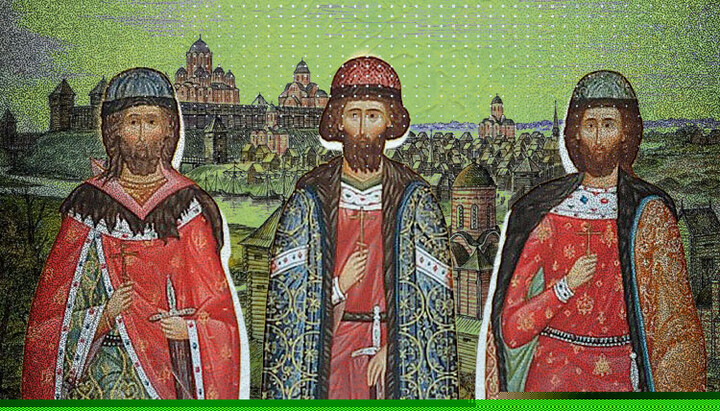
Vilnius Martyrs. Photo: UOJ
The mid-14th century. Europe is already covered by a network of Gothic cathedrals and universities. But there is a "blind spot" on the map — the Grand Duchy of Lithuania. This is the last pagan stronghold on the continent. Here, in the dense forests, sacred fires still burn, the priestly Krivaitis still divines from animal entrails, and the thunder god Perkūnas demands sacrifices.
Vilno (modern Vilnius) of that time is not a cozy baroque town. This is a harsh border outpost, a melting pot where the ambitions of East and West collide. And at the center of this cauldron is Grand Duke Olgierd (Algirdas).
Olgierd is not a caricatured villain from a fairy tale. He is a brilliant politician, cynic and pragmatist. He expands the state from the Baltic to the Black Sea. He is married to Vitebsk Princess Maria Yaroslavna (Orthodox), he builds churches for the Ruthenians, he even possibly received secret baptism (for political motives). But his power rests on the "old guard" – on the pagan Lithuanian nobility and fire-worshipping priests.
For them, Orthodoxy is a threat. It is the "soft power" of Rus'.
And when this force begins to penetrate into the holy of holies – into the prince's personal guard – the political balance collapses.
Revolt of the "bearded"
Olgierd had favorites. Three noble Lithuanians – Nezhilo, Kumets and Kruglets. This was the elite. Princes' court attendants and warriors. They wore silk and gold, ate from the prince's table, and wielded a sword better than many wield a tongue. They had it all: career, money, and status.
But in the early 1340s, a transformation took place with them. They were baptized by the priest Nestor — the spiritual mentor of Princess Maria. Nezhilo became Anthony, Kumets — John, and Kruglets — Eustathius.
The first thing that caught the attention of the entire court was their faces.
The pagan tradition of Lithuania prescribed men to shave their faces clean. The Orthodox tradition of Rus assumed wearing a beard.
Anthony and John stopped shaving. This was not a matter of style. In a totalitarian pagan society, this was a political manifesto. Imagine if today the president's bodyguards suddenly put on the uniform of a foreign army. This was a challenge. Their beards shouted: "We serve another King."
The priests (the princely "war" party) came to Olgierd with an ultimatum:
– If you don't stop these two, tomorrow all of Lithuania will become Russian. They insult our gods and our customs.
Olgierd found himself trapped. As a politician, he didn't want to quarrel with his Orthodox subjects. But as a leader of military democracy, he couldn't ignore the priests' revolt.
Loyalty test: meat and cross
The brothers were arrested and thrown into a damp dungeon – a deep pit where light barely penetrated. Olgierd didn't want to kill them. He needed these warriors. He just wanted to break their will and force them to observe external ritual.
A simple test was devised. Friday. Fasting. The brothers are brought to the prince’s bathhouse (a place for informal negotiations). The table is overflowing with food. The smell of roasted meat fills the room. Olgierd offers them a simple deal: eat the meat, publicly show that you have renounced the “Russian law”, and you will be free. Your titles, estates, and place at the throne will be returned to you.
Chronicler Makary (author of the "Tale of the Vilnius Martyrs," 16th century) preserved the essence of this dialogue. Olgierd speaks with them not as a tyrant, but as a "good boss" persuading subordinates not to be foolish:
– Leave this madness. You are young, you have a brilliant future ahead. Why die over food and a beard?
The answer of the Holy Martyrs John and Anthony was firm. They quoted the Gospel not from a book, but from the heart. Christ's words became their reality:
"And do not fear those who kill the body but cannot kill the soul. Rather fear him who can destroy both soul and body in hell" (Mt. 10:28).
They refused. For them, a piece of meat on Friday became equal to denying Christ. This is a paradox that is difficult for modern man to understand. But for them, faithfulness in small things (fasting) meant faithfulness in the main thing.
Oak of death
After a year in prison, the elder brother, Saint John, wavered. He publicly ate meat and pretended to return to paganism. He was released. Saint Anthony remained in the pit.
But freedom brought John no peace. Seeing his brother's steadfastness, he repented, again declared himself a Christian and was brutally beaten with sticks. According to the chronicle's testimony, he said:
"It is better for me to die with my brother for Christ than to live in wealth, having denied Him."
The resolution came in 1347. The priests demanded blood. Olgierd washed his hands. The place of execution became a sacred oak grove in the suburbs of Vilno. There stood an ancient, gnarled oak dedicated to Perkūnas.
On April 14, 1347, Saint Martyr Anthony was hanged on this oak. On April 24, ten days later, Saint Martyr John was hanged on the same branch.
The bodies were not taken down immediately. They hung as a terrible warning to all: this is what happens to traitors of their fathers' faith.
Third: Eustathius's emergence
It seemed that fear should have paralyzed the Christians of Vilno. But the opposite effect happened.
Young retainer Kruglets, a relative of the deceased brothers, was Olgierd's favorite. A handsome man, a strongman, the hope of the court. Seeing the deaths of Saints Antony and John, he openly professed his faith. He took the name Eustathius (after Saint Eustathius Placidus, the Great Martyr).
In the winter of 1347 (according to other sources – early 1348), Olgierd goes hunting. Eustathius rides with him. The prince notices that the young man does not participate in pagan libations and asks directly:
– Are you with them too?
Eustathius answers:
– I am a Christian.
Olgierd flies into a rage. He orders the youth to be tortured right in the frost. Chronicler Makary describes this with horrifying details: he was stripped, icy water was poured into his mouth, bones were broken, ears and nose were cut off. Sophisticated cruelty aimed to intimidate the rest.
But Saint Martyr Eustathius (Kruglets) endured everything. He was brought to Vilno and hanged on the same oak where the ropes of his brothers had already rotted. The date of his execution is December 13, 1347 (according to other sources – 1348).
Victory of the defeated
From the perspective of secular chronicle, this was a complete failure. Three young, promising guys died for nothing. The pagan party won. Olgierd kept his throne.
But Church history works differently. Literally 27 years later, in 1374, Constantinople Patriarch Philotheos Kokkinos canonizes the Vilnius Martyrs. This is unprecedented speed for that time. In his “Encomium to the Vilnius Martyrs”, the Patriarch writes about them with admiration that shines through the Byzantine rhetoric:
"They did not fear torments, did not tremble before the mighty of this world, but like firm diamonds, they crushed idolatrous flattery... They preferred eternal life to temporal life and imperishable glory to temporal glory."
And what happened to the oak? This is perhaps the strongest image in this story.
When Lithuania was finally baptized (in 1387, under Grand Duke Jagiello), the sacred grove was cut down. And that very killer oak on which the martyrs were hanged was cut down. Its wood did not go for firewood.
At the place of execution, Christians built a church in the name of the Holy Trinity. And the stump from the sacred oak... became the foundation for the altar table in this temple.
Think about this detail. What was an instrument of death became a table for the Eucharist – the Sacrament of Life. The blood of martyrs literally became the foundation of the Church.
Epilogue
Today the relics of the holy martyrs Anthony, John and Eustathius of Vilnius rest in the Holy Spirit Monastery of Vilnius. They lie openly, in a glass reliquary. Three bodies preserved through the centuries.
They remind us that compromise with conscience is impossible.
Prince Olgierd died in 1377. His huge empire was transformed, dissolving in history. His political calculations crumbled to dust.
And the choice of three warriors – Kumets, Nezhilo and Kruglets – remained in eternity. They proved that even in the center of pagan darkness, under pressure from the state machine, a person can remain free. If he serves the Truth, not expediency.
Read also
Facade of bones and facade of light
Antoni Gaudí spent forty-three years building a church in Barcelona, knowing that this construction was for the ages.
Trial of a dead pope
Once in Rome, the body of a deceased pope was seated on the throne and put on trial. The accusation relied on a church canon that had once saved his see.
Monastery built in defiance of king
When Orthodox believers in Minsk were left with just one church, townspeople decided to build another – and even a royal decree did not stop them.
Young Mother and Sleeping Christ
Michelangelo carved a Virgin Mary who looks younger than her Son – and signed his name in marble for the only time in his life. Neither of these peculiarities was accidental.
Orthodox books from a Uniate printing press
In the 18th century, Uniate monks at Pochaiv printed books used in prayer by Orthodox Christians and Old Believers alike.
The story of the honey brotherhood
The Mogilev Brotherhood began with members pooling money to brew honey drinks for feast days – and eventually grew to have its own printing press.